Group · Dairy
Burrata
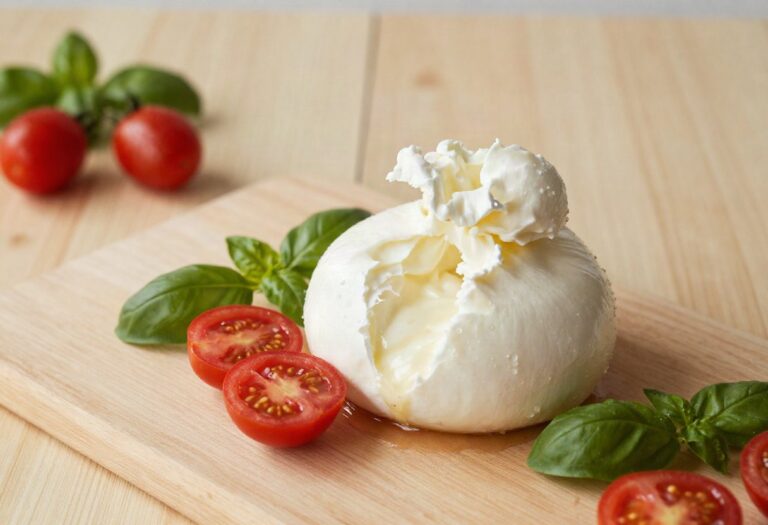
Burrata is a mozzarella with a twist: a shell of stretched curd encloses a filling of stracciatella, shreds of mozzarella soaked in cream. Born in Puglia around 1900 so that no offcuts from cheese-making would be wasted, it owes everything to this cream, including its composition.
On the nutrition side: 259 kcal per 100 g, with 23.4 g of fat, of which 15.4 g saturated, 10.6 g of protein and 0.93 g of carbohydrate. It provides 208 mg of calcium, 175 mg of phosphorus and 36.5 µg of iodine per 100 g, with only 0.53 g of salt.
Macronutrient breakdown
Nutrition table per 100 g
| Calories | 259 kcal |
| Kilojoules | 1070 kJ |
| Protein | 10,6 g |
| Carbohydrate | 1 g |
| Fat | 23,4 g |
Micronutrients per 100 g
All measured nutrients, ranked by share of the daily reference intake.
- Vitamin A239 µg30 %
- Calcium208 mg26 %
- Phosphorus175 mg25 %
- Iodine36,5 µg24 %
- Zinc1,7 mg17 %
- Vitamin B120,39 µg16 %
- Selenium7,6 µg14 %
- Vitamin B20,12 mg9 %
- Vitamin B9dietary folate equivalents1,95 µg
See the other 7 nutrients
- Omega-6 LA0,5 g5 %
- Vitamin K13,4 µg5 %
- Vitamin E0,48 mg4 %
- Omega-3 ALA0,07 g4 %
- Magnesium9,55 mg3 %
- Potassium35,3 mg2 %
- Vitamin B50,09 mg2 %
Anses Ciqual 2025. Source: Anses, 2025, Ciqual food composition table
Tips
It has twice the fat of a mozzarella. The cream at the centre accounts for the whole gap: 23.4 g of fat against about ten for a standard mozzarella, with half the protein. This is not a problem, it is information: burrata is a treat, not an everyday cheese.
A whole burrata weighs 125 g. That is around 325 kcal: a dish, not a garnish. Shared between two over a tomato salad, it finds its proper place.
Take it out thirty minutes beforehand. Cold, its cream is set and its taste is muted. At room temperature, it runs and releases its milky aromas. That is the difference between a decent burrata and a memorable one.
It needs almost nothing. A drizzle of olive oil, some pepper and basil. Its low salt content, 0.53 g per 100 g (very low for a cheese), explains why it calls for a little fleur de sel at the table.
It does not keep. Two days after it is made, the texture breaks down and the acidity rises. It is a fresh cheese to buy on the day you eat it, and the date on the packaging is not a reliable guide.
Pregnant? Mozzarella made with pasteurised milk is allowed, and always once cooked. The rules are in our guide on mozzarella during pregnancy.