Group · Meat
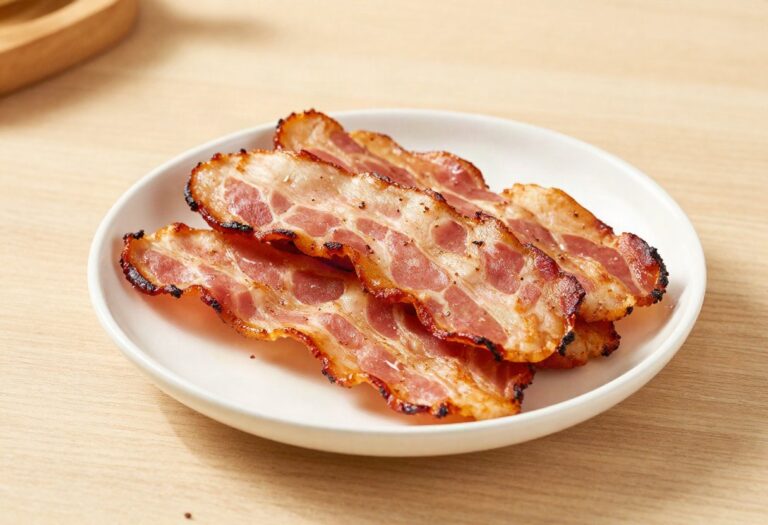
Grilled bacon
Grilled bacon is a cured pork product, dried and then smoked, cut into thin slices and fried in a pan or grilled until crisp. Very common at British and American breakfasts, in burgers, in salads or with scrambled eggs, it appeals with its pronounced smoky taste and crunchy texture. In terms of nutrition facts, grilled bacon is rich in protein (about 33.92 g per 100 g) but also very high in calories (468 kcal) because of its high fat content (nearly 35.09 g). It contains little carbohydrate and no fibre. It is a tasty food to include in moderation in a balanced diet, keeping an eye on salt and fat.
Macronutrient breakdown
Nutrition table per 100 g
| Calories | 468 kcal |
| Kilojoules | 1958 kJ |
| Protein | 34 g |
| Carbohydrate | 1,7 g |
| Fat | 35,1 g |
Micronutrients per 100 g
All measured nutrients, ranked by share of the daily reference intake.
- Selenium50,7 µg92 %
- Vitamin B310,46 mg65 %
- Phosphorus388 mg55 %
- Omega-6 LA5,25 g52 %
- Vitamin B10,56 mg51 %
- Vitamin B121,09 µg44 %
- Vitamin B60,54 mg38 %
- Zinc3,06 mg31 %
See the other 15 nutrients
- Potassium499 mg25 %
- Vitamin B51,1 mg18 %
- Vitamin B20,23 mg17 %
- Omega-3 ALA0,22 g11 %
- Copper0,11 mg11 %
- Total omega-30,24 g9 %
- Magnesium31 mg8 %
- Vitamin D0,4 µg8 %
- Iron0,95 mg7 %
- Vitamin E0,42 mg4 %
- DHA0,01 g3 %
- EPA0 g2 %
- Calcium11 mg1 %
- Vitamin A11 µg1 %
- Manganese0,02 mg1 %
USDA FoodData Central (SR Legacy)
Tips
Grilled bacon is a treat product: its high calorie density and richness in fat call for moderation. A reasonable portion is 2 or 3 thin slices, about 20 to 30 g, which is enough to flavour a dish without blowing the day’s calorie total.
How should you eat grilled bacon? Choose slow cooking in a frying pan, with no added fat, letting the fat melt and then draining the slices on kitchen paper. This removes some of the fat while keeping the crispness. Avoid charring the slices: overcooking spoils the taste and does nothing good nutritionally.
- Smart pairings: with eggs and vegetables (spinach, tomatoes, mushrooms) to balance the fatty, salty side.
- Crumbled into a salad, an omelette or a velouté soup to add flavour with a small amount.
- Storage: in the fridge in its original packaging, or frozen in portions separated by baking paper.
Nutritionally, grilled bacon provides good-quality protein and minerals such as iron and zinc. However, its salt and saturated fat content calls for caution, especially if you are watching your blood pressure or weight. For a lighter protein intake, turn to turkey bacon or chicken breast, which are much lower in fat.
For active people: grilled bacon provides a lot of protein, but its high fat ratio makes it a poor candidate for a post-workout snack, where you want lean protein and carbohydrate. Keep it instead as an occasional treat. When bulking, it can round off a high-calorie meal, but stay vigilant about saturated fat. For recovery, it is better to rely on more digestible sources: discover our protein snack ideas suited to training.
Do you want to compare grilled bacon with other products in the meat family? Also consult our food calorie table to place its nutrition facts and benefits within your diet. In short: a tasty food, to be enjoyed in small amounts, as part of a varied and well-built plate.