Group · Vegetables
Oriental radish (daikon)
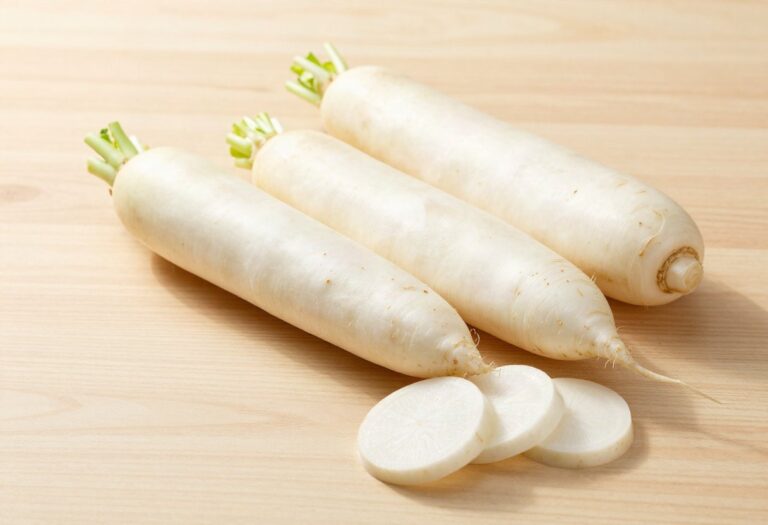
The oriental radish, better known by its Japanese name daikon, is a large, long white radish widely used in Asian cooking. Its crunchy, juicy flesh has a mild, slightly peppery flavour, more subtle than that of the little pink radish. It is eaten raw, pickled, simmered or brined (the famous takuan). Nutritionally, daikon ticks every box for a weight-loss vegetable: only 18 kcal per 100 g, rich in water, low in fat and a source of fibre. With 4.1 g of carbohydrate and 1.6 g of fibre, it fits easily into a balanced, varied diet, whether you want to add crunch to your dishes or freshness to your salads.
Macronutrient breakdown
Nutrition table per 100 g
| Calories | 18 kcal |
| Kilojoules | 76 kJ |
| Protein | 0,6 g |
| Carbohydrate | 4,1 g |
| Fat | 0,1 g |
| Fibre | 1,6 g |
Micronutrients per 100 g
All measured nutrients, ranked by share of the daily reference intake.
- Vitamin C22 mg28 %
- Copper0,12 mg12 %
- Potassium227 mg11 %
- Magnesium16 mg4 %
- Calcium27 mg3 %
- Phosphorus23 mg3 %
- Vitamin B60,05 mg3 %
- Iron0,4 mg3 %
See the other 8 nutrients
- Vitamin B50,14 mg2 %
- Manganese0,04 mg2 %
- Vitamin B10,02 mg2 %
- Zinc0,15 mg2 %
- Vitamin B20,02 mg1 %
- Selenium0,7 µg1 %
- Vitamin B30,2 mg1 %
- Vitamin K10,3 µg0 %
USDA FoodData Central (SR Legacy)
Tips
Versatile, daikon lends itself to many uses. Raw, grated or cut into thin sticks, it freshens salads and goes with raw fish. Cooked, it becomes meltingly soft in stocks, stews and curries, where it pleasantly absorbs the flavours. Pickled in a vinegar, salt and sugar mixture, it turns into crunchy pickles, perfect for lifting a bowl of rice or a sandwich.
How to eat it every day:
- Grated raw with a drizzle of soy sauce and a squeeze of lemon, as a fresh condiment.
- In slices in a miso soup or an Asian pot-au-feu.
- Pickled for a few hours for low-calorie homemade pickles.
- As a crunchy side, like the regular radish or cucumber.
Nutritional values and benefits: with its 18 kcal per 100 g, daikon has a low calorie density, ideal for weight control. Its water content promotes fullness, while its fibre contributes to digestive comfort. It provides vitamin C and potassium, and its glycaemic index stays low thanks to its moderate carbohydrate. Like the pink radish or the turnip, it belongs to the large cruciferous family, rich in the sulphur compounds responsible for their light peppery bite.
For active people: daikon is not a source of energy or protein, but it is an excellent ally for recovery meals. Low in calories, hydrating and rich in water, it ideally completes a balanced plate after exercise, alongside a lean protein source and starchy foods. During a cutting or stabilising phase, it lets you increase the volume of your meals without adding to the calorie total, which helps you keep a feeling of fullness. You will find more ideas for light foods among the vegetables in the guide.
Storage: keep daikon whole in the fridge, wrapped in a cloth or a bag, where it keeps for one to two weeks. Remove the tops, which can also be eaten stir-fried or in soup. To compare its calories with those of other foods, see the calorie table. Choose gentle cooking to preserve its texture and nutrients, and vary the colours by pairing it with carrot for tasty, balanced plates.