Group · Fruit
Dried figs
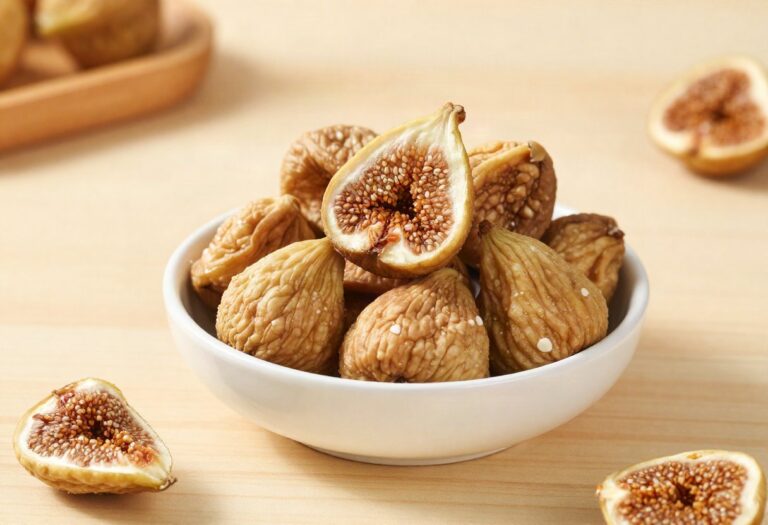
The dried fig is the fruit of the fig tree, dehydrated by natural sun-drying or in a dryer. Beneath its golden, wrinkled skin lies tender, sweet flesh studded with tiny crunchy seeds. It is available all year round, whole, on a string or in pieces, and is one of the essential dried fruits, alongside dates, dried apricots and prunes. Concentrated in sugars and fibre, and rich in minerals such as potassium, calcium and magnesium, it provides dense, tasty energy. At around 261 kcal per 100 g, the dried fig appeals to food lovers and athletes alike who are after a natural, nourishing snack.
Macronutrient breakdown
Nutrition table per 100 g
| Calories | 261 kcal |
| Kilojoules | 1110 kJ |
| Protein | 2,9 g |
| Carbohydrate | 55 g |
| Fat | 1,3 g |
| Fibre | 8,2 g |
Micronutrients per 100 g
All measured nutrients, ranked by share of the daily reference intake.
- Potassium680 mg34 %
- Copper0,27 mg27 %
- Calcium167 mg21 %
- Vitamin K115,6 µg21 %
- Manganese0,4 mg20 %
- Iron2,03 mg15 %
- Magnesium52,5 mg14 %
- Phosphorus67 mg10 %
- Vitamin B9dietary folate equivalents9 µg
See the other 12 nutrients
- Vitamin B60,11 mg8 %
- Vitamin B10,09 mg8 %
- Vitamin B50,43 mg7 %
- Vitamin B20,08 mg6 %
- Zinc0,51 mg5 %
- Vitamin B30,62 mg4 %
- Vitamin E0,35 mg3 %
- Omega-6 LA0,22 g2 %
- Iodine2,55 µg2 %
- Vitamin C1,2 mg2 %
- Omega-3 ALA0,02 g1 %
- Vitamin A0,5 µg0 %
Anses Ciqual 2025. Source: Anses, 2025, Ciqual food composition table
Tips
The dried fig is a concentration of flavour and nutrients, so remember to keep portions moderate. One to three figs (15 to 30 g) are enough for a snack, because the nutritional values are high, with nearly 55 g of carbohydrate and 249 calories per 100 g. Drying shrinks the volume and multiplies the energy density, so it pays to stay sensible if you are watching your weight.
In terms of nutrients, the dried fig stands out for its fibre (nearly 8.15 g per 100 g), useful for digestion and fullness, as well as for its potassium, calcium, magnesium and iron. Its protein is modest (2.9 g) and its fat very low. Its glycaemic index is fairly high because of the concentrated sugars: pair it with a source of protein or healthy fats to smooth the blood sugar response.
- As a snack, combined with nuts and seeds or a plain yoghurt.
- At breakfast, chopped into porridge or muesli.
- In savoury cooking, with a mature cheese, duck breast or a tagine.
- Rehydrated in a little warm water or tea for a softer texture.
For storage, keep your dried figs in an airtight container, away from light and moisture. A light white bloom on the surface is often the natural crystallisation of the sugars and is harmless.
For active people, the dried fig is an excellent source of fast carbohydrates that is easy to carry: ideal as a snack before exercise or during an endurance outing to sustain energy. After training, pair it with a source of protein to support recovery, for example in a homemade protein snack. Its potassium also helps make up for the minerals lost through sweat. To go further on eating for exercise, see our advice on nutrition for fitness.
You can vary things by exploring other dried fruits such as dried apricots or dried dates, or go back to the fresh version by discovering the fig. To compare nutrients across all fruit, browse our dedicated section. Rich in nutritional benefits but energy-dense, the dried fig is best enjoyed with pleasure and moderation every day.