Group · Dairy
Duck egg
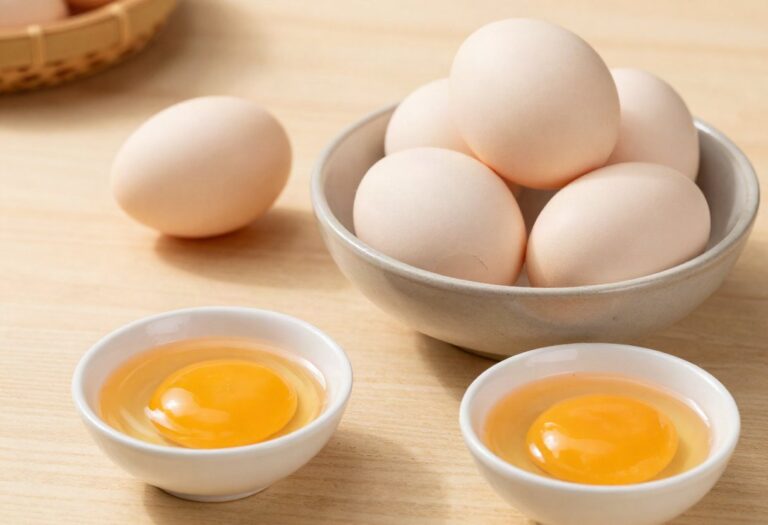
The duck egg weighs 70 to 80 g, a little more than an egg from a hen, with a proportionally larger and more deeply coloured yolk. Its shell is more porous, which explains the particular hygiene precautions it calls for.
In terms of nutrition facts, raw: 181 kcal per 100 g, with 13.8 g of fat and 12.8 g of protein. It provides 5.4 µg of vitamin B12 (more than twice the reference intake), 220 mg of phosphorus, 80 µg of vitamin B9 and 1.7 µg of vitamin D per 100 g. Its cholesterol is very high: 884 mg.
Macronutrient breakdown
Nutrition table per 100 g
| Calories | 181 kcal |
| Kilojoules | 752 kJ |
| Protein | 12,8 g |
| Carbohydrate | 1,5 g |
| Fat | 13,8 g |
Micronutrients per 100 g
All measured nutrients, ranked by share of the daily reference intake.
- Vitamin B125,4 µg216 %
- Vitamin B980 µg40 %
- Vitamin D1,7 µg34 %
- Phosphorus220 mg31 %
- Vitamin B51,86 mg31 %
- Vitamin B20,4 mg29 %
- Iron3,85 mg28 %
- Vitamin A193 µg24 %
See the other 13 nutrients
- Vitamin B60,25 mg18 %
- Vitamin B10,16 mg15 %
- Zinc1,41 mg14 %
- Vitamin E1,34 mg11 %
- Potassium222 mg11 %
- Calcium64 mg8 %
- Copper0,06 mg6 %
- Omega-6 LA0,56 g6 %
- Omega-3 ALA0,1 g5 %
- Magnesium17 mg5 %
- Manganese0,04 mg2 %
- Vitamin B30,2 mg1 %
- Vitamin K10,4 µg1 %
Anses Ciqual 2025. Source: Anses, 2025, Ciqual food composition table
Tips
5.4 µg of vitamin B12: five times the hen’s egg. This is its clearest nutritional advantage. B12 is found only in animal products, and needs rise with age.
Fattier than a hen’s egg. 13.8 g of fat against 8.62 g for a hen’s hard-boiled egg. In baking, this gives richer, moister results, which is why pastry chefs like it.
It must be cooked right through, without exception. Waterfowl eggs carry a higher risk of salmonella, because of a more porous shell and often damp rearing conditions. No mayonnaise, no mousse, no soft-boiled eggs.
884 mg of cholesterol per 100 g. Double that of a hen’s egg. Dietary cholesterol has little effect on blood cholesterol in most people, but this is an occasional product.
Its flavour is stronger. More « gamey » than a hen’s egg, it does not suit every use: excellent in baking and in fresh pasta, more debatable soft-boiled.