Group · Fruit
Raspberries
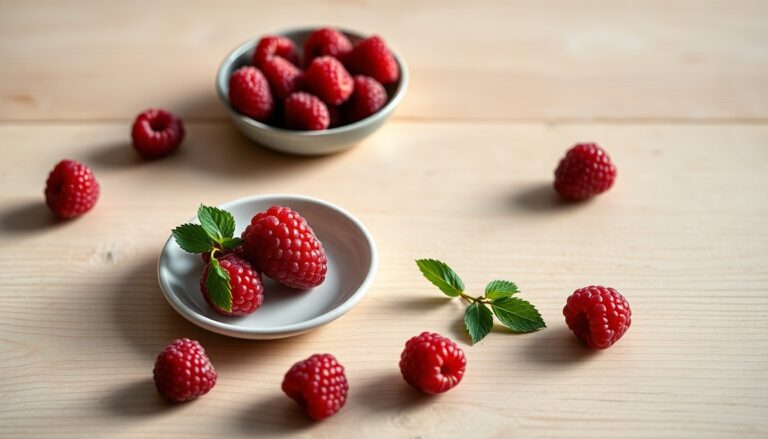
Delicate, fragrant and a brilliant red, the raspberry is one of the best-loved red fruits of summer. A small cluster of drupelets belonging to the bramble family, it comes in autumn-fruiting and summer-fruiting varieties, and even in yellow or purple versions depending on the cultivar. Fresh, frozen, as a coulis or in jam, it features in desserts as well as savoury dishes. In terms of nutritional values, the raspberry has only 47.9 kcal per 100 g, but a remarkable amount of fibre (4.3 g) and water. Low in sugar and rich in flavour, it has its place in a balanced diet and in weight-loss routines, where its lightness and indulgent taste make the difference.
Macronutrient breakdown
Nutrition table per 100 g
| Calories | 48 kcal |
| Kilojoules | 201 kJ |
| Protein | 1,2 g |
| Carbohydrate | 5,9 g |
| Fat | 0,8 g |
| Fibre | 4,3 g |
Micronutrients per 100 g
All measured nutrients, ranked by share of the daily reference intake.
- Vitamin C18,7 mg23 %
- Manganese0,44 mg22 %
- Vitamin B50,85 mg14 %
- Potassium170 mg9 %
- Omega-3 ALA0,16 g8 %
- Vitamin E0,88 mg7 %
- Total omega-30,18 g7 %
- Vitamin K15,02 µg7 %
- Vitamin B9dietary folate equivalents38,1 µg
See the other 11 nutrients
- Magnesium20 mg5 %
- Phosphorus29 mg4 %
- Copper0,04 mg4 %
- Iron0,4 mg3 %
- Omega-6 LA0,27 g3 %
- Zinc0,24 mg2 %
- Vitamin B60,03 mg2 %
- Vitamin B30,35 mg2 %
- Calcium16 mg2 %
- Vitamin B20,02 mg1 %
- Vitamin A8,33 µg1 %
Anses Ciqual 2025. Source: Anses, 2025, Ciqual food composition table
Tips
Raspberries are best eaten raw to preserve their melting texture and their vitamins, notably vitamin C. A portion of around 125 g (a small bowl) makes an indulgent snack with very few calories. They are fragile and keep for only 2 to 3 days in the fridge, not stacked up, and freeze perfectly: spread the fruit on a tray before bagging it, and you will have uncrushed raspberries all year round.
As for benefits and nutritional values, the raspberry is a champion for fibre with 6.5 g per 100 g, which supports fullness and digestive comfort. Its low glycaemic index and low calorie density make it an ally for weight-loss goals. It also provides polyphenols and antioxidant compounds typical of red fruits. You can combine it with other berries such as blueberries or blackberries for a colourful, flavour-packed mix.
In the kitchen the uses are many: a coulis poured over fromage blanc, a tart topping, smoothies, tangy vinaigrettes or an accompaniment to white meats. Raspberries also elevate a porridge or your morning cereal. To limit added sugars, choose the plain fruit rather than commercial jams.
- Active people: add raspberries to a post-workout snack, mixed with Greek yoghurt or fromage blanc, to combine natural carbohydrates, fibre and recovery protein.
- Before training, their light carbohydrate content avoids a heavy feeling.
- Think of them too for a homemade protein snack, as a topping on a tasty bowl.
For weight control, the raspberry is a very sensible choice: little carbohydrate (5.83 g per 100 g), a high proportion of water and plenty of fibre. Beware, however, of sweetened preparations (syrups, sugary coulis, pastries) that push up the calorie count. Choose fresh or frozen fruit with no added sugar.
Want to vary your fresh fruit intake? Discover the whole fruit family and compare nutrients using the food calorie table. The raspberry well deserves its place in a seasonal basket, from spring to the end of summer.
If you have diabetes: red fruits are among the fruits lowest in carbohydrate. Portions and glycaemic index are covered in our guide strawberries and diabetes.