Group · Dairy
Mascarpone
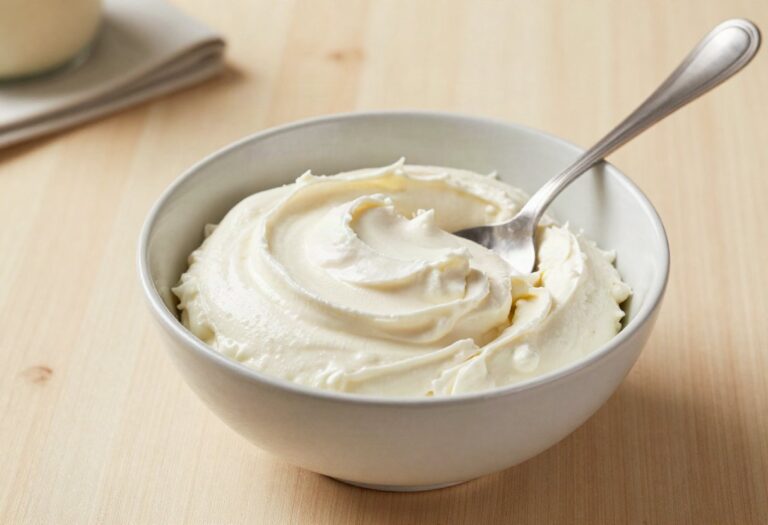
Mascarpone is a milk cream coagulated with citric or tartaric acid, originally from Lombardy. It is not a ripened cheese but a thickened cream, which explains its composition: it sits on the side of crème fraîche, not cheese.
On the nutrition side: 369 kcal per 100 g, with 37 g of fat, of which 25.9 g saturated, 5.88 g of protein and 3.1 g of carbohydrate. It provides 130 mg of calcium and 367 µg of vitamin A per 100 g, and very little salt: 0.13 g per 100 g.
Macronutrient breakdown
Nutrition table per 100 g
| Calories | 369 kcal |
| Kilojoules | 1520 kJ |
| Protein | 5,9 g |
| Carbohydrate | 3,1 g |
| Fat | 37 g |
Micronutrients per 100 g
All measured nutrients, ranked by share of the daily reference intake.
- Vitamin A367 µg46 %
- Vitamin B120,48 µg19 %
- Calcium130 mg16 %
- Phosphorus110 mg16 %
- Iodine21 µg14 %
- Vitamin B20,15 mg11 %
- Omega-3 ALA0,15 g8 %
- Omega-6 LA0,7 g7 %
See the other 9 nutrients
- Potassium120 mg6 %
- Zinc0,53 mg5 %
- Vitamin B50,31 mg5 %
- Magnesium13 mg3 %
- Vitamin B10,03 mg3 %
- Vitamin B60,03 mg2 %
- Vitamin K11,17 µg2 %
- Vitamin B30,13 mg1 %
- Iron0,06 mg0 %
Anses Ciqual 2025. Source: Anses, 2025, Ciqual food composition table
Tips
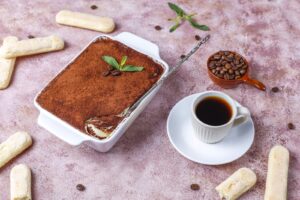
It is a fat, and should be treated as one. 37 g of fat per 100 g: across a whole recipe, mascarpone weighs as much as butter. A tiramisu contains 250 to 500 g of it, which on its own explains how dense the dessert is.
Replacing half of it works very well. Half mascarpone, half ricotta or beaten fromage blanc: the texture stays creamy, the fat drops by more than half and the protein goes up. It is the only adjustment that really holds up in a blind tasting.
It does not split, and that is its technical strength. Its fat content makes it very stable: it binds a hot sauce without going lumpy, where a yoghurt or fromage blanc would curdle. One spoonful is enough to bind a pasta dish for four.
Do not whip it too much. Like cream, it can turn to butter: it then becomes grainy and nothing will rescue it. Work it with a spatula or a whisk at low speed, and after ten minutes out of the fridge.
Its most interesting use is the most discreet. A teaspoon stirred into a vegetable purée or a risotto at the end of cooking gives the creaminess you want for around twenty kilocalories per serving.
Pregnant? This cheese is pasteurised in supermarkets; the risk comes mainly from the raw eggs in no-bake desserts. See our guide on cheesecake during pregnancy.