Group · Dairy
Ricotta
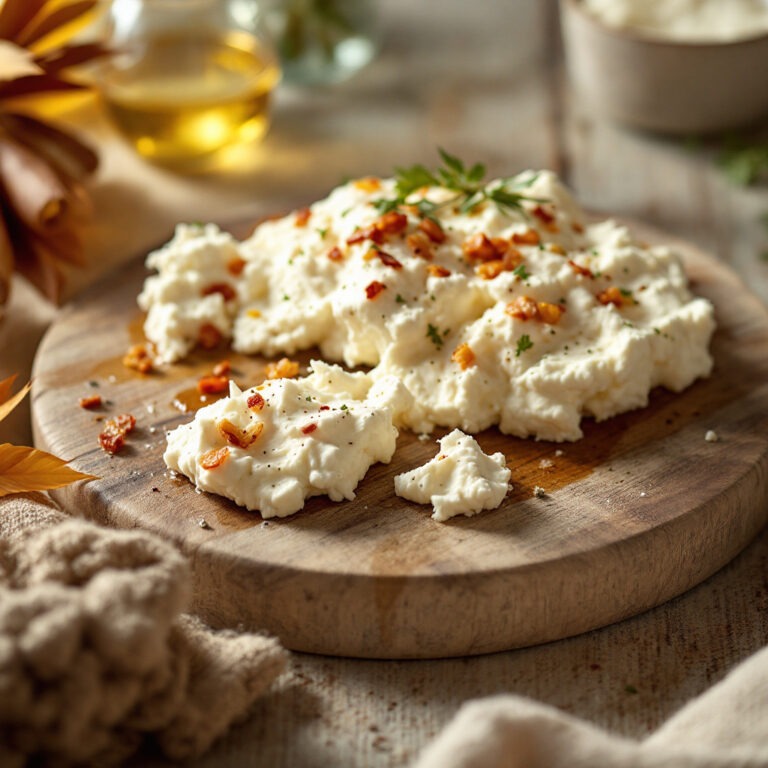
Ricotta is not strictly a cheese: it is made by re-cooking the whey left over from another cheesemaking process (ri-cotta means « recooked »). It is a by-product that has become an ingredient in its own right in Italian cooking.
On the nutrition side: 157 kcal per 100 g, with 10.7 g of fat, of which 7.38 g is saturated fat, 7.96 g of protein and 4.09 g of carbohydrate. It provides 314 mg of calcium per 100 g, more than double that of fromage blanc, and only 0.27 g of salt.
Macronutrient breakdown
Nutrition table per 100 g
| Calories | 157 kcal |
| Kilojoules | 657 kJ |
| Protein | 8 g |
| Carbohydrate | 4,1 g |
| Fat | 10,7 g |
Micronutrients per 100 g
All measured nutrients, ranked by share of the daily reference intake.
- Calcium314 mg39 %
- Phosphorus158 mg23 %
- Vitamin A120 µg15 %
- Vitamin B20,2 mg14 %
- Vitamin B120,34 µg14 %
- Iodine18 µg12 %
- Zinc1,16 mg12 %
- Omega-3 ALA0,16 g8 %
See the other 14 nutrients
- Vitamin B912 µg6 %
- Potassium105 mg5 %
- Vitamin D0,2 µg4 %
- Vitamin B50,21 mg4 %
- Vitamin B60,04 mg3 %
- Magnesium11 mg3 %
- Iron0,38 mg3 %
- Copper0,02 mg2 %
- Omega-6 LA0,15 g2 %
- Vitamin K11,1 µg1 %
- Vitamin B10,01 mg1 %
- Vitamin E0,11 mg1 %
- Vitamin B30,1 mg1 %
- Manganese0,01 mg0 %
Anses Ciqual 2025. Source: Anses, 2025, Ciqual food composition table
Tips
Very low in salt, which is rare for a cheese. 0.27 g per 100 g, compared with 5.3 g for a pecorino. That is what makes it usable in quantity, and suitable for low-sodium diets.
It lightens fillings. In cannelloni, ravioli or a gratin, it replaces some of the cream or béchamel for about a third of the fat, while adding protein and calcium. This is its best use.
Drain it before using it. An hour in a sieve in the fridge removes the residual water. Without this step, a ricotta filling releases its water during cooking and makes the dish soggy.
It moves from savoury to sweet with ease. With lemon and berries, it makes a high-protein dessert in two minutes; with spinach and nutmeg, a classic filling.
It keeps badly. Three to four days after opening, no more, and it cannot be frozen: the texture turns irretrievably grainy. Buy it as you need it.
Pregnant? This cheese is pasteurised in supermarkets; the risk comes mainly from the raw eggs in no-bake desserts. See our guide to cheesecake in pregnancy.
Sources
Average nutrition values per 100 g, given as a guide only (they may vary by brand, cut and preparation).