Tiramisu in pregnancy: why to avoid it and how to adapt it
The short answer
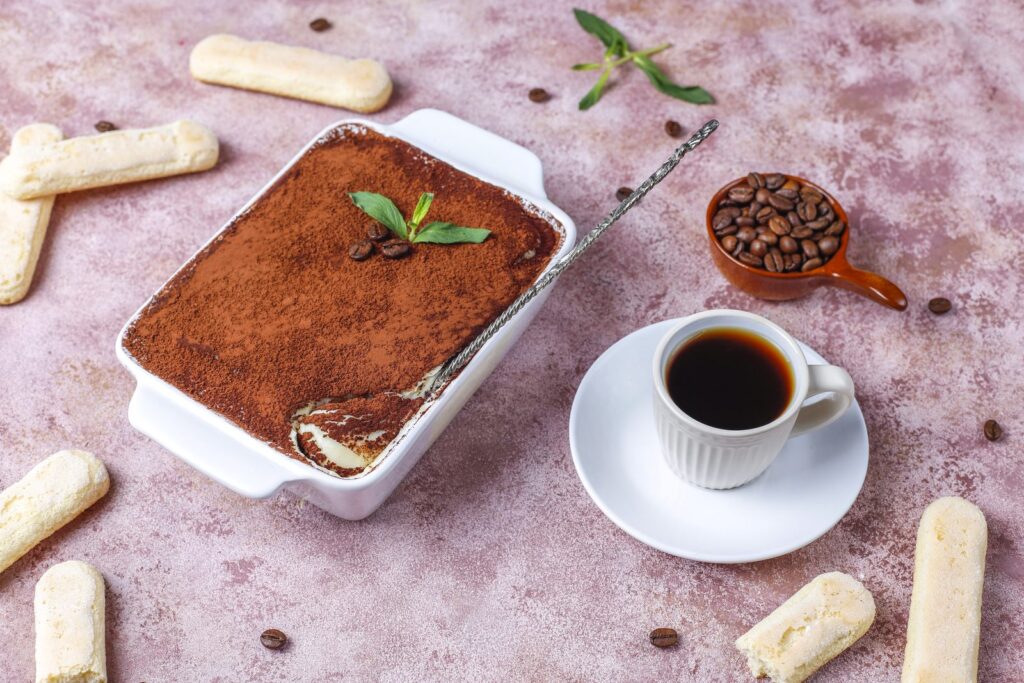
No, classic homemade tiramisu is not recommended during pregnancy, because it contains raw eggs. Manger Bouger names it specifically, along with chocolate mousse and homemade mayonnaise, among the preparations to avoid because of salmonella. The mascarpone is not the problem: it is pasteurised. Tiramisu becomes an option again without eggs, or with pasteurised eggs, and always without alcohol: the marsala, amaretto or rum in some recipes are ruled out throughout pregnancy.
These guidelines follow official French recommendations. If you are in any doubt, your midwife or doctor can advise you.
The real risk: salmonella in raw eggs
In a traditional tiramisu, the yolks are whisked with the sugar and the whites beaten to stiff peaks, then folded in raw with the mascarpone. Raw eggs can carry salmonella, bacteria that cause food poisoning. Salmonellosis causes fever, diarrhoea and vomiting, and the dehydration that follows is best avoided during pregnancy. Manger Bouger therefore recommends avoiding raw or lightly cooked eggs, such as soft-boiled or runny fried eggs, and homemade preparations made with raw eggs.
Two other points matter for tiramisu:
- Alcohol: all alcoholic drinks are discouraged during pregnancy, including in cooked dishes, according to Manger Bouger. A tiramisu made with marsala or amaretto, which is not cooked, keeps all of its alcohol.
- Caffeine: the coffee in tiramisu contains some, which adds to the rest of your day. EFSA recommends not exceeding 200 mg of caffeine a day during pregnancy. A portion of tiramisu provides far less than a cup of coffee, but it still counts.
Salmonella in figures
Salmonella is not a marginal risk: it is behind a large share of collective food poisoning outbreaks in France, and raw eggs are the main source. The data from Anses:
| Data | What Anses says |
|---|---|
| Share of confirmed collective food-borne outbreaks caused by salmonella, 2012-2019 | about 40% |
| Foods behind these outbreaks, 2006-2015 | eggs and products made with raw eggs: about 45%; meat: 30% |
| Time before symptoms appear | 6 to 72 hours, most often 12 to 36 hours |
| Symptoms | nausea, vomiting, abdominal pain, diarrhoea, headache, chills, fever of 39-40 °C, lasting 5 to 7 days |
| Complications | dehydration; the bacteria passing into the blood in 3 to 10% of cases; hospitalisation in 22% of reported cases |
During pregnancy, the main concern is dehydration caused by fever, vomiting and diarrhoea. Hence the simple rule from Manger Bouger: no raw egg and no homemade preparation made with raw eggs for nine months.
The traffic light for tiramisu
| Version | Pregnant | Why |
|---|---|---|
| Classic homemade tiramisu, raw eggs | 🔴 avoid | salmonella |
| Tiramisu with marsala, amaretto, rum | 🔴 avoid | alcohol |
| Tiramisu in a restaurant or pâtisserie | 🟠 conditional | often made with raw eggs: ask before ordering |
| Ready-made tiramisu, chilled aisle | 🟠 conditional | 35 out of 39 contain alcohol according to our survey: read the ingredients list, no alcohol and pasteurised eggs; respect the use-by date |
| Homemade tiramisu without eggs, mascarpone and whipped cream | 🟢 allowed | no raw egg; eat within 3 days |
| Homemade tiramisu with pasteurised eggs, sold in cartons | 🟢 allowed | pasteurised eggs |
| Tiramisu with the cream cooked in a bain-marie, sabayon style | 🟢 allowed | yolks cooked until thickened |
A word of caution about our own recipe: our lighter tiramisu uses raw eggs, with the yolks and the whites beaten to stiff peaks. It is therefore not suitable for pregnancy as it stands. Here is how to adapt it.
Shop-bought tiramisu: what the labels say
You might think a tiramisu from the chilled aisle settles the question of raw eggs. We noted the ingredients list of 39 tiramisus sold in France, own-brand products, national brands and organic products, as they appear on Open Food Facts:
| What you find on the label | Number of products |
|---|---|
| Alcohol in the ingredients list: ethyl alcohol, marsala or wine | 35 out of 39 |
| Marsala in particular | 24 out of 39 |
| A total alcohol content shown | a few products, around 1 to 1.7% |
| Eggs explicitly stated as pasteurised | 1 out of 39 |
| Sugars, most common value | 20 g per 100 g, from 15 to 26 g |
The conclusion is clear: almost all shop-bought tiramisus contain alcohol, added as it is to the cream or the coffee syrup. With the recommendation of no alcohol at all during pregnancy, they are therefore best avoided, even if their eggs have been treated. The rare alcohol-free exceptions do exist: always read the ingredients list, where alcohol has to appear. As for sugar, a 100 g portion generally provides around 20 g of sugars.
The simplest solution remains the homemade version, with no raw eggs and no alcohol, described below.
Our pregnancy-friendly tiramisu
For 6 people, based on our lighter recipe:
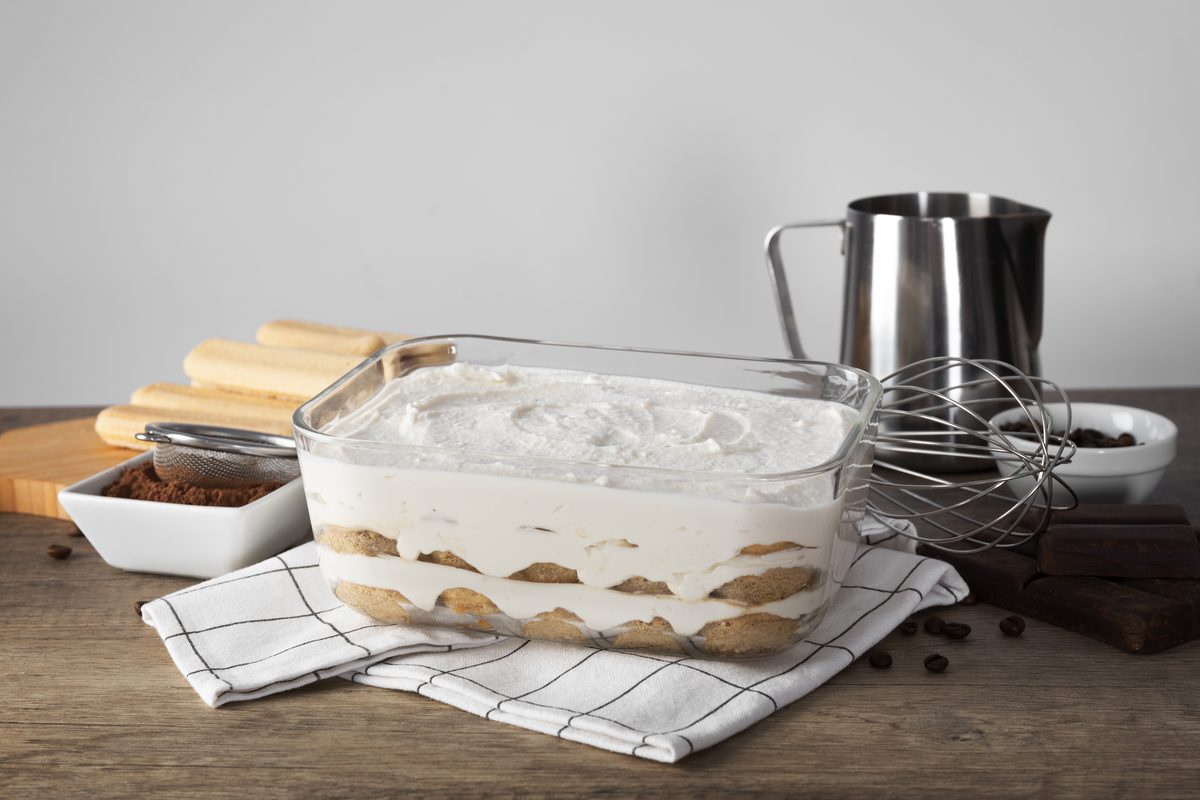
- Leave out the eggs and replace them with 20 cl of whipping cream (full fat), whipped until very firm;
- mix 150 g of mascarpone, 250 g of fromage blanc and 40 to 50 g of sugar, then fold in the whipped cream;
- dip the sponge fingers in strong decaffeinated coffee, with no alcohol;
- build up the layers, dust with unsweetened cocoa and keep in the fridge;
- eat it within 3 days.
The result is lighter than an egg-based mousse, but just as creamy. All the ingredients, shop-bought mascarpone, fromage blanc and cream, are pasteurised.
Why the sabayon version is safe
If you like the taste of egg yolks, there is a solution: cook them. Anses states that heat destroys salmonella quickly: at 70 °C, their numbers fall tenfold in less than a minute, whereas at 60 °C it takes anything from a few seconds to 16 minutes depending on the strain and the food. The sabayon method therefore consists of:
- whisking the yolks and sugar in a bowl set over a pan of simmering water, in a bain-marie;
- continuing to whisk until the cream thickens noticeably and becomes frothy, which takes several minutes;
- ideally, checking with a kitchen thermometer that it goes above 70 °C;
- letting it cool, then folding in the mascarpone.
Beaten egg whites cannot be cooked without losing their texture: in the sabayon version, they are replaced with whipped cream. And so that bacteria do not multiply afterwards, the tiramisu is kept in the fridge: according to Anses, salmonella stops multiplying below 5 °C.
The caffeine in a portion of tiramisu
Our recipe for 6 people uses 20 cl of strong coffee. Using the average levels published by EFSA, this gives an order of magnitude:
| Coffee used for 6 portions | Total caffeine | Per portion, at most |
|---|---|---|
| 20 cl of filter coffee | about 90 mg | about 15 mg |
| 20 cl of espresso | about 270 mg | about 45 mg |
| 20 cl of decaffeinated coffee | almost none | almost none |
Even when made with espresso, a portion stays well below the limit of 200 mg a day that EFSA considers safe during pregnancy. But it adds to the coffees, teas and chocolate you have during the day: see our guide how much coffee a day.
And alcohol: it does not evaporate
The marsala, amaretto or rum in some recipes are not cooked: without cooking, the alcohol stays entirely in the dessert, and even a flambéed alcohol keeps about 75%, according to the retention tables of the US Department of Agriculture. During pregnancy, the recommendation is no alcohol at all: a tiramisu made with alcohol is therefore best avoided, even in a small portion. A little almond syrup in the coffee gives a treat-like note without alcohol; beware of vanilla extract, which is often made with alcohol.
How much and how often
| 100 g of | Calories | Carbohydrate | of which sugars | Saturated fat |
|---|---|---|---|---|
| Coffee tiramisu, chilled aisle | 242 kcal | 30.2 g | 19.5 g | 6.4 g |
| Mascarpone | 369 kcal | 3.1 g | 3.0 g | 25.9 g |
A 100 g portion of ready-made tiramisu provides almost 20 g of sugars, close to the ideal daily target for free sugars from the WHO, about 25 g. It is a dessert for special occasions. With gestational diabetes, it is one of the desserts to limit strictly: see our guide eating during pregnancy.
Useful nutrients during pregnancy
Tiramisu provides nothing essential. The fromage blanc in our adapted version provides protein and calcium, which you will also find in a plain yoghurt or plain fromage blanc with fruit. See our ranking of foods high in calcium.
Other desserts that are safe during pregnancy
- Baked cheesecake: the eggs are cooked in the oven; see cheesecake in pregnancy.
- Crème brûlée: cream and yolks cooked.
- Panna cotta: milk and cream boiled with agar-agar, no egg.
- Floating island, provided the whites are poached and the custard is cooked.
- Baked apples with cinnamon.
Conversely, homemade chocolate mousse made with raw eggs is still best avoided.
And while breastfeeding?
While breastfeeding, raw eggs are an option again, with the usual hygiene precautions. Alcohol, however, passes into breast milk: a tiramisu made with marsala is still best avoided or kept well away from feeds. See our guide eating while breastfeeding.
Frequently asked questions
Can you eat tiramisu when pregnant?
Not classic homemade tiramisu made with raw eggs. Yes to a tiramisu without eggs or with pasteurised eggs, and without alcohol.
Is mascarpone allowed in pregnancy?
Yes: shop-bought mascarpone is pasteurised. The risk in tiramisu comes from the raw eggs, not the mascarpone.
Is ready-made tiramisu allowed in pregnancy?
Read the ingredients: if it contains pasteurised eggs or egg products and no alcohol, it is acceptable within its date. If in doubt, choose another dessert.
What about the coffee in tiramisu?
It provides a little caffeine, to be counted within the limit of 200 mg a day recommended by EFSA during pregnancy. Decaffeinated coffee settles the matter.
I ate tiramisu made with raw eggs while pregnant, what should I do?
The risk is low for a single portion. If you have a fever, diarrhoea or vomiting in the following days, see your doctor or midwife.
Is sabayon tiramisu, with cooked yolks, allowed in pregnancy?
Yes, if the cream has been cooked in a bain-marie until noticeably thickened, ideally above 70 °C, and if the raw whites are replaced with whipped cream.
How much caffeine is in a portion of tiramisu?
About 15 to 45 mg at most for our recipe, depending on whether you use filter coffee or espresso, far less than a cup. With decaffeinated coffee, almost nothing.
How long after eating raw eggs does salmonellosis appear?
According to Anses, between 6 and 72 hours, most often 12 to 36 hours, with fever, diarrhoea and vomiting. If you have symptoms, see a doctor, above all to avoid dehydration.
Does the alcohol in tiramisu evaporate?
No: tiramisu is not cooked, so the alcohol stays entirely in the dessert.
Can you eat it when pregnant? The series
Food by food, what is allowed, conditional or to be avoided during pregnancy: cheesecake in pregnancy, foie gras in pregnancy, feta in pregnancy, mozzarella in pregnancy, raclette in pregnancy, surimi in pregnancy, charcuterie in pregnancy, smoked salmon in pregnancy, chorizo in pregnancy, taramasalata in pregnancy, honey in pregnancy, camembert and brie in pregnancy, prawns in pregnancy, soft-boiled egg in pregnancy, sushi in pregnancy, cured ham in pregnancy, hummus in pregnancy, tinned tuna in pregnancy.
Our sources
- Manger Bouger (Santé publique France), « Quels aliments éviter et quelles précautions prendre quand on est enceinte ? », updated 2026.
- Ameli, « Les aliments à éviter et les précautions d’hygiène pendant la grossesse ».
- EFSA, scientific opinion on the safety of caffeine, 2015: 200 mg a day during pregnancy.
- Ciqual 2025 table (Anses): coffee tiramisu, mascarpone. WHO: guideline on sugars intake, 2015.
- Anses, fiche de description de danger biologique: Salmonella spp., updated June 2021.
- EFSA, scientific opinion on the safety of caffeine, 2015: average levels in drinks, limit of 200 mg a day during pregnancy.
- USDA, Table of Nutrient Retention Factors, Release 6 (2007): alcohol retention.
- Open Food Facts, ingredients lists of 39 tiramisus sold in France, survey of 25 September 2026.