Cured and cooked meats in pregnancy: what is allowed and what is not
The short answer
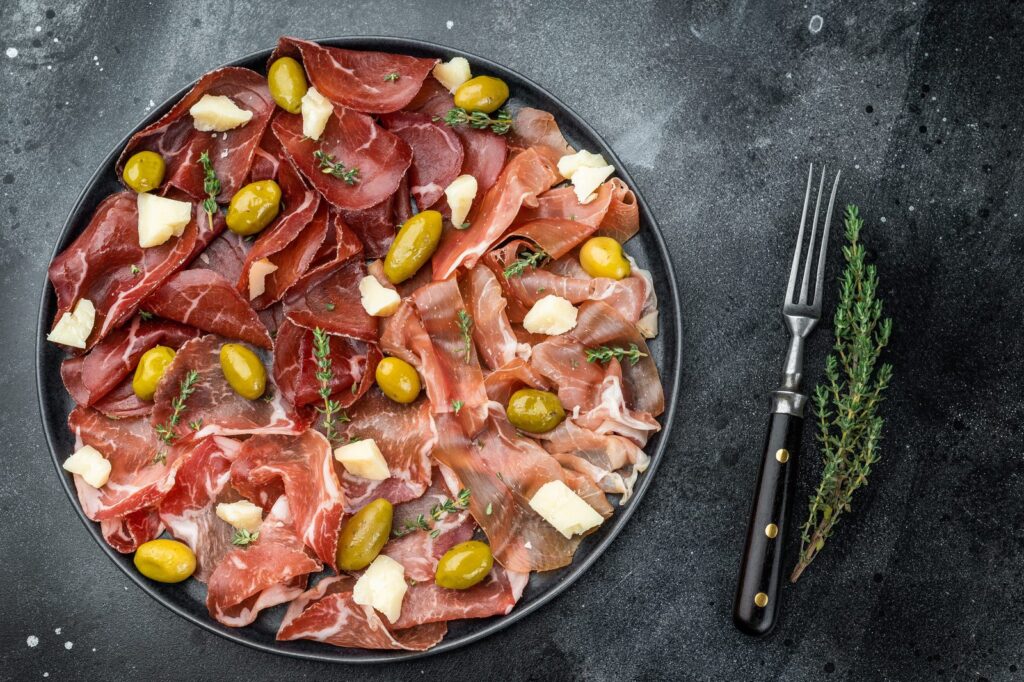
During pregnancy, most charcuterie should be avoided, unless it is cooked and served hot. Official French recommendations advise against two families: raw dried charcuterie, cured ham, dry sausage (saucisson sec), chorizo, rosette, coppa and Bündnerfleisch (viande des Grisons), because of toxoplasmosis and listeriosis, and cooked charcuterie kept cold, rillettes, pâtés, terrines, foie gras and products in aspic, because of listeriosis. Cooked ham is still an option, as long as you reheat it before eating it, like lardons, bacon and sausages cooked right through.
These guidelines follow official French recommendations. If you are in any doubt, your midwife or doctor can advise you.
The two risks of charcuterie
- Toxoplasmosis: a parasite, Toxoplasma gondii, can be present in pork or beef. Cooking destroys it; drying and salting are not enough to guarantee its destruction. The risk concerns only pregnant women who are not immune, which the blood test at the start of pregnancy shows; for them, a further blood test is then done every month.
- Listeriosis: the bacterium Listeria monocytogenes multiplies in the fridge, including in products that are cooked and then sliced and packed. The infection is rare, fewer than fifty cases a year among pregnant women in France according to Santé publique France, but serious for the foetus. Cooking destroys it.
Manger Bouger thus advises against dry sausage and dry-cured ham, and « certain ready-cooked shop-bought charcuterie that needs to be kept cold », such as rillettes, pâtés and products in aspic. It specifies that cooked ham should be reheated before it is eaten.
What outbreaks and recalls show
Caution about charcuterie is not based on an abstract fear. In its reference sheet on Listeria, Anses states that the foods implicated in listeriosis outbreaks in France fall into three categories: cooked charcuterie products, soft cheeses, notably made from raw milk, and ready meals.
Product recalls confirm this. In the public RappelConso database, the « meat » category has more than 1,000 recall notices for Listeria between 2021 and September 2026. Some concern raw meats to be cooked, which are safe once cooked; but a large share targets precisely ready-to-eat charcuterie:
| Type of product, based on its name | Recall notices for Listeria |
|---|---|
| Pâtés, terrines, rillettes, mousses, brawn (fromage de tête) | at least 139 |
| Sausages, andouilles, black puddings | at least 120 |
| Cooked hams and sliced cooked poultry | at least 102 |
| Dry sausages, chorizos, salamis, rosettes | at least 67 |
| Cured hams, coppa, bresaola, Bündnerfleisch | at least 22 |
The number of recalls has risen markedly over the years, from 102 notices in 2022 to 238 in 2025. A recall does not mean that people fell ill, but it shows that these products can be contaminated, including cooked ham, often seen as risk-free. That is why Manger Bouger advises reheating it.
The traffic light for charcuterie
| Charcuterie | Pregnant | Why |
|---|---|---|
| Cured ham, Parma ham, Bayonne ham, serrano | 🔴 avoid | raw dried meat: toxoplasmosis, listeriosis |
| Dry sausage, rosette, salami | 🔴 avoid | raw dried meat |
| Raw chorizo | 🔴 avoid | dry sausage; 🟢 once cooked in a paella or on a pizza |
| Coppa, bresaola, Bündnerfleisch | 🔴 avoid | raw dried meats |
| Rillettes, pâtés, terrines, mousses | 🔴 avoid | cooked charcuterie kept cold |
| Foie gras, products in aspic | 🔴 avoid | listeriosis; vitamin A for liver |
| Cooked ham, cold, in slices | 🟠 conditional | to be reheated before eating |
| Hot cooked ham: croque-monsieur, gratin, quiche, pasta | 🟢 allowed | reheated until properly hot |
| Lardons, bacon, belly pork | 🟢 allowed cooked | cooked right through |
| Strasbourg sausages, knacks, fresh sausages | 🟢 allowed hot | to be heated right through, not cold |
| Sliced chicken or turkey breast, cold | 🟠 conditional | same logic as cooked ham: preferably reheated |
| Chorizo, dry sausage or lardons in a dish cooked for a long time | 🟢 allowed | cooking destroys the parasite and the bacterium |
The logic is always the same: what is cooked and eaten hot is safe, what is raw or kept cold after cooking is not. Sliced poultry breast is not named specifically by the authorities, but it is prepared and stored like cooked ham: apply the same precaution to it.
What if you are immune to toxoplasmosis?
If your blood test shows that you have already had toxoplasmosis, this risk disappears. But the risk of listeriosis concerns all pregnant women: raw charcuterie and cooked charcuterie kept cold are still not recommended. Immunity to toxoplasmosis therefore does not make dry sausage or rillettes allowed.
Freezing dry sausage: a false good idea
You sometimes read that freezing raw charcuterie would be enough to make it safe during pregnancy. That is true for only one of the two risks.
| Risk | Effect of freezing | What destroys it |
|---|---|---|
| Toxoplasmosis | 🟢 effective on the cysts in meat: at least 3 days at −12 °C at the centre | cooking to 70 °C at the centre, or this freezing |
| Listeriosis | 🔴 no destruction: Listeria can still multiply down to −2 °C | cooking |
Freezing a dry sausage or a cured ham can therefore reduce the risk of toxoplasmosis, provided your freezer gets down to −12 °C at the centre for three days, but it does not deal with listeriosis, which concerns all pregnant women. The only treatment that removes both is cooking. A domestic freezer does not, in any case, let you check the temperature at the centre of a whole sausage.
Sandwiches, salads, buffets: everyday situations
Charcuterie slips in everywhere, especially in meals eaten out. Here are the most common cases:
| Situation | Pregnant | Why |
|---|---|---|
| Cold ham and butter baguette from the bakery | 🟠 conditional | cold cooked ham: Manger Bouger advises reheating it |
| Croque-monsieur, panini or galette complète, served hot | 🟢 allowed | ham reheated right through |
| Sandwich or wrap with cold sliced chicken | 🟠 conditional | same logic as cooked ham |
| Salad with grilled chicken served hot | 🟢 allowed | cooked meat; salad vegetables washed at home |
| Caesar salad with homemade dressing made with raw eggs | 🔴 avoid | raw eggs; ask for a dressing without raw egg |
| Piedmontese salad or tabbouleh with diced ham, from a deli counter | 🟠 conditional | cold charcuterie in a dish prepared in advance |
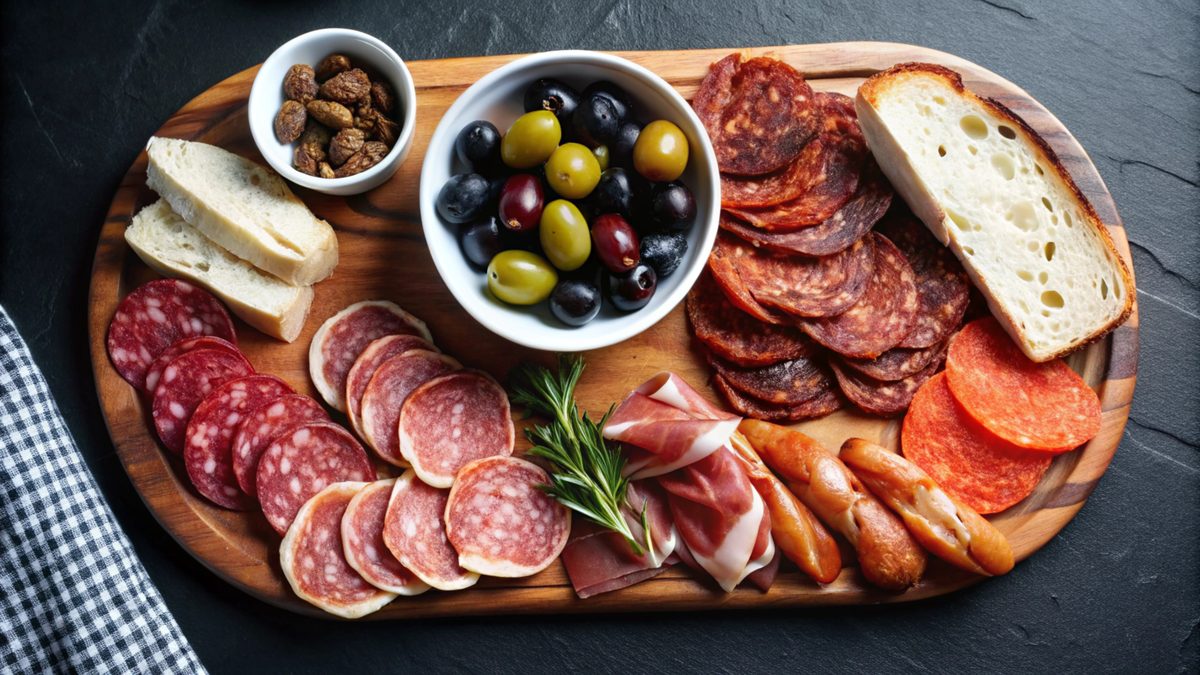
| Nibbles board: dry sausage, cured ham, rillettes | 🔴 avoid | raw charcuterie and cooked charcuterie kept cold |
| Pâté en croûte, buffet terrine | 🔴 avoid | cooked charcuterie kept cold |
| Quiche, pizza, ham puff pastry served hot | 🟢 allowed | baked in the oven |
| Hot dog with a sausage heated right through | 🟢 allowed | cooked sausage, served hot |
How do you reheat cooked ham? Anses recommends reheating dishes that are eaten hot to above 70 °C at the centre. In practice: a few minutes in a frying pan or the oven, or in the microwave until it is steaming and piping hot in the middle. Lukewarm is not enough.
The salt and fat in charcuterie
| 50 g of | Calories | Protein | Salt | Saturated fat |
|---|---|---|---|---|
| Superior cooked ham | 57 kcal | 10.5 g | 0.94 g | 0.6 g |
| Strasbourg sausage | 146 kcal | 6.2 g | 1.00 g | 5.5 g |
| Cooked lardons | 162 kcal | 11.9 g | 1.90 g | 6.3 g |
| Bündnerfleisch | 104 kcal | 19.5 g | 1.92 g | 1.3 g |
| Chorizo | 213 kcal | 11.8 g | 2.12 g | 7.2 g |
| Dry sausage | 209 kcal | 12.1 g | 2.38 g | 5.7 g |
| Cured ham | 120 kcal | 13.0 g | 2.84 g | 2.5 g |
Beyond safety, charcuterie is very salty: 50 g of cured ham provides 2.84 g of salt, more than half of the limit of 5 g a day advised by the WHO. Cooked ham is by far the least salty and the least fatty. The PNNS recommends limiting charcuterie to 150 g a week for the whole population: see our guide how much red meat a week.
Nitrites: one more reason to limit it, for everyone
Beyond pregnancy, charcuterie raises another health question. In 2022, Anses confirmed the existence of an association between exposure to nitrites and nitrates and the risk of colorectal cancer, whether these compounds come from charcuterie or from drinking water. More than half of exposure to nitrites comes from charcuterie, because of the additives used in its manufacture.
Anses recommends limiting the addition of nitrites to foods to the lowest possible level, and reminds us of the guideline of 150 g of charcuterie a week at most, about three slices of ham. During pregnancy, this limit is in any case comfortably respected if you stick to cooked charcuterie served hot, from time to time.
Useful nutrients during pregnancy
Charcuterie provides protein and a little iron, but nothing that a pregnant woman cannot find better elsewhere. Iron, for which needs increase during pregnancy, is best obtained from well-cooked meat, fish, pulses and green vegetables: see our guide to foods high in iron. Going without raw charcuterie for nine months does not create any deficiency.
Ideas for safe dishes with cooked charcuterie
- A croque-monsieur with cooked ham, piping hot.
- Lighter pasta carbonara, with cooked lardons and a sauce heated until the egg is set.
- Paella: the chorizo is cooked for a long time.
- A quiche Lorraine, baked in the oven and served hot.
For all the rules, see our guide eating during pregnancy.
And while breastfeeding?
While breastfeeding, the precautions against toxoplasmosis and listeriosis that apply to pregnancy no longer apply: charcuterie is an option again, with the moderation advised for everyone for salt and fat. See our guide eating while breastfeeding.
Frequently asked questions
Which charcuterie can you eat when pregnant?
Reheated cooked ham, lardons, bacon and sausages cooked right through, and any charcuterie cooked in a hot dish. The rest, raw or kept cold, is to be avoided.
Is cooked ham allowed in pregnancy?
Yes, but Manger Bouger advises reheating it before eating it, for example in a croque-monsieur or a gratin.
Can you eat dry sausage when pregnant if you are immune to toxoplasmosis?
No: the risk of listeriosis remains. Dry sausage is not recommended for any pregnant woman.
Is cooked chorizo allowed in pregnancy?
Yes, if it is cooked right through, for example in a paella or on a pizza served hot.
I ate dry sausage while pregnant, what should I do?
The risk from a one-off portion is low. Tell your doctor or midwife if you have a fever; if you are not immune to toxoplasmosis, your monthly blood tests will allow it to be checked.
Does freezing dry sausage make it allowed in pregnancy?
No. Freezing at −12 °C at the centre for at least 3 days destroys the toxoplasma parasite, according to Anses, but not Listeria, which can still multiply down to −2 °C. Only cooking removes both risks.
Can you eat a ham and butter baguette when pregnant?
Cold, it is not recommended: Manger Bouger advises reheating cooked ham. Prefer a croque-monsieur or a panini served piping hot.
Is pâté en croûte allowed in pregnancy?
No: it is cooked charcuterie kept cold, like pâtés and terrines, a category implicated in listeriosis outbreaks in France.
Can cooked ham really contain Listeria?
Yes: the RappelConso database lists at least a hundred recalls for Listeria on cooked hams and sliced cooked poultry since 2021. Hence the advice to reheat it.
Can you eat it when pregnant? The series
Food by food, what is allowed, conditional or to be avoided during pregnancy: cheesecake in pregnancy, foie gras in pregnancy, feta in pregnancy, mozzarella in pregnancy, raclette in pregnancy, surimi in pregnancy, smoked salmon in pregnancy, tiramisu in pregnancy, chorizo in pregnancy, taramasalata in pregnancy, honey in pregnancy, camembert and brie in pregnancy, prawns in pregnancy, soft-boiled egg in pregnancy, sushi in pregnancy, cured ham in pregnancy, hummus in pregnancy, tinned tuna in pregnancy.
Our sources
- Manger Bouger (Santé publique France), « Quels aliments éviter et quelles précautions prendre quand on est enceinte ? », updated 2026.
- Santé publique France, 1000 premiers jours website: « Les précautions alimentaires pendant la grossesse ».
- Ameli, foods to avoid during pregnancy; toxoplasmosis: preventive measures.
- Santé publique France, listeriosis surveillance data; PNNS: charcuterie limited to 150 g a week.
- Ciqual 2025 table (Anses): cooked ham, cured ham, dry sausage, chorizo, Bündnerfleisch, lardons, Strasbourg sausage. WHO: less than 5 g of salt a day.
- Anses, biological hazard description sheet: Listeria monocytogenes, updated April 2020; Toxoplasma gondii, updated May 2021.
- Anses, « Réduire l’exposition aux nitrites et aux nitrates dans l’alimentation », opinion of July 2022.
- RappelConso, public product recall dataset (data.economie.gouv.fr), « meat » sub-category, Listeria, 2021 to September 2026.
- Anses, « Qu’est-ce que la listériose et comment s’en prémunir ? »: reheating above 70 °C.