Group · Dairy
Turkey egg
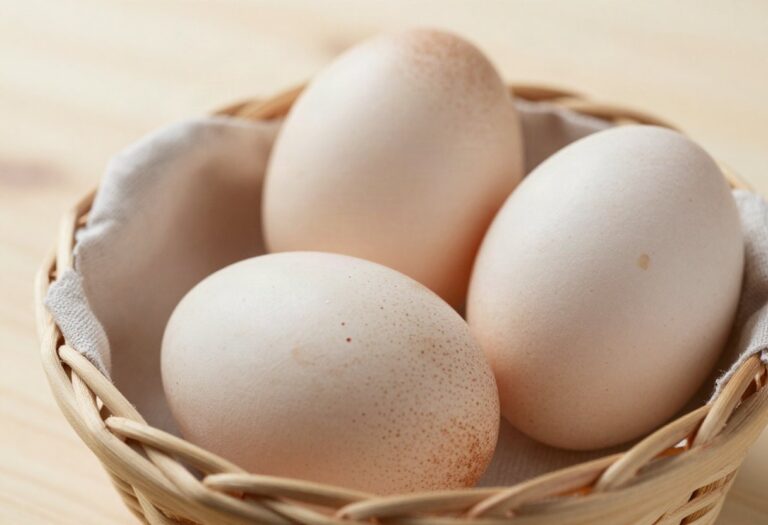
The turkey egg weighs 80 to 90 g and looks like a large, speckled egg from a hen. It is rarely sold: a turkey lays around a hundred eggs a year against three hundred for a hen, and the eggs go mainly to breeding.
In terms of nutrition facts, raw: 166 kcal per 100 g, with 13.7 g of protein and 11.9 g of fat. It provides 170 mg of phosphorus, 99 mg of calcium, 1.75 µg of vitamin D and 71 µg of vitamin B9 per 100 g. Its cholesterol is very high: 933 mg.
Macronutrient breakdown
Nutrition table per 100 g
| Calories | 166 kcal |
| Kilojoules | 691 kJ |
| Protein | 13,7 g |
| Carbohydrate | 1,2 g |
| Fat | 11,9 g |
Micronutrients per 100 g
All measured nutrients, ranked by share of the daily reference intake.
- Vitamin B121,69 µg68 %
- Vitamin B971 µg36 %
- Vitamin D1,75 µg35 %
- Vitamin B20,47 mg34 %
- Vitamin B51,89 mg32 %
- Iron4,1 mg29 %
- Phosphorus170 mg24 %
- Vitamin A173 µg22 %
See the other 9 nutrients
- Zinc1,58 mg16 %
- Calcium99 mg12 %
- Vitamin B10,11 mg10 %
- Vitamin B60,13 mg9 %
- Potassium142 mg7 %
- Copper0,06 mg6 %
- Magnesium13 mg3 %
- Manganese0,04 mg2 %
- Vitamin B30,02 mg0 %
Anses Ciqual 2025. Source: Anses, 2025, Ciqual food composition table
Tips
It sits between the hen’s egg and the duck egg. 166 kcal and 11.9 g of fat, against 134 kcal and 8.62 g for a hen’s hard-boiled egg, and 181 kcal for a duck egg.
1.75 µg of vitamin D per 100 g. That is 35% of the reference intake, and more than a hen’s egg. Eggs are one of the few food sources of vitamin D, along with oily fish.
933 mg of cholesterol: the highest of the eggs in the database. Its significance is limited, as dietary cholesterol has little effect on blood cholesterol, but the figure is worth knowing.
It replaces one and a half hen’s eggs. Useful to know in baking, where proportions matter. Its shell is noticeably thicker and harder to crack.
Cook it right through, like all eggs. Allow about twelve minutes for a hard-boiled egg, against nine for a hen’s egg.