Group · Fruit
Watermelon
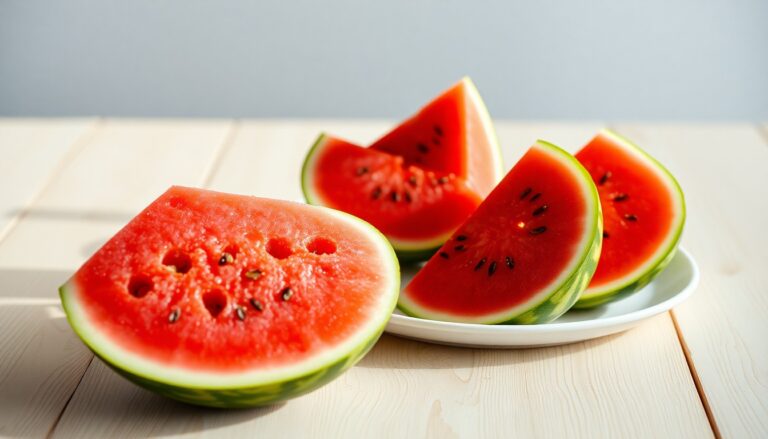
The watermelon is the summer fruit par excellence: full of water, refreshing and low in calories. Native to Africa, this large berry of the gourd family stands out for its red or sometimes yellow flesh, sweet and juicy, dotted with black seeds (or seedless, depending on the variety). With only 35.4 kcal per 100 g, it is more than 90% water, which makes it an ally for hydration. In terms of nutrition facts, it provides carbohydrates (8.33 g), very little fat and a touch of fibre. Easy to include in a balanced diet, watermelon is enjoyed plain, in a salad or as a drink, and appeals as much to people with a sweet tooth as to active people looking for freshness.
Macronutrient breakdown
Nutrition table per 100 g
| Calories | 35 kcal |
| Kilojoules | 150 kJ |
| Protein | 0,7 g |
| Carbohydrate | 8,4 g |
| Fat | 0,2 g |
| Fibre | 0,5 g |
Micronutrients per 100 g
All measured nutrients, ranked by share of the daily reference intake.
- Vitamin A102 µg13 %
- Vitamin C4,26 mg5 %
- Potassium100 mg5 %
- Vitamin B60,06 mg5 %
- Vitamin B50,2 mg3 %
- Copper0,03 mg3 %
- Magnesium11 mg3 %
- Vitamin B30,3 mg2 %
- Vitamin B9dietary folate equivalents36,9 µg
See the other 8 nutrients
- Phosphorus9,7 mg1 %
- Vitamin B10,02 mg1 %
- Total omega-30,03 g1 %
- Iron0,16 mg1 %
- Manganese0,02 mg1 %
- Zinc0,09 mg1 %
- Calcium6 mg1 %
- Vitamin B20,01 mg1 %
Anses Ciqual 2025. Source: Anses, 2025, Ciqual food composition table
Tips
The watermelon can be enjoyed in countless ways, but the simplest is often the best: in well-chilled slices straight from the fridge. A portion of 150 to 250 g is enough for a thirst-quenching snack. You can cut it into cubes for a summer fruit salad, pair it with feta and mint for an original sweet-and-savoury contrast, or blend it into a juice, smoothie or granita with no added sugar. Just avoid very sweet versions or those drizzled with syrup, which needlessly add to the calorie count.
Nutritionally, watermelon is one of the least calorie-dense fruits, thanks to its high water content. It provides carbohydrates in the form of simple sugars, a little vitamin C, vitamin A (via beta-carotene) and lycopene, the pigment responsible for its red colour, known for its antioxidant properties. To find out more on this subject, see our guide to antioxidant foods. Its fibre content stays modest (0.5 g), but it still contributes to digestive comfort when it is part of a varied diet.
For active people, watermelon is an interesting option after exercise: it rehydrates effectively and provides quickly absorbed carbohydrates to kick-start recovery. You can eat it as a post-workout snack or work it into a homemade drink rich in water and minerals. If you are looking for more ideas to optimise your recovery, take a look at our advice on fitness nutrition.
A few pointers for weight control:
- Its glycaemic index is high, but its glycaemic load stays low for a reasonable portion, because the amount of sugar per bite is limited by the water.
- Choose plain watermelon rather than candied or very sweet versions.
- Its low energy density makes it an excellent slimming choice, as long as you do not overdo it to the point of replacing full meals.
As for seasonality, watermelon is at its best from June to September, at peak ripeness. Choose one that feels heavy and sounds hollow when tapped. Once cut, keep it covered in the fridge and eat it within two to three days. You can vary your treats by alternating with other thirst-quenching fruits such as melon or fruits rich in vitamin C such as kiwi. To explore the full diversity of this category, browse our page on fruits.
If you have diabetes: the glycaemic index of melon and watermelon is high, but the portion changes everything. The grams to remember are in our guide to melon and diabetes.