Group · Sweet foods
White sugar
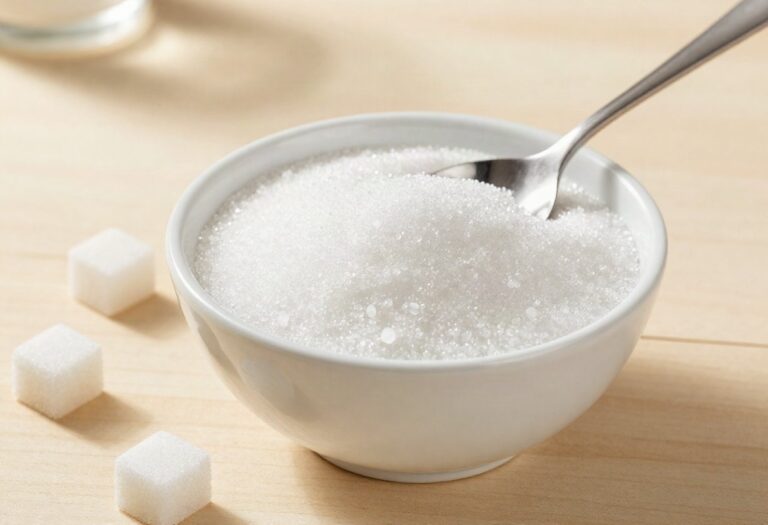
White sugar, also called table sugar or sucrose, is the most widespread sweetening ingredient in our kitchens. Made from sugar beet or sugar cane, it comes in different forms: granulated, caster (fine) or in cubes. With 399 kcal per 100 g and 99.7 g of carbohydrate, it is a simple carbohydrate in its pure state: the archetypal « empty calories », with no protein, fat, fibre or micronutrients. Indispensable in baking and for sweetening drinks and desserts, it should still be eaten in moderation, especially as it is already very present in processed foods. Understanding its nutrition facts helps you manage your intake of added sugars day to day.
Macronutrient breakdown
Nutrition table per 100 g
| Calories | 399 kcal |
| Kilojoules | 1700 kJ |
| Carbohydrate | 99,7 g |
Micronutrients per 100 g
All measured nutrients, ranked by share of the daily reference intake.
- Vitamin B20,02 mg1 %
- Potassium13,5 mg1 %
- Iron0,08 mg1 %
- Copper0,01 mg1 %
- Calcium3,69 mg0 %
- Magnesium1,65 mg0 %
- Manganese0,01 mg0 %
- Zinc0,02 mg0 %
Voir le dernier nutriment
- Iodine0,3 µg0 %
Anses Ciqual 2025. Source: Anses, 2025, Ciqual food composition table
Tips
Table sugar gives an immediate sweet flavour, but its high glycaemic index causes a rapid rise in blood sugar followed by a drop. It is therefore best measured carefully. A teaspoon is around 5 g, or 20 kcal: enough to sweeten a coffee or tea without excess. Guidelines encourage limiting added sugars day to day, whether it is the sugar in your drinks, your yoghurts or your homemade preparations.
How to use it wisely:
- Gradually reduce the amount in your coffee or tea to retrain your palate.
- Favour the natural flavour of fresh fruit or dried fruit to sweeten your desserts.
- Try alternatives depending on your recipes, such as honey or maple syrup, which are more aromatic (but just as calorific).
- In baking, you can often reduce the sugar in the recipe by 20 to 30% without spoiling the result.
Varieties and culinary uses: white sugar suits all neutral preparations, while light brown sugar and brown sugar bring caramelised notes. Icing sugar is used for glazing and decorations. In the kitchen, sugar also allows caramelisation, the preservation of jams and the rising of certain doughs. Simply store it away from humidity, in an airtight container: it keeps almost indefinitely.
For active people: a quick supply of carbohydrate can be useful during a long or intense effort, when the body needs immediately available energy. A lightly sweetened drink during an endurance outing helps maintain your pace. Outside exercise, however, it is better to favour complex carbohydrates and nutritious sources. For recovery or a balanced snack, look instead at high-protein snack ideas that combine energy and fullness.
Weight control: table sugar is one of the so-called empty calorie sources, because it provides no vitamins, minerals or fibre. If you are watching your weight, the point is not to ban it entirely but to limit how often you have it and how much. To go further, discover our guide on empty calories and their alternatives, and explore the other sugary foods to compare their nutritional profiles. Moderation remains the key to a diet that is both enjoyable and balanced.
Good to know: wholecane sugar (rapadura, muscovado) retains a few minerals but is still sugar. White sugar provides only empty calories.