Group · Sweet foods
Light brown sugar
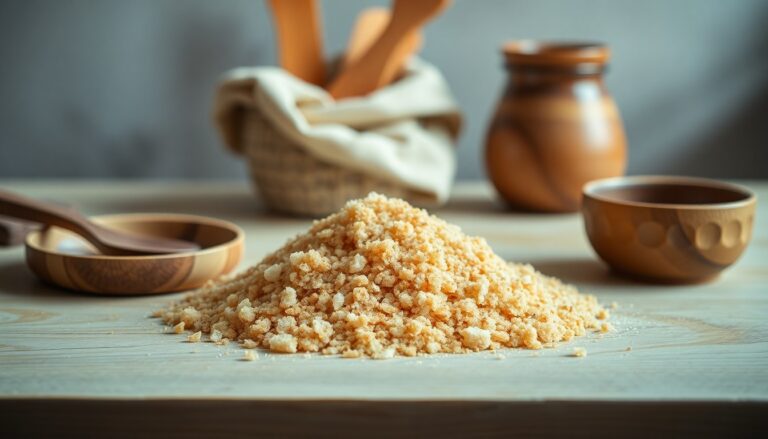
Cassonade is a light brown cane sugar, recognisable by its amber colour and small, slightly moist crystals. More aromatic than refined white sugar, it gives off notes of caramel and natural vanilla, thanks to the molasses residues it retains. It comes in fine or coarser crystals and is sometimes confused with brown beet sugar. In terms of nutrition facts, light brown sugar provides around 393 kcal per 100 g and nearly 98.1 g of carbohydrate, a profile close to ordinary sugar. Widely used in baking and to sweeten drinks and desserts, it remains a sugary food to enjoy in moderation as part of a balanced diet.
Macronutrient breakdown
Nutrition table per 100 g
| Calories | 393 kcal |
| Kilojoules | 1670 kJ |
| Protein | 0,2 g |
| Carbohydrate | 98,1 g |
Micronutrients per 100 g
All measured nutrients, ranked by share of the daily reference intake.
- Calcium83 mg10 %
- Potassium133 mg7 %
- Iron0,71 mg5 %
- Copper0,05 mg5 %
- Manganese0,06 mg3 %
- Vitamin B60,04 mg3 %
- Magnesium9 mg2 %
- Vitamin B50,13 mg2 %
- Vitamin B9dietary folate equivalents1 µg
See the other 5 nutrients
- Selenium1,1 µg2 %
- Vitamin B30,11 mg1 %
- Phosphorus4 mg1 %
- Zinc0,03 mg0 %
- Iodine0,3 µg0 %
Anses Ciqual 2025. Source: Anses, 2025, Ciqual food composition table
Tips
Light brown sugar is used like table sugar, but it adds a caramelised flavour that cooks love. Sprinkled over yoghurt, roasted fruit or a pancake, it forms a thin, crisp crust as it caramelises. It is also the star of crumbles, cookies, financiers and other golden bakes. Given its high calorie density (around 393 kcal per 100 g, or nearly 20 kcal per teaspoon), it is better to measure it by the spoonful than to sprinkle it freely.
- Portions: one or two teaspoons are enough to sweeten a coffee, a tea or a homemade dessert.
- Cooking: ideal for gentle caramelisation, tarts and biscuits, where it is a good substitute for table sugar and adds more flavour.
- Storage: keep it in an airtight container to stop it hardening because of its natural moisture.
Nutritionally, light brown sugar is still a simple sugar with a high glycaemic index. Despite its colour and traces of minerals from the molasses, its contribution of vitamins and trace elements is negligible: it is above all a source of fast carbohydrate, with no significant fibre or protein. Believing it to be « healthier » than white sugar is a common misconception, as explained in this article on empty calories.
For active people, light brown sugar can be a quick source of energy, for example in a drink or a carbohydrate snack before prolonged exercise, or to help replenish glycogen stores after training. It works well in homemade preparations such as bars or protein snacks, where it adds flavour while limiting ultra-processed sugars. Still, remember to prioritise water and a complete diet rather than piling on sugary intakes.
If you are watching your weight, light brown sugar calls for moderation: its calories add up quickly when you put it in several dishes during the day. You can cut back gradually, as your palate soon gets used to less sugar. To compare its contribution with other sweet treats, see the calorie table or explore the sugary foods family to make informed choices. Well measured, light brown sugar is an indulgence that fits perfectly well in a balanced diet.