5-HTP (griffonia): benefits, side effects, dosage and what the studies show
The short answer
5-HTP (5-hydroxytryptophan) is the molecule your body turns directly into serotonin, and most 5-HTP supplements are extracted from the seeds of Griffonia simplicifolia, a West African plant. People take it for mood, sleep or sugar cravings. The evidence is thin: a few small, older depression trials, often poorly designed, and one 20-person trial on appetite. In 2012, the EU rejected mood and satiety claims for 5-HTP. The key safety point: never combine it with an antidepressant or other serotonin-raising drugs, because of the risk of serotonin syndrome. It is also not advised during pregnancy or breastfeeding.
This article is for information and does not replace medical advice.
What is 5-HTP and where does griffonia come in?
Griffonia simplicifolia is a climbing shrub from West Africa. Its seeds contain 5-HTP. Your body makes 5-HTP from tryptophan, an amino acid found in protein, then turns it into serotonin, a chemical messenger involved in mood, sleep and appetite. Serotonin is then used to make melatonin, the sleep hormone.
The idea behind supplements is simple: supply 5-HTP directly and skip the rate-limiting step. But “more precursor” does not mean “more wellbeing”, and that is what studies struggle to show. Griffonia supplements are seed extracts, usually standardised for 5-HTP (for example 30%): what matters is the amount of 5-HTP, not the weight of extract.
5-HTP benefits: what the research really shows
| Use | What was studied | Strength of evidence |
|---|---|---|
| Depression | 2002 meta-analysis: of 108 studies, only 2 (64 patients) were good enough to include. 2020 meta-analysis: 13 studies, favourable effect but few placebo groups and very mixed results | Weak |
| Appetite and weight | 20 adults with obesity, 900 mg 5-HTP a day vs placebo, two 6-week periods: weight loss, fewer carbs, earlier fullness | Weak (one small 1992 trial) |
| Sleep | No solid randomised trial found in adults with poor sleep; drowsiness is a listed side effect | Insufficient |
| Anxiety, headaches, fibromyalgia | A few older studies, benefit not formally shown | Insufficient |
Key takeaways. The authors of the 2002 meta-analysis concluded that 5-HTP was too poorly studied to judge. The 2020 review found a more positive signal, but stressed that most studies had no placebo group, which inflates effects. For appetite, the 1992 trial used 900 mg of pure 5-HTP a day, far more than most supplements provide. Finally, in 2012, EFSA and the European Commission rejected claims that 5-HTP improves mood or concentration or helps control weight: they cannot appear on labels in the EU.
What about sleep? It is the most advertised use and the least studied in adults. Before reaching for a supplement, the proven levers are sleep habits and your evening meal: our guide to foods that help you sleep covers tryptophan sources, and our best sleep supplement comparison reviews the better-studied options. If stress keeps you awake, read diet and stress management too.
5-HTP side effects and who should avoid it
The major risk: serotonin syndrome
5-HTP raises serotonin. Combined with a drug that already raises serotonin, it can cause serotonin syndrome: confusion, agitation, sweating, muscle twitching, and in severe cases seizures or coma. It is a medical emergency. Turner’s 2006 review gives this risk a central place in its safety analysis.
Do not take 5-HTP or griffonia if you take:
- any antidepressant, including herbal ones (St John’s wort);
- a Parkinson’s disease treatment;
- any other drug acting on serotonin: ask your pharmacist, the list is long.
Never stop an antidepressant to replace it with 5-HTP: stopping is a decision to make with your doctor.
Other contraindications and side effects
| Contraindications | Most common side effects |
|---|---|
| Pregnancy and breastfeeding | Drowsiness |
| High blood pressure and heart problems | Digestive upset |
| Down syndrome, scleroderma | Blurred vision |
| Antidepressants, Parkinson’s treatments | Heart rhythm disturbances |
Quality matters. In the 1980s, contaminated tryptophan supplements caused eosinophilia-myalgia syndrome, with severe muscle pain and deaths. Toxicity has also been reported with some 5-HTP supplements, linked to a contaminant from manufacturing. That is why a known manufacturer with batch testing matters.
In France, griffonia appears in the national food safety agency’s (Anses) list of herbs most cited in nutrivigilance reports: 10 reports from 2016 to 2021 where a link with the supplement was judged at least possible. To our knowledge, the agency has not published an opinion specific to griffonia. Vidal states that European and North American health authorities strongly advise against self-medicating with 5-HTP.
If you are pregnant, follow our pregnancy diet guide.
5-HTP dosage: how to take it if you choose to
- Dose: clinical trials used 150 to 600 mg of 5-HTP a day (900 mg in the appetite trial). Supplements usually provide less: check the 5-HTP content per capsule, not just the extract weight, and do not exceed the label dose.
- Timing: since drowsiness is common, many people take it in the evening; no solid study sets an ideal time.
- Duration: trials lasted a few weeks. Check in with a health professional if you notice nothing after a month, or sooner if you have side effects.
- Before you start: check with your doctor or pharmacist that it does not interact with your medications.
Griffonia is often paired with magnesium or rhodiola in “anti-stress” formulas. If you want a better-studied adaptogen for stress, see our best ashwagandha supplement comparison.
Nutrition•pro: a griffonia 5-HTP supplement made in France
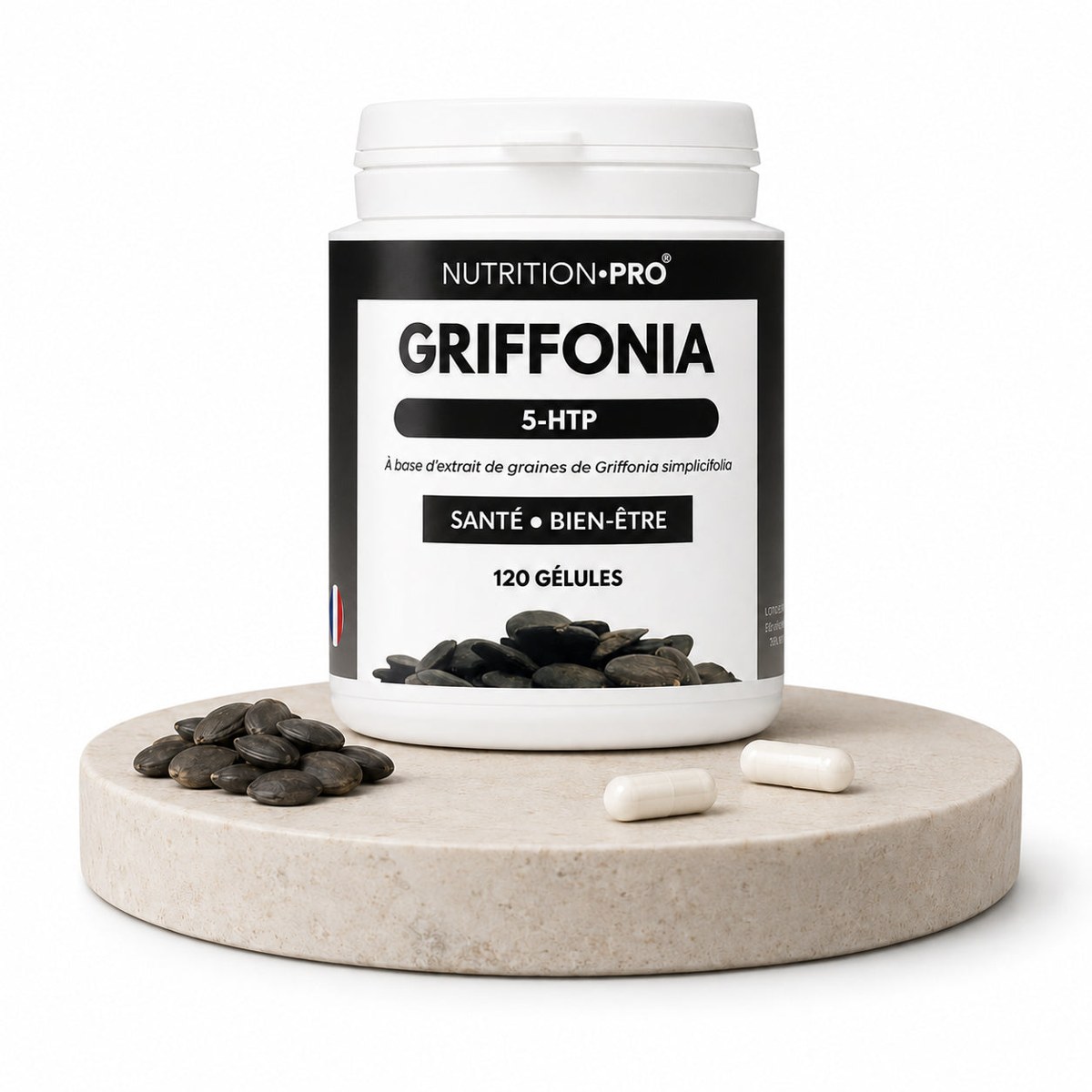
Nutrition•pro is a French brand that says it designs and makes its formulas in France. Its Griffonia (5-HTP) stands out for:
- a Griffonia simplicifolia seed extract standardised to 30% 5-HTP, for a consistent content from batch to batch;
- a single-ingredient formula focused on griffonia;
- 4 capsules a day, for 1.20 g of extract and 360 mg of 5-HTP;
- 120 capsules, a 30-day course;
- €29.99 per jar (price checked on 22/11/2026), about €1 a day.
Putting the dose in context. 360 mg of 5-HTP a day is a substantial dose: it sits within the range used in trials (150 to 600 mg), below the 900 mg of the appetite trial, and well above what many supplements provide. Given how weak the studies are, no effect is guaranteed at this dose. The standardised extract makes it easy to adjust: you can start lower, for example 1 or 2 capsules a day (90 to 180 mg of 5-HTP), after checking with your doctor or pharmacist. And the precautions fully apply: never with an antidepressant, not during pregnancy or breastfeeding.
Promo code: SEOCONSULTINGSL for 10% off your order, €26.99 per jar (as of 22/11/2026).
See Nutrition•pro Griffonia 5-HTP →
Partner link: we earn a commission if you order through this link, at no extra cost to you.
Frequently asked questions
What is 5-HTP good for?
It is a serotonin precursor. Older, low-quality studies suggest an effect on mood, and one small trial on appetite. No benefit is firmly established, and EU authorities rejected mood and satiety claims in 2012.
Is 5-HTP an antidepressant?
No. It is not a medicine and does not replace treatment. Above all, it must never be combined with an antidepressant because of the risk of serotonin syndrome.
What are the side effects of 5-HTP?
Drowsiness, digestive upset, blurred vision and heart rhythm disturbances are the most cited. Combined with serotonin-raising drugs: confusion, agitation, sweating, muscle twitching.
Should I take 5-HTP at night or in the morning?
Often at night, as it can make you drowsy. No study sets an ideal time; follow the label and ask your pharmacist.
Does 5-HTP help with weight loss?
Only one small trial, at 900 mg a day. To manage appetite, protein- and fibre-rich foods have better support: see our natural appetite suppressants guide.
Sources
- Shaw K., Turner J., Del Mar C. Are tryptophan and 5-hydroxytryptophan effective treatments for depression? A meta-analysis. Aust N Z J Psychiatry, 2002; 36(4): 488-91. PubMed 12169147
- Javelle F. et al. Effects of 5-hydroxytryptophan on distinct types of depression: a systematic review and meta-analysis. Nutr Rev, 2020; 78(1): 77-88. PubMed 31504850
- Cangiano C. et al. Eating behavior and adherence to dietary prescriptions in obese adult subjects treated with 5-hydroxytryptophan. Am J Clin Nutr, 1992; 56(5): 863-7. PubMed 1384305
- Turner E.H., Loftis J.M., Blackwell A.D. Serotonin a la carte: supplementation with the serotonin precursor 5-hydroxytryptophan. Pharmacol Ther, 2006; 109(3): 325-38. PubMed 16023217
- Vidal. L-5-hydroxytryptophane (5-HTP), supplement page, updated 18/08/2014. vidal.fr
- Anses (French food safety agency). Technical note on the herbs most involved in nutrivigilance reports (2021-AST-0133), 17/12/2021. anses.fr