Acai bowl: calories, sugar, benefits and is it healthy?
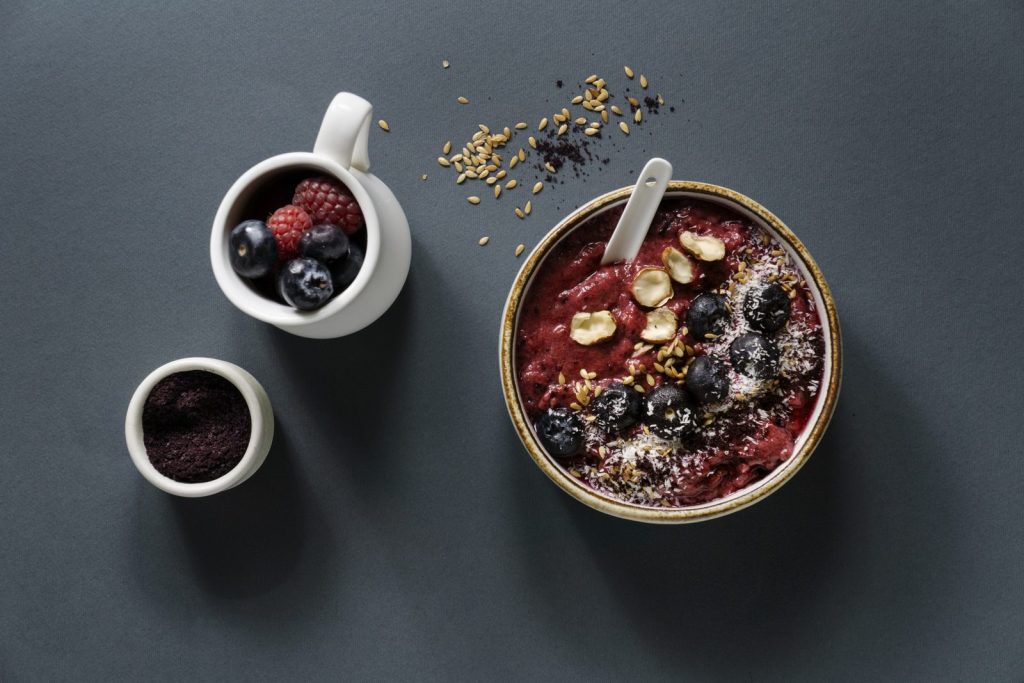
The short answer
Acai is the small purple fruit of an Amazon palm (Euterpe oleracea), mostly harvested in Brazil. It spoils fast, so outside South America you buy it as frozen pulp or powder. Pure, unsweetened pulp is low in sugar: about 70 calories and 0 g of sugar per 100 g. An acai bowl is a different story: with a sweetened base, banana, granola and honey it can top 500 calories and 60 g of sugar. Acai is rich in anthocyanins, but human trials are small and mostly inconclusive: it is a good fruit, not a cure.
This article is for information and does not replace medical advice.
Want to try it without picking the wrong product? Here is our pick, from Nutrition•pro: a French brand that designs and makes its products in France, it says.
What is acai?
Acai (pronounced “ah-sigh-EE”) grows in bunches on a palm in the Amazon floodplains. The berries are blueberry-sized, with a large seed and little flesh. The taste is earthy and only mildly sweet, somewhere between berries and cocoa, which is why it is nearly always blended with other fruit. In Brazil the pulp has been a staple for centuries; its global fame came with the “superfood” label. See what is a superfood for what that word is worth.
Acai bowl calories and sugar
An acai bowl is thick blended frozen acai, topped with fruit and crunch. Two choices make or break it: the base (pure acai or a pre-sweetened blend) and the toppings. Packs labelled “with guarana” often contain cane sugar (10 to 13 g of sugar per 100 g) plus caffeine from the guarana.
| Ingredient | Homemade bowl | Cafe-style bowl |
|---|---|---|
| Acai base | 100 g pure unsweetened pulp: 70 kcal, 0 g sugar | 200 g sweetened acai-guarana pulp: 200 kcal, 26 g sugar |
| Banana | 1 banana (120 g): 105 kcal, 18.7 g sugar | 1 banana (120 g): 105 kcal, 18.7 g sugar |
| Granola | 30 g: 135 kcal, 5.2 g sugar | 50 g: 225 kcal, 8.6 g sugar |
| Blueberries | 50 g: 29 kcal, 5 g sugar | None |
| Honey | None | 1 tbsp (15 g): 50 kcal, 12.2 g sugar |
| Total | about 340 kcal, 29 g sugar (mostly from fruit) | about 580 kcal, 65 g sugar, much of it added |
For comparison, a 170 g packaged acai bowl in the same database provides about 210 calories and 19 g of sugar before toppings (FoodData Central, entry 2579678). Is an acai bowl healthy? Homemade, yes. Cafe-style, it is closer to a dessert. To put 65 g of sugar in context, see how much sugar a day.
A low-sugar acai bowl recipe
- Base: 100 g pure unsweetened acai pulp blended with a frozen ripe banana and a splash of milk. No pulp? Use 100 g frozen berries and 1 teaspoon (3 to 5 g) of acai powder.
- Toppings: a handful of blueberries, 2 tablespoons of granola, some seeds or nuts.
- To stay full until lunch: add protein (skyr, Greek yogurt). Our berry smoothie bowl works the same way.
- Skip the honey: the banana already sweetens it.
Acai berry benefits: what the research really shows
“Packed with antioxidants”: what that means
Acai is rich in anthocyanins, the purple pigments also found in blueberries and blackcurrants, and it scores very high on lab antioxidant tests. But a test-tube score says little about the body, as explained in our antioxidant foods guide.
One study shows the problem well (Mertens-Talcott et al., 2008). Twelve volunteers drank acai pulp or juice at 7 ml per kg of body weight (close to half a litre at 70 kg). Anthocyanins reached the blood, peaking about 2 hours later. Plasma antioxidant capacity rose with the pulp… and with the applesauce used as a comparison. Nothing changed in urine or in free radical production.
Human trials: few and inconsistent
A review of clinical trials (Baptista et al., Nutrition Reviews, 2021) found 17 acai trials up to 2020, suggesting small effects on antioxidant defences, metabolic stress and inflammation, with high heterogeneity in doses, forms and populations. On cholesterol, the latest meta-analysis (Candeloro et al., 2025; 8 studies, 411 participants) found no significant effect on LDL, HDL, total cholesterol or triglycerides, with low to very low certainty of evidence.
The rest is lab work
The heart, liver, brain and anti-cancer effects often quoted come mainly from cell and animal studies, as a 2023 critical review (Laurindo et al.) details. These are research leads, not proof. Bottom line: acai is a polyphenol-rich fruit that fits a varied diet, with no proven edge over other deep-coloured berries.
Is acai safe? Precautions
- The sugar, not the fruit: a sweetened acai bowl every morning is the main everyday issue. Look for “pure” or “unsweetened” packs.
- Guarana caffeine: acai-guarana blends contain caffeine. Avoid for children, in pregnancy, or in the evening if you are sensitive.
- Travelling in the Amazon: fresh artisanal pulp can transmit Chagas disease when infected insects are crushed with the fruit. A 2026 review (Useche et al.) linked acai to 32 of 64 food-borne outbreaks in Brazil. This concerns fresh pulp made locally, not dried or frozen retail products.
- Allergy: rare, but possible if you react to other tropical fruits.
Acai powder: how to use it
Acai powder is dried, ground pulp. A typical serving is 1 teaspoon (3 to 5 g) in a smoothie, yogurt, oatmeal or a bowl. Keep the scale in mind: trials used hundreds of grams of pulp or juice, so a spoonful of powder is for flavour and colour, with some polyphenols as a bonus.
Nutrition•pro: organic acai powder from Brazilian pulp
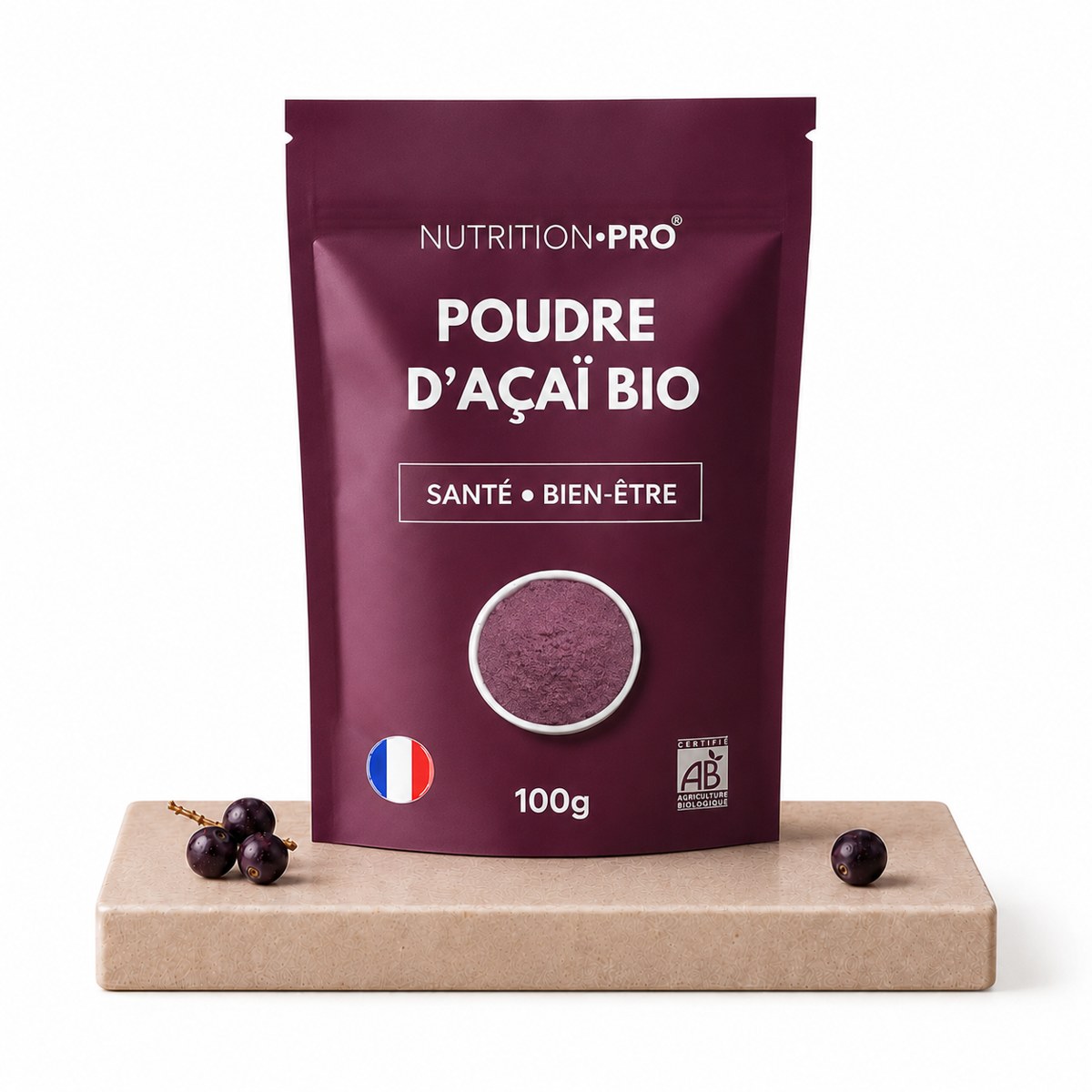
Nutrition•pro is a French brand based in Paris. Its organic acai powder keeps things simple: one ingredient, nothing added, and no freezer space needed.
- 100% organic acai powder (Euterpe oleracea), certified organic;
- made from fruit pulp harvested in Brazil, according to the product page;
- suggested serving: 1 teaspoon (3 to 5 g) a day;
- about 20 calories per 5 g (403 kcal per 100 g on the label);
- 100 g bag, 20 to 33 days depending on the serving;
- €19.99 per bag (price checked on 22/11/2026), about €0.60 to €1.00 a day.
Our take: an easy way to get acai into your bowl without buying sweetened pulp, so you stay in control of the sugar. The brand presents acai as an antioxidant source; as shown above, human studies used other forms and far larger amounts, with modest results. Use it for taste and colour. The brand advises starting small if you have a sensitive gut, avoiding it with a tropical fruit allergy, and asking a professional in pregnancy, breastfeeding or on medication.
Promo code: SEOCONSULTINGSL for 10% off your order, €17.99 per bag, about €0.54 to €0.90 a day (as of 22/11/2026).
See Nutrition•pro organic acai powder →
Partner link: we earn a commission if you order through this link, at no extra cost to you.
Frequently asked questions
How many calories are in an acai bowl?
From about 300 to over 600, depending on size and toppings. Pure pulp is only about 70 calories per 100 g: the sweetened base, granola and honey drive the total up.
Is an acai bowl healthy?
A homemade bowl with pure pulp, banana and berries is a solid breakfast. Cafe bowls with sweetened bases and lots of toppings are closer to dessert.
What are the benefits of acai berries?
Acai provides anthocyanins, fibre and unsaturated fats. Human trials suggest small effects on antioxidant and inflammation markers, but no proven effect on cholesterol.
What does acai taste like?
Earthy and mildly sweet, between berries and unsweetened cocoa.
Is acai powder as good as frozen pulp?
Both are acai; powder is more convenient and keeps longer, while pulp gives the classic thick texture. Check that neither has added sugar.
Sources
- Baptista S.L. et al. Biological activities of açaí and juçara intake in humans: an integrative review of clinical trials. Nutr Rev, 2021; 79(12): 1375-1391. PubMed 33555024
- Candeloro B.M. et al. Investigating the Impact of Açai (Euterpe oleracea) on Lipid Profile: A Comprehensive Systematic Review and Meta-Analysis. Nutr Bull, 2025; 50(2): 206-219. PubMed 39960343
- Mertens-Talcott S.U. et al. Pharmacokinetics of anthocyanins and antioxidant effects after the consumption of anthocyanin-rich acai juice and pulp in human healthy volunteers. J Agric Food Chem, 2008; 56(17): 7796-802. PubMed 18693743
- Laurindo L.F. et al. Açaí (Euterpe oleracea Mart.) in Health and Disease: A Critical Review. Nutrients, 2023; 15(4): 989. PubMed 36839349
- Useche Y.M. et al. Orally transmitted Chagas disease outbreaks in Latin America: a comprehensive systematic review. Front Public Health, 2026; 14: 1911186. PubMed 42774413
- USDA FoodData Central: unsweetened acai pulp (FoodData Central 2038653), sweetened acai-guarana pulp (FoodData Central 2019024), packaged acai bowl (FoodData Central 2579678).