CoQ10: benefits, statins, ubiquinol vs ubiquinone and side effects
The short answer
CoQ10 (coenzyme Q10) is a compound your body makes that is essential for energy production in mitochondria and acts as an antioxidant. It is mostly taken for muscle pain on statins, but meta-analyses disagree: one found a benefit, two did not. The most interesting results are in heart failure (one trial, Q-SYMBIO, with fewer serious events) and migraine (fewer attacks), always alongside standard treatment. It is well tolerated; the drug to watch is warfarin, with a few reported cases of reduced effect. If you take a blood thinner, ask your doctor before taking CoQ10.
This article is for information and does not replace medical advice. Never stop a statin or heart medication without talking to your doctor.
What is CoQ10?
CoQ10 is present in almost every cell, especially in the heart, liver and muscles. It carries electrons in the chain that produces energy (ATP) inside mitochondria, and in its reduced form it protects cell fats from oxidation.
Your body makes it; food provides only about 3 to 6 mg a day, while supplements usually provide 30 to 100 mg or more (Linus Pauling Institute). It is not a vitamin: there is no recommended intake and no common deficiency outside rare genetic disorders.
Ubiquinol vs ubiquinone
CoQ10 comes in two forms: ubiquinone (oxidized), the most sold and most studied, and ubiquinol (reduced). The body switches between them constantly. In a trial of 21 adults aged 65 to 74, ubiquinol was not significantly better absorbed than ubiquinone (1.7-fold, not significant), whereas a water-soluble formulation was 2.4 times better; and CoQ10 appeared in the blood mostly as ubiquinol even when taken as ubiquinone (Pravst et al., 2020). The formulation matters at least as much as the form. The major trials used ubiquinone.
CoQ10 and statins: what meta-analyses show
Statins block an enzyme used to make both cholesterol and CoQ10. They lower blood CoQ10, but the Linus Pauling Institute notes this may be mostly because they lower the lipids that carry it, and there is little evidence that low CoQ10 causes statin muscle symptoms.
| Meta-analysis | Trials and patients | Effect on muscle pain |
|---|---|---|
| Banach et al., 2015 | 6 trials, 302 patients | No significant effect on pain or CK |
| Qu et al., 2018 | 12 trials, 575 patients | Less pain, weakness, cramps and muscle tiredness; CK unchanged |
| Kennedy et al., 2020 | 7 trials, 321 patients | No effect on pain or on staying on the statin |
The trials are small (37 to 76 participants each in the 2020 review), and only two of eight showed a benefit. Honest takeaway: CoQ10 may be worth a try for statin muscle pain, with your doctor’s agreement, but it is not a proven fix; changing the statin or dose often helps more. CoQ10 does not lower cholesterol: for that, see foods to lower cholesterol.
CoQ10 for heart failure: the Q-SYMBIO trial
420 patients with moderate to severe heart failure took 100 mg of CoQ10 three times a day (300 mg) or a placebo, on top of standard treatment, for 2 years (Mortensen et al., 2014).
- At 16 weeks: no difference in symptoms, walking test or NT-proBNP.
- At 2 years: major cardiovascular events in 15% on CoQ10 vs 26% on placebo; cardiovascular death 9% vs 16%; death from any cause 10% vs 18%.
Encouraging, but it is a single mid-sized trial still awaiting confirmation. CoQ10 does not replace any heart failure medication: ask your cardiologist.
CoQ10 for migraine
In a Swiss trial of 42 patients, 3 × 100 mg a day cut attack frequency by month 3: 47.6% halved their attacks versus 14.4% on placebo (Sándor et al., 2005). A meta-analysis of 6 trials (371 participants) confirmed fewer and shorter attacks, but not less severe ones (Sazali et al., 2021). Allow 3 months to judge.
| Use | What studies show | Evidence |
|---|---|---|
| Statin muscle pain | Conflicting meta-analyses | Uncertain |
| Heart failure (add-on) | Fewer serious events at 2 years in one 420-patient trial | Promising, unconfirmed |
| Migraine prevention | Fewer, shorter attacks in small trials | Moderate |
| Blood sugar | No drop in fasting glucose or HbA1c | No effect |
| Blood pressure | Conflicting results | Insufficient |
CoQ10 benefits for women and men, fatigue, weight loss, skin: we found no solid trial in healthy people. For tiredness, see our best supplement for fatigue comparison.
CoQ10 side effects and drug interactions
Side effects
The Linus Pauling Institute reports no significant side effects in trials. Some people get digestive upset (nausea, diarrhea), mostly at 200 mg a day or more; splitting doses above 100 mg helps. In Q-SYMBIO, 300 mg a day for 2 years was judged safe.
What medications should not be taken with CoQ10?
The key one is warfarin. A few isolated cases described a reduced warfarin effect with CoQ10 (it is structurally similar to vitamin K). Yet a Danish placebo-controlled trial in 24 patients on warfarin found no change in INR or warfarin dose with 100 mg of CoQ10 a day for 4 weeks (Engelsen et al., 2003). To be safe, the Linus Pauling Institute advises not starting CoQ10 on warfarin without your doctor, and checking INR often, especially in the first two weeks. The same trial tested ginkgo: see our guide to ginkgo biloba benefits and side effects.
Other precautions
- Diabetes or blood pressure medication: data are reassuring or conflicting, but tell your doctor.
- Pregnancy: one trial used 100 mg twice a day from 20 weeks with no reported problem, but data are limited: ask your doctor.
- Breastfeeding: avoid, for lack of reliable data.
- Children: only on medical advice.
CoQ10 in food
| Food | Serving | CoQ10 (mg) |
|---|---|---|
| Beef, fried | 3 oz | 2.6 |
| Herring, marinated | 3 oz | 2.3 |
| Chicken, fried | 3 oz | 1.4 |
| Soybean oil | 1 tbsp | 1.3 |
| Peanuts, roasted | 1 oz | 0.8 |
| Pistachios, roasted | 1 oz | 0.6 |
| Broccoli, boiled | 1/2 cup | 0.5 |
Trial doses (100 to 300 mg a day) are impossible to reach through food: that is what supplements are for.
How much CoQ10 per day?
- Doses studied: 300 mg a day (3 × 100 mg) in Q-SYMBIO and the migraine trial; 100 to 200 mg a day in most statin trials.
- Timing: CoQ10 is fat-soluble: take it with a meal containing fat, split into two doses above 100 mg.
- What happens if you take CoQ10 every day? Daily use for months or years was well tolerated in trials; migraine benefits took about 3 months, heart failure benefits appeared long term.
- On warfarin: only with your doctor’s approval and INR monitoring.
Nutrimea: a 200 mg-a-day ubiquinone CoQ10
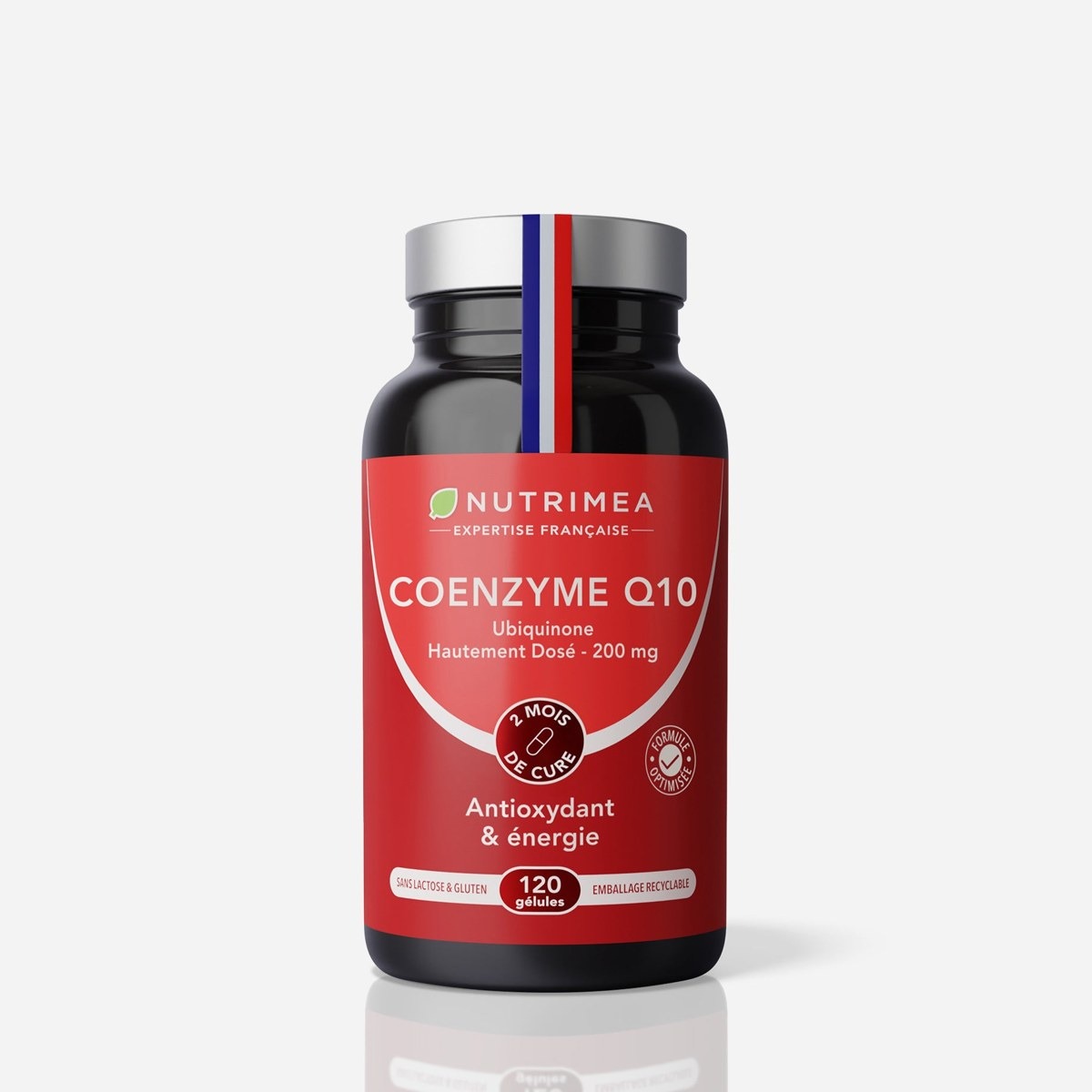
If you want to try CoQ10, Nutrimea’s Coenzyme Q10 uses the form of the major trials, ubiquinone, at a solid dose and a moderate daily cost. Its product page lists:
- 100 mg of CoQ10 (ubiquinone) per capsule, made by natural fermentation;
- 2 capsules a day, i.e. 200 mg, with a glass of water, preferably in the morning with a meal containing fat;
- plant capsule, vegan, non-GMO, gluten- and lactose-free; the brand highlights its French expertise;
- 120 capsules, i.e. 2 months; the brand suggests 2 to 3 months;
- €23.90 a jar (price checked on 22/11/2026), about €0.40 a day. Ships from France.
How does the dose compare? 200 mg a day is within the range of the statin trials and a little below the 300 mg used in Q-SYMBIO and the migraine trial. The studies above did not use this product and do not guarantee its effect.
The page is careful: it advises against use with anticoagulant treatment and for people with diabetes, does not recommend it for children and teens, and asks pregnant or breastfeeding women to consult a health professional.
Partner link: we earn a commission if you order through this link, at no extra cost to you.
FAQ
What is CoQ10 good for?
The best evidence is for migraine prevention and, in one trial, heart failure on top of treatment. For statin muscle pain, results conflict.
What drugs should not be taken with CoQ10?
Be careful with warfarin: a few cases of reduced effect were reported, although a small trial found no change in INR. Ask your doctor and monitor INR. Mention CoQ10 if you take diabetes or blood pressure medication.
Is there any downside to taking CoQ10?
Mostly digestive upset at higher doses, the cost, and the risk of relying on it instead of a proper medical review of your symptoms.
Should I take CoQ10 with a statin?
Not routinely. If you have muscle pain, talk to your doctor first; CoQ10 can be tried, with no guarantee.
Is ubiquinol better than ubiquinone?
Not clearly: in a comparative trial, ubiquinol was not significantly better absorbed, and ubiquinone is converted to ubiquinol in the body. Ubiquinone is the form used in the major trials.
Sources
- Qu H. et al. Effects of Coenzyme Q10 on Statin-Induced Myopathy: An Updated Meta-Analysis of Randomized Controlled Trials. J Am Heart Assoc, 2018; 7(19): e009835. PubMed 30371340
- Banach M. et al. Effects of coenzyme Q10 on statin-induced myopathy: a meta-analysis of randomized controlled trials. Mayo Clin Proc, 2015; 90(1): 24-34. PubMed 25440725
- Kennedy C., Köller Y., Surkova E. Effect of Coenzyme Q10 on statin-associated myalgia and adherence to statin therapy: A systematic review and meta-analysis. Atherosclerosis, 2020; 299: 1-8. PubMed 32179207
- Mortensen S.A. et al. The effect of coenzyme Q10 on morbidity and mortality in chronic heart failure: results from Q-SYMBIO. JACC Heart Fail, 2014; 2(6): 641-9. PubMed 25282031
- Sándor P.S. et al. Efficacy of coenzyme Q10 in migraine prophylaxis: a randomized controlled trial. Neurology, 2005; 64(4): 713-5. PubMed 15728298
- Sazali S. et al. Coenzyme Q10 supplementation for prophylaxis in adult patients with migraine: a meta-analysis. BMJ Open, 2021; 11(1): e039358. PubMed 33402403
- Engelsen J., Nielsen J.D., Hansen K.F. Effect of coenzyme Q10 and Ginkgo biloba on warfarin dosage (randomized placebo-controlled crossover trial, in Danish). Ugeskr Laeger, 2003; 165(18): 1868-71. PubMed 12772396
- Pravst I. et al. Comparative Bioavailability of Different Coenzyme Q10 Formulations in Healthy Elderly Individuals. Nutrients, 2020; 12(3): 784. PubMed 32188111
- Linus Pauling Institute, Micronutrient Information Center: Coenzyme Q10. lpi.oregonstate.edu