Cordyceps: benefits, side effects, risks and how to take it
The short answer
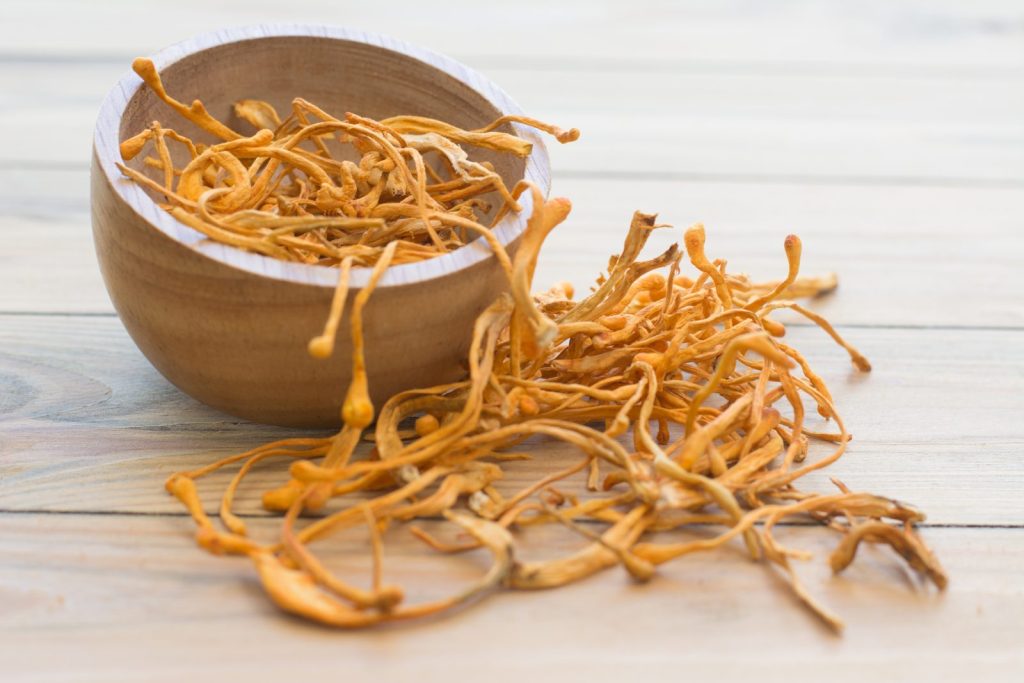
Cordyceps is a mushroom used mainly for endurance and energy. Its best-studied benefits concern exercise: a 2025 meta-analysis in athletes found a small improvement in endurance and oxygen uptake with Cordyceps sinensis, but other trials, including one in trained cyclists, found no effect at all. The evidence is thin and mixed. Side effects were rare in trials, but product quality matters: cases of lead poisoning have been linked to contaminated cordyceps. And no, the cordyceps from The Last of Us does not infect humans.
This article is for information and does not replace medical advice.
What is cordyceps? Sinensis, militaris and the zombie ant fungus
Cordyceps is a group of fungi that parasitize insects. The famous “zombie ant” fungus is a related species (Ophiocordyceps unilateralis) that is not used in supplements. Two species matter for nutrition:
| Cordyceps sinensis | Cordyceps militaris | |
|---|---|---|
| Origin | Wild, Himalayan and Tibetan high plateaus, on insect larvae | Cultivated on growth media |
| Availability | Very rare and costly in the wild; supplements use cultivated preparations (such as Cs-4) | Easy to grow, the most common supplement form |
| Studies in athletes | The most numerous (2025 meta-analysis) | 5 human studies from 2017 to 2024, mixed results |
These fungi contain cordycepin, a molecule close to adenosine, a building block of ATP (the molecule that powers cells). That is the usual explanation for its energy reputation. It remains a hypothesis: in people, only trials count.
Cordyceps benefits: what studies show for endurance
Exercise performance is the most studied use. Here are the main trials, positive and negative.
| Study | Participants | What was taken | Result |
|---|---|---|---|
| Parcell, 2004 | 22 trained cyclists | Cs-4 (C. sinensis), 3 g a day, 5 weeks | No effect on VO2 max, ventilatory threshold or time trial |
| Chen, 2010 | 20 healthy adults aged 50 to 75 | Cs-4, 333 mg 3 times a day, 12 weeks | Metabolic threshold +10.5%, ventilatory threshold +8.5%; no change in VO2 max |
| Hirsch, 2017 | 28 young adults, 10 of them for 3 weeks | Mushroom blend containing C. militaris, 4 g a day | Nothing after 1 week; after 3 weeks, VO2 max +4.8 ml/kg/min vs +0.9 with placebo |
| Farzan, 2026 | 12 active young men | 1 g of C. militaris extract, 30 min before exercise | Faster reaction time after exercise; no change in peak oxygen uptake |
The 2025 meta-analysis (Shu et al., Frontiers in Nutrition) gathered 14 randomized trials in 528 athletes, 8 of which (288 athletes) could be pooled. With Cordyceps sinensis, endurance, ventilatory threshold and peak VO2 improved, just reaching statistical significance. For Cordyceps militaris, a 2026 review calls the results inconsistent: small samples, varied protocols, multi-ingredient blends and products rarely tested for active compounds.
Key takeaways:
- any effect is modest, and seems clearer in less trained or older people than in high-level athletes;
- positive trials needed several weeks of daily use;
- the 2017 trial tested a mushroom blend, not cordyceps alone.
For endurance gains, training, what you eat before and after exercise and hydration matter far more. Among sports supplements, creatine has much stronger evidence.
Cordyceps for fatigue, immunity or kidneys?
Traditional Chinese medicine uses cordyceps for fatigue and the kidneys. A Cochrane review (2014) analysed 22 trials in 1,746 people with chronic kidney disease: cordyceps added to medical treatment seemed to improve some markers, but the evidence was low quality. It is never a reason to self-treat kidney disease. For everyday tiredness, see our best supplement for fatigue comparison.
Cordyceps side effects, risks and who should avoid it
Few adverse effects were reported in trials in athletes. The real points to watch are elsewhere:
| Risk | What we know |
|---|---|
| Contamination | Two cases of lead poisoning in Taiwan linked to cordyceps powder containing up to 20,000 ppm of lead (Wu, 1996) |
| Active compounds | Cordycepin and pentostatin have dose-dependent toxic effects; mycotoxin production has not been fully ruled out (2020 review) |
| Long-term data | Trials lasted 1 to 16 weeks: there is little data on long-term use |
Ask a doctor before taking it if:
- you are pregnant or breastfeeding: there are no safety data;
- you have kidney disease, an autoimmune disease or a transplant;
- you take long-term medication (blood thinners, diabetes drugs, immunosuppressants): interactions are poorly known, so caution is wise;
- you are a drug-tested athlete: pick a product made to strict standards, since contamination is the main risk.
Can cordyceps infect humans? No. Cordyceps species are insect parasites. The Last of Us is fiction: supplements contain dried mushroom or an extract, not an organism able to colonize the body.
Cordyceps dosage: how much, when and for how long
- Doses studied: 1 g (C. militaris extract) to 3 g a day (Cs-4), and 1 to 12 g across C. militaris trials. There is no official dose.
- Duration: positive effects appeared after 3 to 12 weeks; one week is not enough.
- Timing: morning or before training is most common. Only one study tested a dose 30 minutes before exercise.
- Sleep: none of the trials we read measured sleep. To be safe, avoid evening doses if it keeps you alert.
For daily energy, also look at your coffee intake. For other mushrooms, our lion’s mane guide covers memory, and our shiitake guide covers cooking and immunity.
Nutrition•pro: a Cordyceps militaris made in France
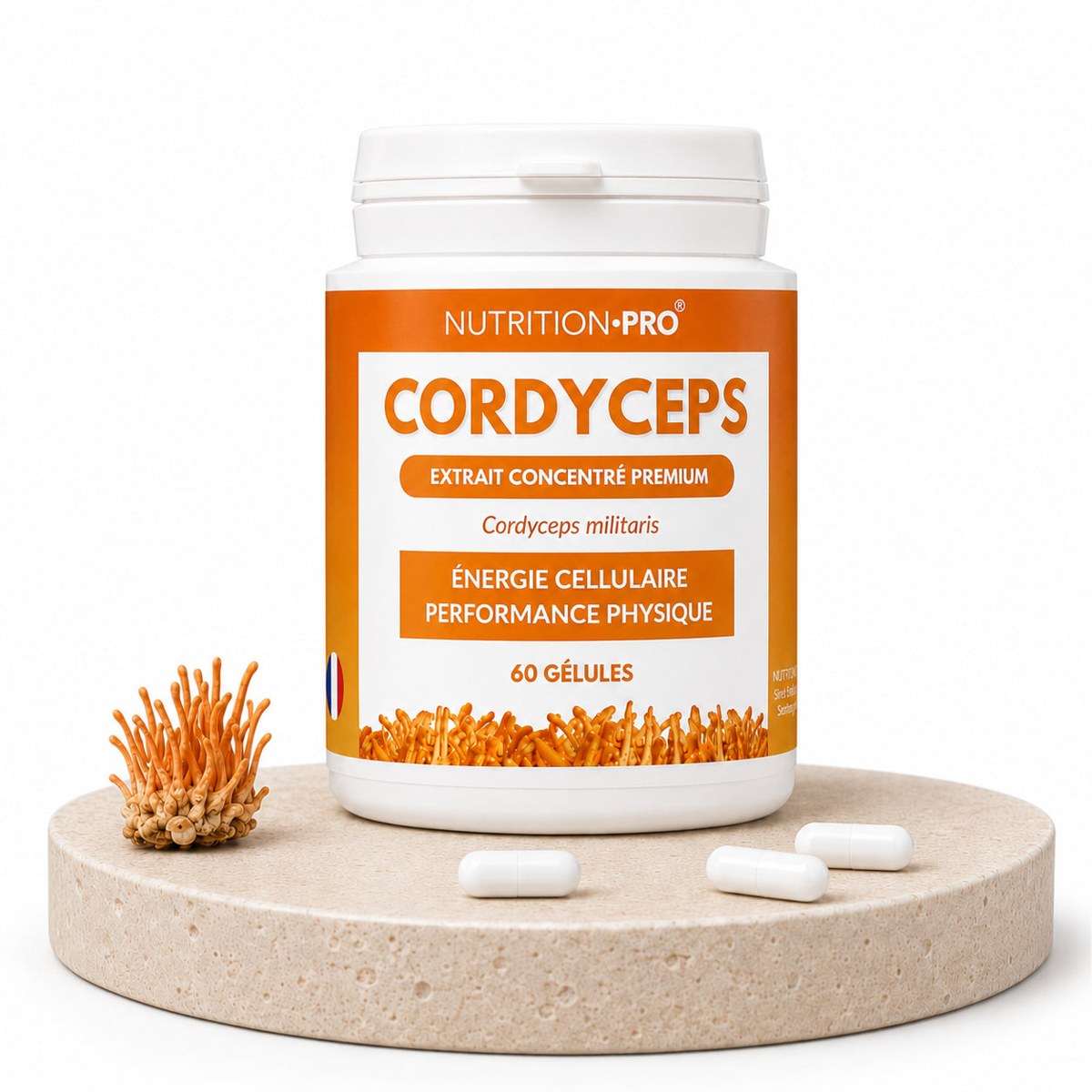
Nutrition•pro is a French brand based in Paris that makes its supplements in France. Its Cordyceps belongs to its functional mushroom range, alongside lion’s mane, reishi, chaga and shiitake. Its strengths:
- Cordyceps militaris, the most common cultivated form in supplements, a source of cordycepin;
- 4:1 concentrated extract: at this ratio, the 1,800 mg of extract per day match about 7 g of mushroom;
- single ingredient, in vegetable capsules, made in France;
- 60 capsules, a 30-day course at 2 capsules a day, in the morning or 30 to 60 minutes before exercise;
- €29.99 per bottle (price checked on 22/11/2026), about €1 a day.
Good to know: the 2025 meta-analysis mostly covers C. sinensis, and the C. militaris trials used other preparations and doses. Their results do not apply as such to this product, or to any other cordyceps supplement.
Promo code: SEOCONSULTINGSL for 10% off your order, €26.99 per bottle (as of 22/11/2026).
Partner link: we earn a commission if you order through this link, at no extra cost to you.
Our pick: Organic Cordyceps sinensis Dynveo (Dynveo) See the product → Partner link
Frequently asked questions
What are the benefits of cordyceps?
The best-studied is endurance: a 2025 meta-analysis found a small improvement in athletes with C. sinensis, but some trials found nothing. Other claims (energy, immunity, libido) rest mostly on tradition and lab studies.
What are the side effects of cordyceps?
Few were reported in trials. The main risk is contamination of the product, including heavy metals. Long-term safety is not well known.
Who should not take cordyceps?
Pregnant or breastfeeding women, and people with kidney disease, an autoimmune disease, a transplant or long-term medication should ask a doctor first.
Is the cordyceps from The Last of Us real?
The fungus exists, but it infects insects, mainly ants. It cannot infect humans, and supplements do not contain a living form able to infect.
When should I take cordyceps?
In the morning or before training, every day for several weeks, as in the positive trials. Avoid the evening if it keeps you awake.
Sources
- Shu MY. et al. Effects of fungal supplementation on endurance, immune function, and hematological profiles in adult athletes: a systematic review and meta-analysis. Front Nutr, 2025; 12: 1670416. PubMed 41280379
- Parcell AC. et al. Cordyceps Sinensis (CordyMax Cs-4) supplementation does not improve endurance exercise performance. Int J Sport Nutr Exerc Metab, 2004; 14(2): 236-42. PubMed 15118196
- Chen S. et al. Effect of Cs-4 (Cordyceps sinensis) on exercise performance in healthy older subjects: a double-blind, placebo-controlled trial. J Altern Complement Med, 2010; 16(5): 585-90. PubMed 20804368
- Hirsch KR. et al. Cordyceps militaris Improves Tolerance to High-Intensity Exercise After Acute and Chronic Supplementation. J Diet Suppl, 2017; 14(1): 42-53. PubMed 27408987
- Jedrejko M. et al. Current Evidence of Ergogenic and Post-Exercise Recovery Effects of Dietary Supplementation with Cordyceps militaris in Humans: A Narrative Review. Nutrients, 2026; 18(5): 781. PubMed 41829950
- Farzan H. et al. Acute Cordyceps militaris supplementation and elevated resting oxygen uptake with faster reaction times: A randomized crossover trial. PLoS One, 2026; 21(7): e0351725. PubMed 42455764
- Zhang HW. et al. Cordyceps sinensis (a traditional Chinese medicine) for treating chronic kidney disease. Cochrane Database Syst Rev, 2014; CD008353. PubMed 25519252
- Wu TN. et al. Lead poisoning caused by contaminated Cordyceps, a Chinese herbal medicine: two case reports. Sci Total Environ, 1996; 182: 193-5. PubMed 8854946
- Chen B. et al. Bioactive Metabolites and Potential Mycotoxins Produced by Cordyceps Fungi: A Review of Safety. Toxins, 2020; 12(6): 410. PubMed 32575649