Green tea: benefits, caffeine, weight loss and extract safety
The short answer
Brewed green tea is safe for most adults, and in large Japanese studies heavy drinkers had slightly lower death rates. Yes, green tea has caffeine: about 14 to 61 mg per cup, less than coffee, plus some L-theanine. For weight loss, a Cochrane review found only a tiny, clinically unimportant effect. The real concern is concentrated green tea extract: the European Food Safety Authority (EFSA) found that 800 mg or more of EGCG a day from supplements raises liver enzymes. Since EU Regulation 2022/2340, supplements sold in Europe must provide less than 800 mg of EGCG a day, and must not be taken on an empty stomach or during pregnancy.
This article is for information and does not replace medical advice. With liver disease, pregnancy, or heart or blood pressure medication, talk to your doctor before taking green tea extract.
What is green tea?
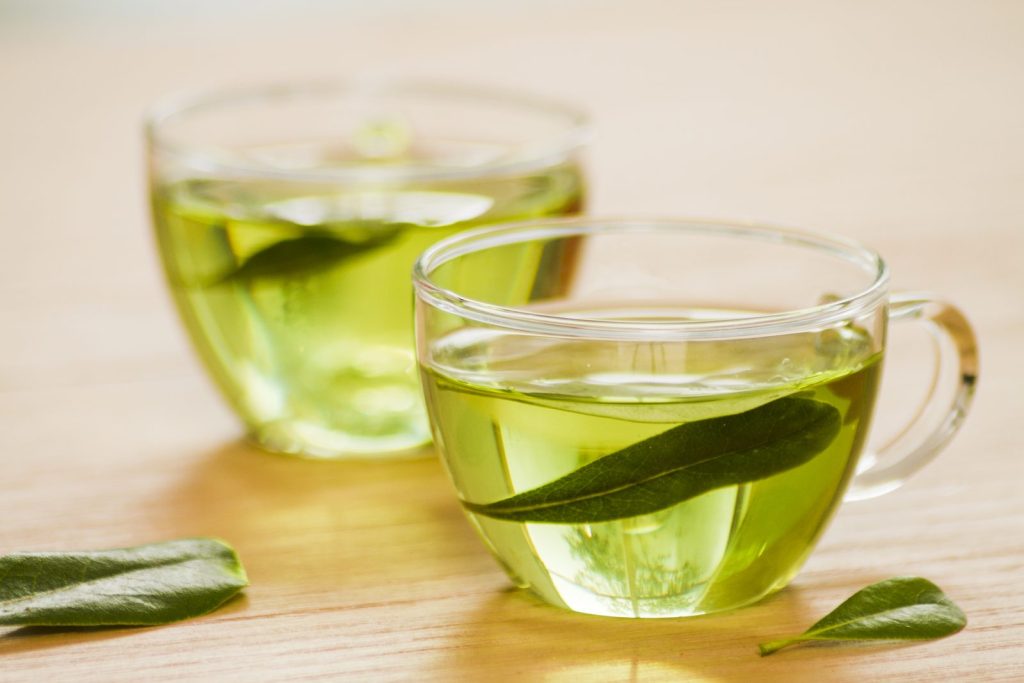
Green and black tea come from the same plant, Camellia sinensis. Green tea leaves are heated soon after picking, which stops oxidation and preserves their polyphenols as catechins, chiefly EGCG (epigallocatechin gallate). Sencha, gunpowder, jasmine tea and matcha are all green teas; matcha is a powdered leaf you drink whole, so it is more concentrated.
A plain cup has almost no calories: see our tea nutrition page.
| Compound | Measured amount |
|---|---|
| Caffeine | 14 to 61 mg per 6 or 8 oz cup, depending on the tea and steep time; about 16 mg per gram of brewed green tea leaves |
| L-theanine | About 6.6 mg per gram of brewed green tea leaves, highly variable |
| EGCG | 90 to 300 mg a day on average in European green tea drinkers; up to 866 mg in the heaviest drinkers |
Green tea benefits: what the evidence shows
Heart, blood pressure and longevity: modest links
- Mortality: across eight Japanese cohorts of 313,381 people followed for 17 years on average, drinking 5 or more cups a day was linked to a 10% lower risk of death in men and 18% in women versus less than one cup, mainly from heart disease and stroke (Abe et al., 2019). This is an association: tea drinkers may have other healthy habits;
- blood pressure: a meta-analysis of 36 randomized trials found a drop of about 1 mmHg in systolic and diastolic pressure (Rezaei et al., 2025). Real, but small and inconsistent.
Green tea for weight loss: the Cochrane verdict
| Trials | Weight loss vs control |
|---|---|
| 6 trials outside Japan (pooled) | 0.04 kg (about 0.1 lb), not significant |
| 8 trials in Japan (1,030 people, too different to pool) | 0.2 to 3.5 kg |
| Weight maintenance after dieting (2 trials) | No significant effect |
The authors concluded the effect is small, not significant and unlikely to be clinically important. Green tea helps only if it replaces sugary drinks. For what does work, see our guide to losing weight healthily.
Theanine, caffeine and focus
Green tea pairs caffeine with L-theanine, which may have a calming effect. In a Japanese randomized trial of 30 adults, 200 mg of L-theanine a day for 4 weeks improved stress, sleep and some cognitive scores (Hidese et al., 2019). At 6.6 mg per gram of leaves, you would need to brew around 30 g of tea to get that dose, so a cup does not reproduce a theanine supplement.
Green tea vs green tea extract: the liver question
What EFSA concluded in 2018
- Traditionally brewed tea is generally considered safe at the amounts drunk in Europe;
- rare liver injuries have been reported even with brewed tea, most likely an unpredictable individual reaction;
- supplements provide 5 to 1,000 mg of EGCG a day, and trials show that 800 mg of EGCG a day or more significantly raises liver enzymes (transaminases) compared with placebo.
A 2018 review written by employees of a supplement company (Hu et al.) agrees that liver problems cluster with concentrated products taken as large single doses, not brewed tea, and proposes 338 mg of EGCG a day as a safe level for capsules or tablets.
The EU rules on green tea extract
According to Sümer’s 2026 review, EU Regulation 2022/2340 requires foods and supplements with green tea extract to provide under 800 mg of EGCG per daily portion, and to warn against taking other green tea products the same day, use in pregnancy, breastfeeding or under 18, and use on an empty stomach. Concentrated EGCG taken while fasting reaches much higher blood levels. Sümer also notes that 800 mg is not a guarantee: rare serious liver injuries seem tied to individual susceptibility (a genetic marker, HLA-B*35:01, is associated with them). US products are not bound by these rules, so check the EGCG content on the label. Yellow skin, dark urine, severe fatigue or pain under the right ribs: stop the extract and see a doctor.
How much caffeine is too much?
EFSA considers up to 400 mg of caffeine a day safe for adults and 200 mg in pregnancy and breastfeeding; for children and teens, the benchmark is 3 mg per kilo of body weight a day. A few cups of green tea stay well below the limit, but caffeine adds up with coffee, soda and yerba mate. Our guide how much coffee per day helps you count. Late-day cups can disturb sleep if you are sensitive.
Interactions
- Nadolol (a beta-blocker): in 10 volunteers, 700 ml of green tea a day for 14 days cut blood levels of the drug by 85% (Misaka et al., 2014). On heart or blood pressure drugs, ask your doctor or pharmacist;
- pregnancy: the drink is fine if you count caffeine; avoid extracts;
- liver disease or heavy drinking: no extract without medical advice.
How to drink it
- Use hot but not boiling water and a short steep for a less bitter cup; longer steeping means more caffeine (Chin et al.);
- a few cups a day suit most adults, keeping total caffeine under 400 mg;
- if you are low in iron, drink it between meals;
- if you choose an extract, take it with food, do not combine green tea products, and stay far below 800 mg of EGCG a day.
Dynveo: an organic green tea extract dosed with caution
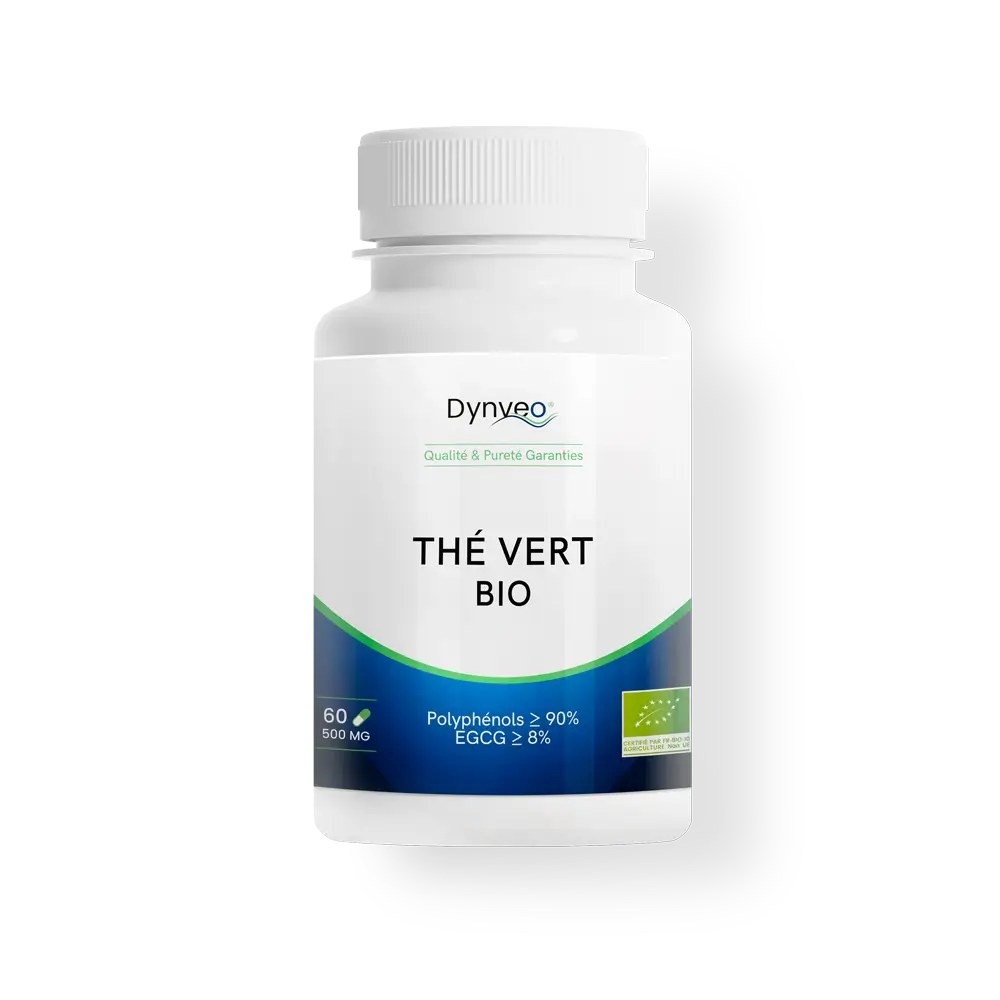
If you do not drink tea and want its polyphenols in capsules, Dynveo’s organic green tea extract stands out for one reason: its EGCG dose is ten times below the EU limit. The product page lists:
- 1,000 mg of extract per 2 capsules, with at least 900 mg of polyphenols, 240 mg of catechins and 80 mg of EGCG;
- caffeine capped at 6%, under 30 mg per capsule;
- a water-only extraction from hand-picked organic tea from Sri Lanka;
- 2 capsules a day with meals; 60 capsules, a 1-month supply;
- the EU warnings: not on an empty stomach, not with other green tea products the same day, not in pregnancy or breastfeeding, adults only; also not advised with stomach ulcer, heart problems or hyperthyroidism;
- batch certificates (contaminants, pyrrolizidine alkaloids, active content); the brand states French manufacturing in its quality charter;
- €20.90 per bottle (price checked on 22/11/2026), about €0.70 a day.
How does the dose compare? 80 mg of EGCG a day is less than an average green tea drinker gets from brewed tea according to EFSA (90 to 300 mg), and ten times below 800 mg. Caffeine stays under 60 mg a day, roughly one cup. That is a safety-first choice; the trade-off is that weight-loss trials often used higher doses for an already tiny effect, so do not expect a slimming effect. No study has tested this product. Dynveo ships from France; check delivery to your country.
See Dynveo Organic Green Tea →
Partner link: we earn a commission if you order through this link, at no extra cost to you.
Frequently asked questions
Is green tea good for you?
Yes for most adults: brewed tea is considered safe, has no calories, and is linked to slightly lower heart and stroke deaths in Japanese studies.
Does green tea have caffeine?
Yes, about 14 to 61 mg per cup depending on the tea and steep time; the researchers note most brewed teas contain less caffeine than brewed coffee.
Does green tea help you lose weight?
Barely: the Cochrane review found a non-significant, clinically unimportant loss.
Is green tea extract bad for your liver?
At 800 mg of EGCG a day or more, it raises liver enzymes, and rare serious injuries occur in susceptible people. Brewed tea is generally safe.
Matcha vs green tea: which is stronger?
Matcha, because you drink the whole leaf: more caffeine and catechins per serving. See our matcha guide for the numbers.
Sources
- EFSA ANS Panel. Scientific opinion on the safety of green tea catechins. EFSA Journal, 2018; 16(4): e05239. PubMed 32625874
- Sümer A. Fasting, Systemic Epigallocatechin-3-Gallate Exposure, and Hepatotoxicity. Int J Mol Sci, 2026; 27(21): 9420. PubMed 43027674
- Hu J. et al. The safety of green tea and green tea extract consumption in adults: results of a systematic review. Regul Toxicol Pharmacol, 2018; 95: 412-433. PubMed 29580974
- Jurgens T.M. et al. Green tea for weight loss and weight maintenance in overweight or obese adults. Cochrane Database Syst Rev, 2012; 12: CD008650. PubMed 23235664
- Abe S.K. et al. Green tea consumption and mortality in Japanese men and women. Eur J Epidemiol, 2019; 34(10): 917-926. PubMed 31392470
- Rezaei M. et al. Effect of green tea supplementation on blood pressure in adults. Blood Press, 2025; 34(1): 2517122. PubMed 40497293
- Chin J.M. et al. Caffeine content of brewed teas. J Anal Toxicol, 2008; 32(8): 702-4. PubMed 19007524
- Boros K., Jedlinszki N., Csupor D. Theanine and Caffeine Content of Infusions Prepared from Commercial Tea Samples. Pharmacogn Mag, 2016; 12(45): 75-9. PubMed 27019564
- Hidese S. et al. Effects of L-Theanine Administration on Stress-Related Symptoms and Cognitive Functions in Healthy Adults. Nutrients, 2019; 11(10): 2362. PubMed 31623400
- Misaka S. et al. Green tea ingestion greatly reduces plasma concentrations of nadolol in healthy subjects. Clin Pharmacol Ther, 2014; 95(4): 432-8. PubMed 24419562