Guarana: what it is, benefits, caffeine content, weight loss and side effects
The short answer
Guarana is the seed of an Amazonian vine and one of the most caffeine-rich plants: up to 6% caffeine in the seed, and often 8% to 12% in supplement extracts. Its energy boost comes mainly from that caffeine (sometimes called “guaranine”, but it is the same molecule). Studies show slightly faster reaction times, conflicting results for cancer-related fatigue, and no solid evidence that guarana alone helps weight loss. The real issue is stacking: guarana plus coffee, tea and energy drinks can quickly exceed the European Food Safety Authority (EFSA) benchmarks of 200 mg of caffeine at once and 400 mg a day for healthy adults, and 200 mg a day in pregnancy. If you have a heart rhythm problem, uncontrolled high blood pressure or anxiety, ask your doctor first.
This article is for information and does not replace medical advice.
What is guarana?
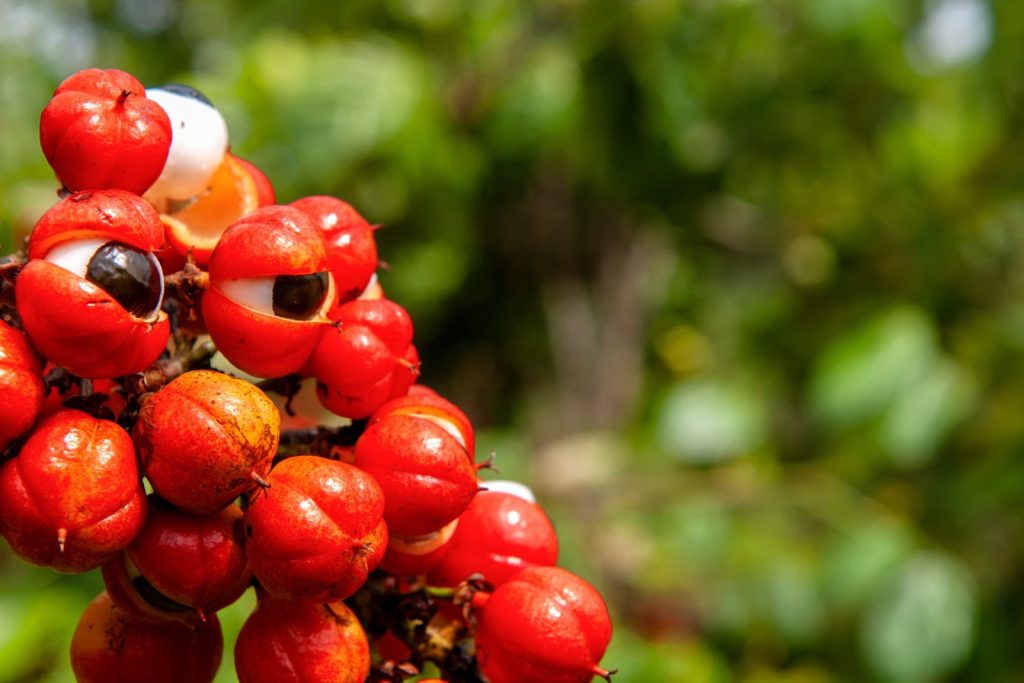
Guarana (Paullinia cupana) is a climbing vine from the Amazon basin, grown mainly in the Brazilian states of Amazonas and Bahia. Its red fruit splits open to show a black seed, which is roasted and ground. About 70% of the harvest goes into soft drinks and energy drinks; the rest becomes powder, capsules or ingredients for pharmaceuticals and cosmetics (Schimpl et al., 2013). Guarana sodas such as Guarana Antarctica are flavored soft drinks whose caffeine content varies: check the label.
Besides caffeine, the seed contains theophylline and theobromine (the milder stimulant in chocolate), plus tannins and catechins, antioxidants similar to those in green tea.
How much caffeine is in guarana?
It varies a lot. One extract in a study was about 12% caffeine (Kennedy et al., 2004); another delivered 130 mg of caffeine per 500 mg of guarana (Penna et al., 2024). Always look for milligrams of caffeine per serving, not just milligrams of guarana.
| Source | Caffeine (approx.) |
|---|---|
| 1 guarana capsule standardized to 8% (500 mg extract) | 40 mg |
| 1 espresso (60 ml) | 80 mg |
| 1 cup of filter coffee (200 ml) | 90 mg |
| 1 cup of black tea (220 ml) | 50 mg |
| 1 can of cola (355 ml) | 40 mg |
| 1 can of energy drink (250 ml) | 80 mg |
| 1 dark chocolate bar (50 g) | 25 mg |
EFSA caffeine limits
- healthy adults: up to 200 mg in one sitting (about 3 mg/kg) and 400 mg a day (about 5.7 mg/kg) from all sources;
- sleep: 100 mg close to bedtime can affect sleep in some adults;
- pregnancy and breastfeeding: up to 200 mg a day;
- children and teens: 3 mg/kg a day.
Example: 2 guarana capsules (80 mg) + 3 cups of filter coffee (270 mg) + 1 energy drink (80 mg) = 430 mg, above the daily benchmark. See how much coffee per day for other sources, and remember that yerba mate and matcha count too.
Guarana benefits: what the research shows
Energy and focus
A 2023 meta-analysis (Hack et al.) pooled 8 placebo-controlled trials with 328 people, using 37.5 to 500 mg of guarana (4.3 to 100 mg of caffeine). Overall, the effect on cognitive tests was “less than trivial”; guarana made responses slightly faster without making them more accurate. Whether this comes from caffeine or other compounds is unknown. An earlier UK trial in 28 young adults found better attention with 75 mg of extract providing just 9 mg of caffeine (Kennedy et al., 2004).
Exercise
In 11 endurance athletes, 500 mg of guarana (130 mg of caffeine) increased work during a 15-minute cycling time trial (241 vs 232 kJ on placebo). The authors called the effect “trivial to small” and could not say whether guarana beats the same dose of plain caffeine (Penna et al., 2024).
Cancer-related fatigue
- a crossover trial in 75 women on chemotherapy for breast cancer found less fatigue after 21 days with 50 mg twice daily (de Oliveira Campos et al., 2011);
- a 2021 meta-analysis (7 studies, 427 patients) found no difference from placebo in breast cancer, with very low-quality evidence (de Araujo et al., 2021);
- a 2024 meta-analysis (5 studies, 229 patients) found a benefit, but results were very heterogeneous and the authors include the team behind several of the trials (Maselli-Schoueri et al., 2024).
If this applies to you, talk to your oncology team first.
Guarana for weight loss: weak evidence
- the best-known trial gave guarana combined with ephedra (ma huang): 4 kg lost in 8 weeks vs 0.8 kg on placebo, but 23% of the active group dropped out due to side effects such as dry mouth, insomnia and headache (Boozer et al., 2001);
- ephedra-guarana products raised heart rate by about 9 beats per minute and systolic pressure by up to 11.5 mmHg in volunteers (Haller et al., 2005);
- a bitter orange, green tea and guarana blend (150 mg caffeine) did not increase energy expenditure in 20 overweight men (Sale et al., 2006).
We found no randomized trial of guarana alone for weight loss. For what actually works, see how to lose weight healthily.
Guarana side effects and safety
Side effects are those of caffeine: jitters, palpitations, insomnia, headache, stomach upset and frequent urination.
Heart health
- a meta-analysis of 17 trials found energy drinks raise systolic pressure by about 4.7 mmHg 60 to 80 minutes later and diastolic by 4.5 mmHg at 2 hours (Gualberto et al., 2024);
- a 44-year-old man who swallowed guarana extract containing 1.6 g of caffeine developed atrial fibrillation, helped by an undiagnosed heart muscle disease (Ciszowski et al., 2014).
Energy drinks often combine guarana, added caffeine, sugar and taurine. EFSA concluded that the other ingredients, at usual levels, do not change the safety of single caffeine doses up to 200 mg: total caffeine is what matters.
Guarana and the liver
The NIH LiverTox database states that at usual doses guarana has few side effects and has not been linked to liver injury. Multi-ingredient “fat burners” are harder to assess.
Who should avoid guarana
- people with heart rhythm problems, heart disease or uncontrolled high blood pressure;
- anxiety, insomnia, stomach ulcers or an overactive thyroid;
- pregnancy and breastfeeding (count it in the 200 mg limit; capsules are best avoided);
- children and teens; anyone on medication without asking a pharmacist.
How to take guarana
- Dose: think in caffeine. Alertness studies used 4 to 130 mg of caffeine from guarana. Stay under 200 mg at once and 400 mg a day from all sources.
- Timing: morning or early afternoon; avoid late in the day, since 100 mg near bedtime can disturb sleep.
- Duration: studies lasted from a few hours to 3 weeks; take breaks.
- Ongoing fatigue: a stimulant does not fix the cause. See our best supplement for fatigue comparison and our ginseng guide.
Dynveo: an organic guarana standardized to 8% caffeine
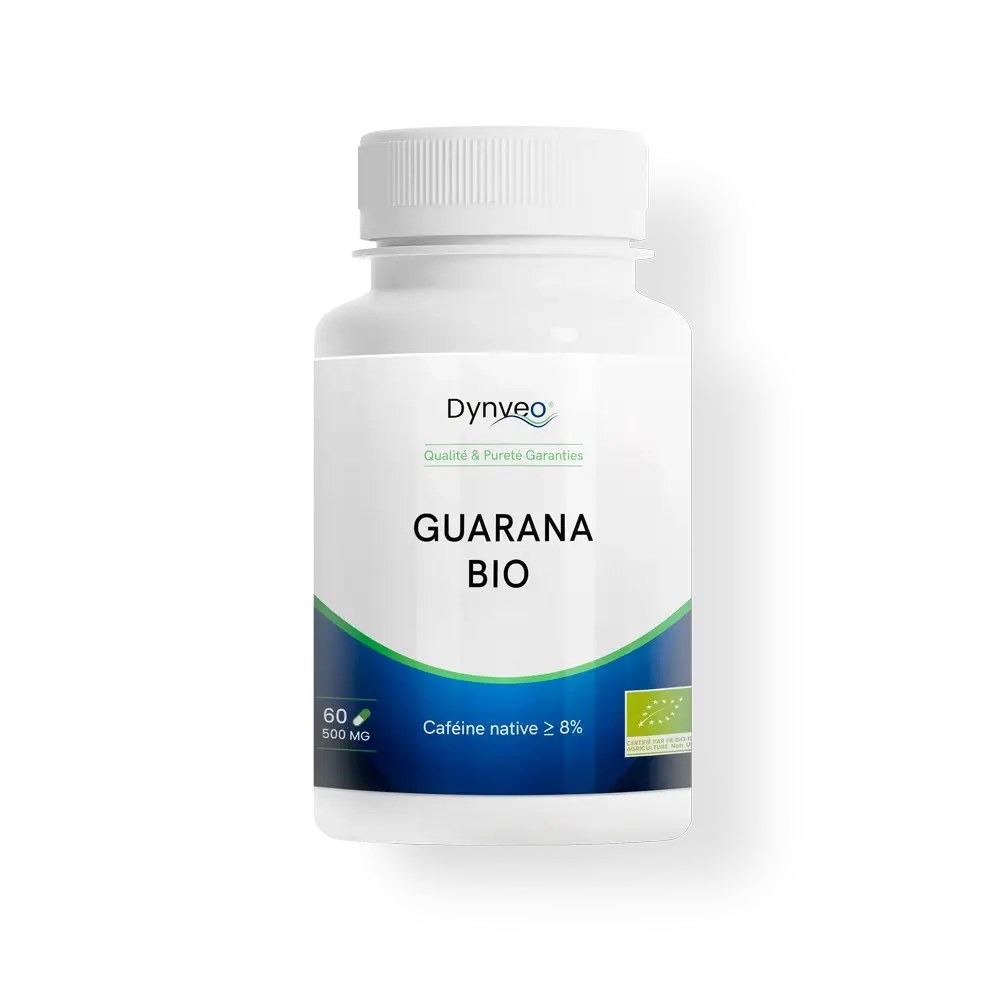
If you want guarana capsules, Dynveo’s Guarana BIO is clear about what matters most: the caffeine. The product page lists:
- an organic guarana seed extract as the only ingredient, in a plant-based capsule with no excipients or additives;
- standardized to 8% natural caffeine, no synthetic caffeine added: 40 mg of caffeine per 500 mg capsule, 80 mg for 2;
- caffeine content checked by HPLC, contaminant testing (microbes, heavy metals, residual solvents) and a batch certificate online; the brand says it packs the extract itself in Teyran, southern France;
- 1 to 2 capsules a day, morning and early afternoon, away from meals; 60 capsules, a 1 to 2-month supply;
- €22.90 per bottle (price checked on 22/11/2026), about €0.38 a day at 1 capsule or €0.76 at 2.
How does the dose compare? One capsule (500 mg extract, 40 mg caffeine) is within the range of the alertness trials and has half the caffeine of an espresso; two capsules stay under the 200 mg single-dose benchmark. The studies above did not test this exact product. Add this caffeine to your coffee and tea total. The page itself advises against it with ulcers, heart problems, overactive thyroid, pregnancy and breastfeeding, and reserves it for adults.
Partner link: we earn a commission if you order through this link, at no extra cost to you.
Frequently asked questions
What is guarana?
A seed from an Amazonian vine, very rich in caffeine, used in sodas, energy drinks, powders and capsules.
What are the benefits of guarana?
Mainly caffeine’s: more alertness and slightly faster reactions. Effects in studies are small, with nothing solid for memory or weight loss.
Does guarana have more caffeine than coffee?
Gram for gram, guarana seeds are very caffeine-rich, but what matters is the dose: one 8% capsule gives about 40 mg, half an espresso. Check the mg of caffeine on the label.
Is guarana safe?
For healthy adults, yes, if total daily caffeine stays under 400 mg. Avoid it with heart problems, anxiety, insomnia, in pregnancy and in children.
Is guarana in energy drinks bad for you?
It adds to the drink’s caffeine. Energy drinks raise blood pressure for a few hours; the risk grows with large amounts or alongside other caffeine.
Sources
- EFSA. Scientific opinion on the safety of caffeine (Q&A), 2015. efsa.europa.eu
- Schimpl F.C. et al. Guarana: revisiting a highly caffeinated plant from the Amazon. J Ethnopharmacol, 2013; 150(1): 14-31. PubMed 23981847
- Hack B. et al. Effect of Guarana (Paullinia cupana) on Cognitive Performance: A Systematic Review and Meta-Analysis. Nutrients, 2023; 15(2): 434. PubMed 36678305
- Kennedy D.O. et al. Improved cognitive performance in human volunteers following administration of guarana extract. Pharmacol Biochem Behav, 2004; 79(3): 401-11. PubMed 15582012
- Penna E.M. et al. Guarana but Not Low-Dose Caffeine Improves Cycling Time-Trial Performance Versus Placebo. Int J Sport Nutr Exerc Metab, 2024; 34(1): 30-37. PubMed 37898479
- de Araujo D.P. et al. Guarana as a dietary supplement for fatigue in cancer patients: a systematic review with a meta-analysis. Support Care Cancer, 2021; 29(12): 7171-7182. PubMed 34146166
- Boozer C.N. et al. An herbal supplement containing Ma Huang-Guarana for weight loss. Int J Obes Relat Metab Disord, 2001; 25(3): 316-24. PubMed 11319627
- Gualberto P.I.B. et al. Acute effects of energy drink consumption on cardiovascular parameters in healthy adults. Nutr Rev, 2024; 82(8): 1028-1045. PubMed 37695306
- LiverTox. Guarana. NIDDK, updated 2023. PubMed 36753599