Inositol (myo-inositol): benefits for PCOS, pregnancy, side effects and dosage

The short answer
Inositol is a small sugar-like molecule your body makes and that you also get from grains, legumes and meat. Its main form, myo-inositol, is mostly studied in polycystic ovary syndrome (PCOS): meta-analyses show lower insulin and more regular cycles, but the 2023 international PCOS guideline review rates the evidence as limited and inconclusive. In pregnancy, it may lower the risk of gestational diabetes, with low-certainty evidence. It is well tolerated: mild digestive upset shows up mainly at high doses (12 g a day).
This article is for information and does not replace medical advice. With PCOS, trying to conceive, pregnancy, diabetes or an anxiety disorder, talk to your doctor, gynecologist or midwife before taking inositol, and never stop a prescribed treatment to replace it.
What is inositol?
Inositol is a sugar alcohol (polyol). Two forms matter in supplements: myo-inositol, the most abundant in the body and in food, and D-chiro-inositol (DCI), present in smaller amounts and often combined with myo-inositol in PCOS products (“myo and D-chiro inositol”). Myo-inositol acts as a messenger inside cells, notably for insulin signaling, which explains the interest in PCOS and gestational diabetes. It is not strictly a vitamin, since your body can make it.
Inositol for PCOS: what the meta-analyses show
| Meta-analysis | Trials | Main findings |
|---|---|---|
| Unfer et al., 2017 | 9 trials, 496 women | Lower fasting insulin and HOMA index; non-significant trend on testosterone; SHBG rose only after 24 weeks or more |
| Greff et al., 2023 | 26 trials, 1,691 women | Regular cycles 1.79 times as likely as on placebo; small drops in BMI (-0.45), testosterone and glucose; not inferior to metformin on most outcomes |
| Fitz et al., 2024 (for the 2023 international guideline) | 30 trials, 2,230 women | Possible benefit on some metabolic measures; evidence limited and inconclusive; metformin better for waist-hip ratio and hirsutism |
Why the differences? Trials are often small, with varied doses and durations, and some authors work for manufacturers, as do some authors of the 2017 analysis. The 2024 review advises women and clinicians to weigh this uncertainty in shared decisions. Inositol can be part of the conversation; it does not replace PCOS care.
Myo-inositol or myo and D-chiro inositol?
The 2024 review found possible metabolic benefits for both myo-inositol and DCI, and a possible benefit of DCI on ovulation. The data don’t single out a winning form or ratio; myo-inositol alone remains the most studied.
Inositol and fertility
The Cochrane review (Showell et al., 2018: 13 trials, 1,472 women with PCOS, mostly before IVF) rates the evidence as low to very low quality: it is uncertain whether myo-inositol increases live births or pregnancies. Diet and folic acid matter too: see diet and fertility before conception.
Inositol in pregnancy: gestational diabetes
The 2023 Cochrane review (Motuhifonua et al.) pooled 7 trials and 1,319 women who were 10 to 24 weeks pregnant. Myo-inositol may reduce gestational diabetes (risk ratio 0.53), high blood pressure in pregnancy (0.34) and preterm birth (0.35), but certainty is low to very low: small trials, six of seven in Italy, varied doses and start times, and no data on serious newborn outcomes or long-term child health.
A typical trial (D’Anna et al., 2013) gave 2 g of myo-inositol twice a day with folic acid to 110 women with a diabetic parent: 6% developed gestational diabetes versus 15.3% in the control group. A 2026 analysis by researchers in the field stresses that the right population, protocol and start time are not established, and long-term safety data for the child are limited. During pregnancy, take inositol only on your doctor’s or midwife’s advice. See our pregnancy diet guide.
Inositol for anxiety
Anxiety studies used much higher doses. In panic disorder, 12 g a day for 4 weeks reduced panic attacks more than placebo in 21 patients (Benjamin et al., 1995), and up to 18 g a day matched the antidepressant fluvoxamine in 20 patients (Palatnik et al., 2001). But a 2014 meta-analysis (4 anxiety trials, 70 patients) found no significant effect on anxiety, with a possible benefit in premenstrual dysphoric disorder (Mukai et al., 2014). These trials are tiny and old: don’t replace treatment with inositol. See also diet and stress management.
Inositol and weight loss
In women with PCOS, the 2023 meta-analysis found a BMI drop of 0.45 points versus placebo, about 2.7 lb for a 5’5″ woman; the 2024 review calls the BMI effect very uncertain. Outside PCOS, we found no solid trial showing inositol causes weight loss.
Inositol side effects and safety
A safety review (Carlomagno and Unfer, 2011) found that only the highest dose, 12 g a day, caused mild digestive effects: nausea, gas, diarrhea. In PCOS, myo-inositol likely causes fewer digestive side effects than metformin (Fitz et al., 2024).
| Situation | What to know |
|---|---|
| High doses (12 g and up) | Possible nausea, gas, diarrhea |
| Pregnancy | Encouraging trials, low certainty; only with medical advice |
| Diabetes medication (metformin, insulin) | Inositol acts on insulin signaling: tell your doctor so monitoring can be adjusted |
| Treated psychiatric condition | Studies used very high doses; no self-treatment, ask your psychiatrist |
Berberine and inositol: both are studied for blood sugar, but berberine has more drug interactions and is not advised in pregnancy: see berberine benefits and side effects and our best blood sugar supplements.
How much inositol per day?
- Most studied dose in women: 2 g of myo-inositol twice a day (4 g), as in the pregnancy trials.
- Duration: in PCOS, SHBG (a protein that binds testosterone) rose only after 24 weeks or more. Think months, not weeks.
- Timing: split morning and evening with water; the powder dissolves easily and tastes slightly sweet.
- The 12 to 18 g doses from anxiety trials are not for self-use.
Dynveo: pure myo-inositol powder or capsules
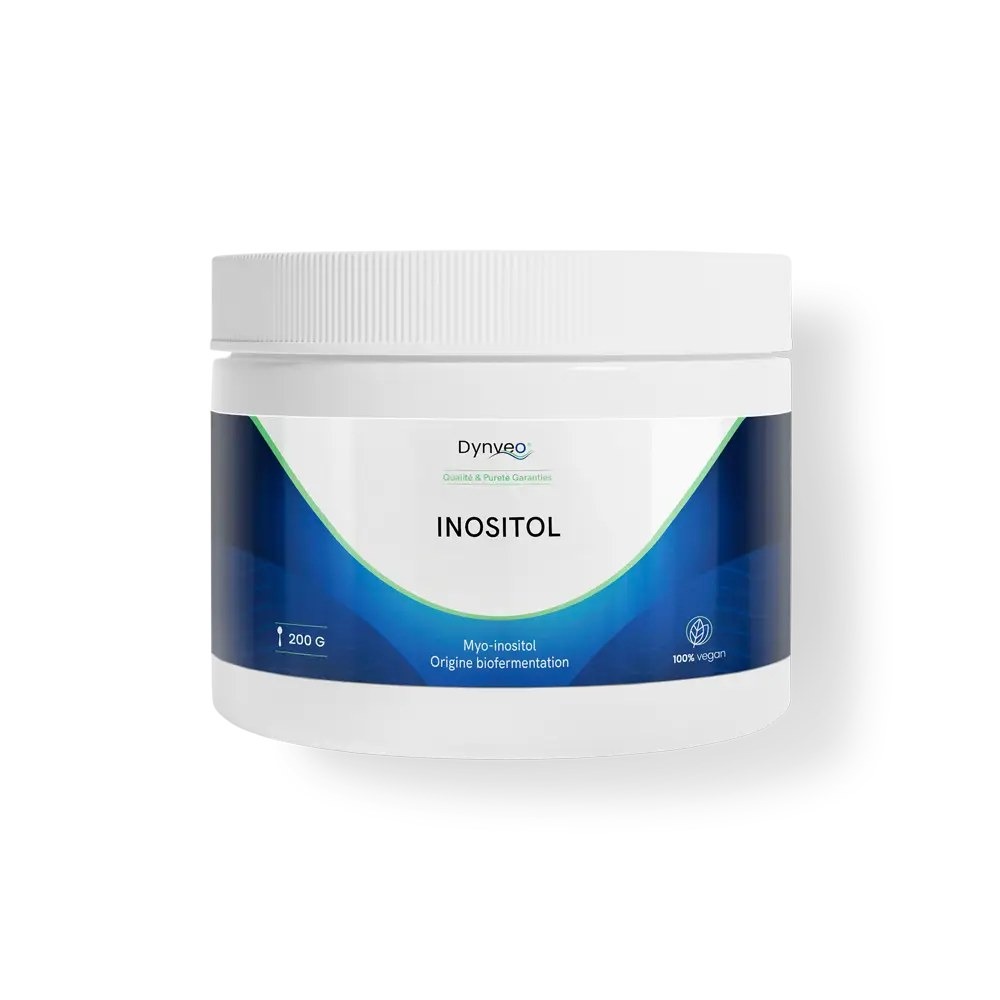
If your doctor agrees to a trial, Dynveo’s Myo-Inositol is a single-ingredient product that makes the studied dose easy to hit. Its label lists:
- 100% myo-inositol from fermented corn starch, solvent-free, no additives; purity checked by HPLC with published certificates of analysis per batch;
- two formats: 200 g powder (1 g per scoop included) or 150 vegetable capsules of 750 mg; vegan;
- directions: 1 to 2 g a day for general use, 3 to 4 g a day for women of childbearing age, split into two doses with meals;
- packed by the brand at its site in Teyran, France;
- €29.90 for the 200 g powder, 50 days at 4 g a day (about €0.60 a day); €24.90 for 150 capsules, 30 days at 5 capsules a day (about €0.83 a day); prices checked on 22/11/2026.
How does the dose compare? Four scoops give exactly the 4 g used in the gestational diabetes trials; five capsules give 3.75 g. At that dose, the powder is handier and cheaper per day. It contains no D-chiro-inositol and none of the folic acid used alongside it in some trials. The studies above did not test this product. The brand advises professional advice during pregnancy.
Partner link: we earn a commission if you order through this link, at no extra cost to you.
Frequently asked questions
What does inositol do?
It relays insulin and other signals inside cells. In women with PCOS, it improves insulin and cycle regularity in several meta-analyses, with limited evidence.
Is inositol good for PCOS?
It may help some metabolic markers and cycle regularity; the 2023 guideline review calls the evidence limited and inconclusive. Discuss it with your doctor.
What are the side effects of inositol?
Mainly mild digestive upset (nausea, gas, diarrhea) at 12 g a day. At 2 to 4 g, it is generally well tolerated.
Can you take inositol while pregnant?
It was given to pregnant women in several trials with no short-term warning signs, but long-term data on children are lacking. Only with medical advice.
Does inositol help with weight loss?
In PCOS, the effect is small (about -0.45 BMI points) and uncertain. Outside PCOS, there is no solid evidence.
Sources
- Unfer V. et al. Myo-inositol effects in women with PCOS: a meta-analysis of randomized controlled trials. Endocr Connect, 2017; 6(8): 647-658. PubMed 29042448
- Greff D. et al. Inositol is an effective and safe treatment in polycystic ovary syndrome: a systematic review and meta-analysis of randomized controlled trials. Reprod Biol Endocrinol, 2023; 21(1): 10. PubMed 36703143
- Fitz V. et al. Inositol for Polycystic Ovary Syndrome: A Systematic Review and Meta-analysis to Inform the 2023 Update of the International Evidence-based PCOS Guidelines. J Clin Endocrinol Metab, 2024; 109(6): 1630-1655. PubMed 38163998
- Showell M.G. et al. Inositol for subfertile women with polycystic ovary syndrome. Cochrane Database Syst Rev, 2018; 12: CD012378. PubMed 30570133
- Motuhifonua S.K. et al. Antenatal dietary supplementation with myo-inositol for preventing gestational diabetes. Cochrane Database Syst Rev, 2023; 2: CD011507. PubMed 36790138
- D’Anna R. et al. myo-Inositol supplementation and onset of gestational diabetes mellitus in pregnant women with a family history of type 2 diabetes. Diabetes Care, 2013; 36(4): 854-7. PubMed 23340885
- Lecis S. et al. Myo-inositol to prevent gestational diabetes: what do conflicting trials tell clinicians? Am J Obstet Gynecol, 2026. PubMed 42864184
- Benjamin J. et al. Double-blind, placebo-controlled, crossover trial of inositol treatment for panic disorder. Am J Psychiatry, 1995; 152(7): 1084-6. PubMed 7793450
- Palatnik A. et al. Double-blind, controlled, crossover trial of inositol versus fluvoxamine for the treatment of panic disorder. J Clin Psychopharmacol, 2001; 21(3): 335-9. PubMed 11386498
- Mukai T. et al. A meta-analysis of inositol for depression and anxiety disorders. Hum Psychopharmacol, 2014; 29(1): 55-63. PubMed 24424706
- Carlomagno G., Unfer V. Inositol safety: clinical evidences. Eur Rev Med Pharmacol Sci, 2011; 15(8): 931-6. PubMed 21845803