Folic acid: benefits, pregnancy dose, folate vs folic acid, methylfolate and side effects

The short answer
Folic acid is the synthetic form of vitamin B9 (folate). If you are planning a pregnancy or could become pregnant, it is the one supplement with rock-solid evidence: taken before conception and in early pregnancy, it cuts the risk of neural tube defects such as spina bifida by about 70%. The US Preventive Services Task Force recommends 0.4 to 0.8 mg (400 to 800 mcg) a day; in France, the official regimen is 0.4 mg a day, starting at least 4 weeks before conception and continuing 8 weeks after. Women with a previous affected pregnancy or on certain anti-seizure drugs need a different, higher dose set by their doctor. Outside pregnancy, a diet rich in leafy greens and legumes usually covers your needs. And too much folic acid can mask a vitamin B12 deficiency: the European safe upper limit is 1,000 mcg a day from supplements.
This article is for information and does not replace medical advice. If you are trying to conceive or pregnant, check any supplement with your doctor or midwife.
Folate vs folic acid vs methylfolate
- Folate is the natural form in food (leafy greens, legumes, liver, yeast);
- folic acid is a stable synthetic molecule used in supplements and medicines. Your body has to convert it before using it;
- methylfolate (5-MTHF, sold as Quatrefolic®, Metafolin® and others) is the form that circulates in the blood.
B9 is needed to make DNA and for cells to divide. That is why it matters so much in the first weeks of pregnancy, when the neural tube (the future brain and spinal cord) forms and closes, often before a woman knows she is pregnant. It is also needed to make red blood cells: deficiency causes anemia with large red cells, just like B12 deficiency.
A pharmacology review (Pietrzik et al., 2010) concludes that at equivalent doses, methylfolate is at least as effective as folic acid at raising blood folate and lowering homocysteine, with two possible advantages: less risk of masking B12 deficiency and fewer interactions with some drugs. In a crossover study of 24 adults (Obeid et al., 2020), a single 436 mcg dose of methylfolate (sodium salt) produced blood 5-MTHF levels about twice as high as 400 mcg of folic acid, and only folic acid briefly left “unmetabolized” folic acid in the blood. That study was run with a methylfolate manufacturer, used a single dose, and used a different salt from Quatrefolic®.
The bottom line for pregnancy: every trial that proved neural tube defect prevention used folic acid, in women not selected by genotype. Methylfolate is approved in Europe and raises folate levels well, but no trial shows it prevents these defects better, including in women with the much-discussed MTHFR gene variant. If you prefer methylfolate, check with your doctor or midwife that it fits your plan.
Folic acid in pregnancy: what the evidence shows
| Study | Who | Effect on neural tube defects |
|---|---|---|
| MRC Vitamin Study, 1991 | 1,817 women with a previous affected pregnancy, 33 centers in 7 countries | 72% lower risk (6 cases vs 21) |
| Czeizel and Dudás, 1992 | Women planning a (mostly first) pregnancy; multivitamin with 0.8 mg folic acid | 0 cases in 2,104 pregnancies vs 6 in 2,052 |
| Cochrane review, 2015 | 5 trials, 7,391 women | 69% lower risk (risk ratio 0.31), high-quality evidence |
The Cochrane review found the benefit did not depend on dose from 400 mcg a day upward. It found no clear effect on cleft lip or palate, heart defects or miscarriage.
How much folic acid should I take, and when?
- Planning or could become pregnant: 400 to 800 mcg of folic acid a day (USPSTF 2023, “high certainty” of substantial net benefit). France’s official label for 0.4 mg tablets: 1 tablet a day, covering at least the 4 weeks before conception and the 8 weeks after;
- Start early: as soon as you think about getting pregnant, since the neural tube closes very early and pregnancies are not always planned to the day;
- Higher doses (such as 5 mg tablets): only on medical advice, for women with a personal or family history of neural tube defects or on certain anti-seizure medications. Don’t double up on your own.
For the rest of your plate, see our guides on diet and fertility before conception and the pregnancy diet.
Folate-rich foods
| Food | Folate (mcg per 100 g) |
|---|---|
| Dried baker’s yeast | 2,340 |
| Calf liver, cooked | 592 |
| Sunflower seeds | 254 |
| Fresh parsley | 152 |
| Spinach, cooked | 125 |
| Chickpeas, cooked | 84 |
| Kidney beans, cooked | 78 |
| Avocado | 70 |
| Lentils, cooked | 50 |
Liver is very rich but also high in vitamin A, so ask before eating it in pregnancy. Folate is sensitive to heat and leaches into cooking water: steam, cook briefly and eat some raw greens every day. A spinach and chickpea soup or a red lentil dahl with spinach are easy wins. Still, food does not replace the supplement around conception: the trials gave folic acid on top of the diet.
Folic acid side effects and the risk of too much
At 0.4 mg, side effects are rare: allergic reactions (hives, swelling) and digestive upset, according to the French product label. Excess folic acid is mostly cleared in urine.
The real concern is masking B12 deficiency. B12 deficiency causes anemia and nerve damage. High doses of folic acid can correct the anemia, removing the warning sign, while the nerve damage continues. This is the effect the European Food Safety Authority (EFSA) used in 2023 to set the upper limit:
- 1,000 mcg a day for adults, including during pregnancy and breastfeeding;
- 200 mcg (ages 1 to 3), 300 mcg (4 to 6), 400 mcg (7 to 10), 600 mcg (11 to 14), 800 mcg (15 to 17);
- it covers combined folic acid and methylfolate salts from supplements and fortified foods, not natural food folate.
In older Americans with low B12, high blood folate was linked to 3 times more anemia and 2.6 times more cognitive impairment (Morris et al., 2007). It is observational, but consistent with EFSA’s caution. EFSA found the evidence insufficient to link folate to colorectal or prostate cancer or cognitive decline.
If you are vegan, older, or have tingling or unexplained fatigue, get your B12 checked before taking high-dose B9. See who needs B12 supplements and our best vitamin B12 supplement comparison.
Interactions: folic acid can lower blood levels of some anti-seizure drugs (phenobarbital, phenytoin, primidone), so your doctor may need to adjust them. Many drugs work by blocking folate: if you take long-term medication, show your supplement to your pharmacist.
Folate deficiency: signs and causes
True deficiency shows up on a blood test: anemia with large red cells and low serum or red-cell folate. It may cause fatigue, shortness of breath or pallor, none of which is specific. Alcohol, smoking, a diet low in greens and some medications raise the risk. Fatigue alone doesn’t justify a course: test B9 and B12 together, because their deficiencies look alike.
Novoma: a 400 mcg Quatrefolic® folate made in France
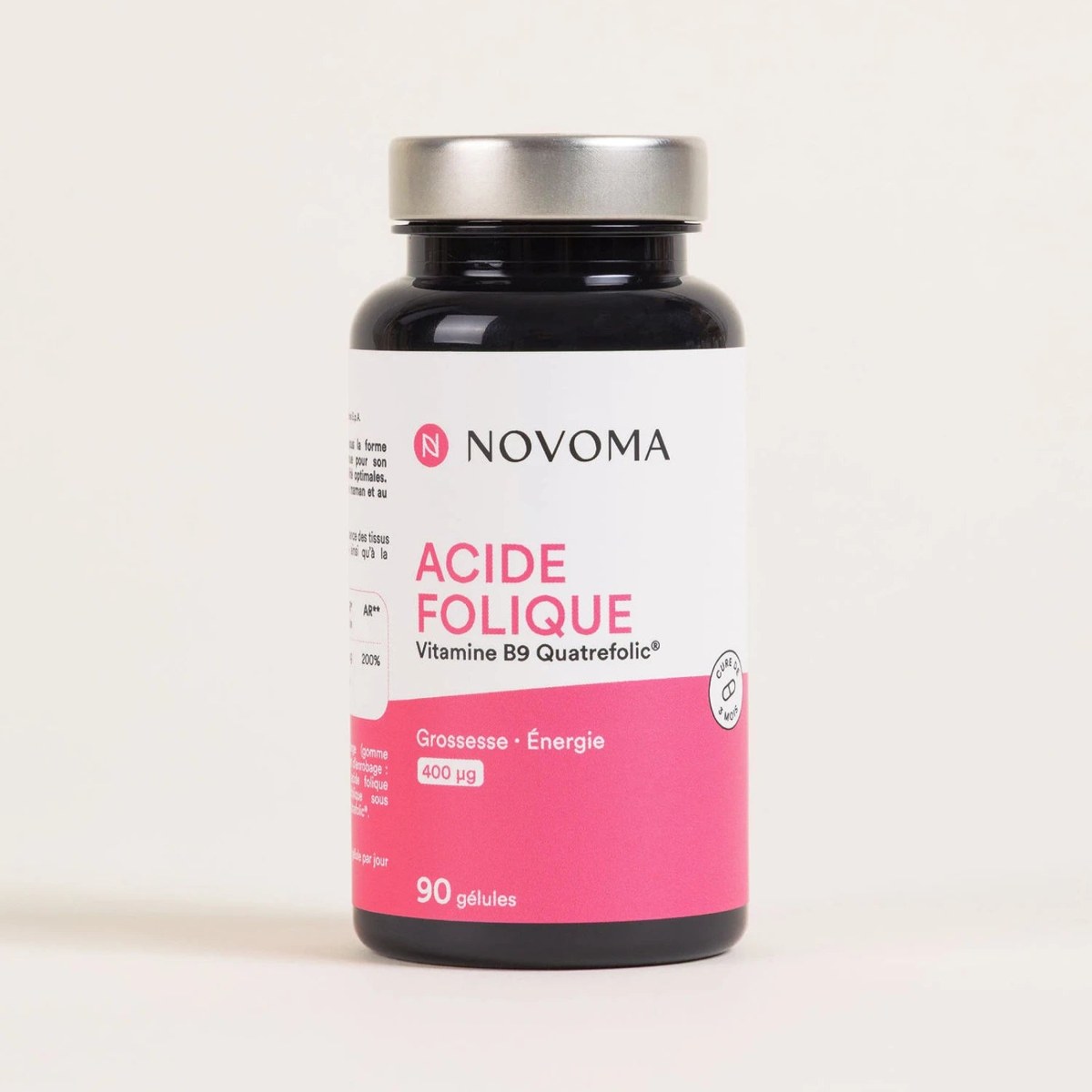
If your doctor or midwife is happy with the methylfolate form, Novoma’s Acide Folique keeps things simple: one active, at the reference dose, with clear directions. The product page lists:
- 400 mcg of folate per capsule as (6S)-5-methyltetrahydrofolate Quatrefolic® (sourced from Italy), 200% of the EU reference value;
- a very short formula: organic acacia fiber, plant capsule, Quatrefolic®; suitable for vegetarians and vegans;
- 1 capsule a day with a meal, from at least a month before conception to the end of the first trimester;
- 90 capsules, a 3-month supply; the product is made in France and a certificate of analysis can be downloaded;
- €12.68 per bottle (price checked on 22/11/2026), about €0.14 a day.
How does it compare? The dose matches the French label and the low end of the USPSTF range, well under the 1,000 mcg limit. The form is not the one used in the trials: methylfolate raises blood folate at least as well, but it has not been studied directly against neural tube defects, and this exact product has not been studied. If you have a history of neural tube defects or take anti-seizure medication, follow your doctor’s prescription instead.
Partner link: we earn a commission if you order through this link, at no extra cost to you.
Also considering inositol for PCOS or fertility? Our inositol guide reviews the evidence.
Frequently asked questions
What are the benefits of folic acid?
Its proven benefit is preventing neural tube defects when taken before and in early pregnancy (about 70% lower risk). It also treats folate deficiency anemia confirmed by a blood test.
What is the difference between folate and folic acid?
Folate is the natural form in food; folic acid is the synthetic, more stable form in supplements, which your body must convert. Pregnancy prevention trials used folic acid.
Is methylfolate better than folic acid?
It raises blood folate at least as well and may be less likely to mask B12 deficiency, but it has not been shown to prevent neural tube defects better. Discuss it with your doctor or midwife.
What are the side effects of folic acid?
Rare at 0.4 mg: allergy and digestive upset. Above 1,000 mcg a day from supplements, the main risk is masking B12 deficiency.
How much folic acid should I take before pregnancy?
400 to 800 mcg a day, starting at least 4 weeks before conception, unless your doctor prescribes a higher dose for a specific reason.
Sources
- De-Regil L.M. et al. Effects and safety of periconceptional oral folate supplementation for preventing birth defects. Cochrane Database Syst Rev, 2015; (12): CD007950. PubMed 26662928
- MRC Vitamin Study Research Group. Prevention of neural tube defects: results of the Medical Research Council Vitamin Study. Lancet, 1991; 338(8760): 131-7. PubMed 1677062
- Czeizel A.E., Dudás I. Prevention of the first occurrence of neural-tube defects by periconceptional vitamin supplementation. N Engl J Med, 1992; 327(26): 1832-5. PubMed 1307234
- US Preventive Services Task Force. Folic Acid Supplementation to Prevent Neural Tube Defects. JAMA, 2023; 330(5): 454-459. PubMed 37526713
- ANSM (France). Summary of product characteristics, folic acid 0.4 mg tablets, updated 09/02/2023. base des médicaments ANSM
- EFSA NDA Panel. Scientific opinion on the tolerable upper intake level for folate. EFSA J, 2023; 21(11): e08353. PubMed 37965303
- Morris M.S. et al. Folate and vitamin B-12 status in relation to anemia, macrocytosis, and cognitive impairment in older Americans. Am J Clin Nutr, 2007; 85(1): 193-200. PubMed 17209196
- Pietrzik K. et al. Folic acid and L-5-methyltetrahydrofolate: comparison of clinical pharmacokinetics and pharmacodynamics. Clin Pharmacokinet, 2010; 49(8): 535-48. PubMed 20608755
- Obeid R. et al. Pharmacokinetics of Sodium and Calcium Salts of (6S)-5-Methyltetrahydrofolic Acid Compared to Folic Acid. Nutrients, 2020; 12(12): 3623. PubMed 33255787