Saffron benefits: mood, sleep, side effects and supplement dosage
The short answer
Saffron (Crocus sativus) is one of the best-studied herbs for mood. A 2026 meta-analysis of 34 randomised trials found lower self-reported depression and anxiety scores, but no clear effect when clinicians did the rating. For sleep, several trials show a modest improvement. These benefits come from standardised extracts at 15 to 100 mg a day, not from the saffron in your spice rack. At those doses it is well tolerated; at high doses it lowers blood pressure and stimulates the uterus, so saffron supplements are not for pregnancy or breastfeeding.
This article is for information and does not replace medical advice. Depression needs proper care: never swap an antidepressant for saffron on your own.
What is saffron?
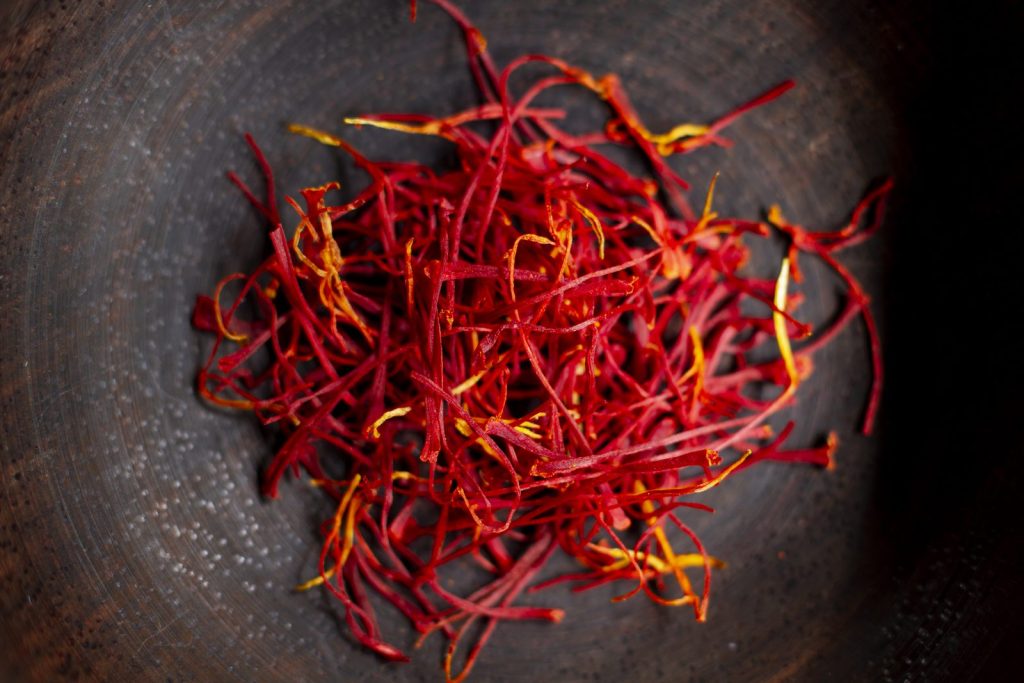
Saffron is the dried stigmas (the red threads at the centre of the flower) of the saffron crocus. Thousands of hand-picked flowers make just a few grams, hence the price. Our saffron food page covers its nutrition and kitchen uses.
Researchers focus on three compounds:
- crocin, the golden pigment;
- picrocrocin, behind the bitter taste;
- safranal, the aroma compound, studied for stress.
A saffron supplement usually contains a standardised saffron extract (set levels of crocins or safranal), so every capsule delivers the same amount. Saffron threads vary with origin and storage.
Saffron benefits for mood: what the meta-analyses show
The latest review (Mahmoudi et al., Nutritional Neuroscience, 2026) pooled 34 placebo-controlled trials with 1,769 adults, each lasting at least 4 weeks:
| Measure | Saffron vs placebo | Reading |
|---|---|---|
| Self-reported depression (Beck Depression Inventory) | -4.4 points (14 trials, 817 people) | Significant drop |
| Self-reported anxiety (Beck Anxiety Inventory) | -5.1 points (6 trials, 339 people) | Significant drop |
| Clinician-rated depression and anxiety (Hamilton scales) | No clear difference | No proven effect |
| General mood (POMS) | No clear difference | No proven effect |
The authors see saffron as a possible complementary option, but the lack of effect on clinician-rated scales means better trials are needed, and results varied widely between studies.
Another meta-analysis (Shafiee et al., Nutrition Reviews, 2025) compared saffron with SSRI antidepressants in 8 trials: no significant difference in depressive symptoms, and fewer side effects with saffron. Promising, but based on short, small trials: it is not a reason to stop prescribed treatment.
Without depression? In 128 healthy adults reporting low mood, a saffron extract (affron) at 28 mg a day for 4 weeks improved mood, stress and anxiety, while 22 mg did no better than placebo (Kell et al., 2017). Dose matters.
Saffron and stress: a fast effect?
In a crossover trial (Pouchieu et al., Nutrients, 2023), 19 young men took a single 30 mg dose of Safr’Inside extract, safranal alone or placebo 13 minutes before a lab stress test. With the extract and safranal, stress and anxiety felt lower than with placebo, and the cortisol peak came later. Interesting, but small, limited to young men, and funded by the extract maker. Food matters for stress too: see our guide on diet and stress management.
Saffron for sleep
A meta-analysis (Lian et al., Sleep Medicine, 2022) found better sleep with saffron: -2.1 points on the Pittsburgh Sleep Quality Index (0 to 21) and -2.6 points on the Insomnia Severity Index. In their analysis, 100 mg a day gave the most consistent effect.
- 66 adults with mild to moderate anxiety-related sleep problems: 15.5 mg of extract a day for 6 weeks improved time in bed (wrist sensor), ease of falling asleep and sleep quality (Pachikian et al., 2021);
- 165 adults with moderate insomnia: 20 or 30 mg of Safr’Inside for 4 weeks reduced insomnia symptoms slightly more than placebo (-0.95 points on a 0 to 24 scale) and lowered perceived stress (Schuster et al., 2025). The extract maker funded this study.
Bottom line: real but modest. Saffron is not a sleeping pill. See also foods that help you sleep and our best sleep supplement comparison.
Saffron and appetite
A French trial (Gout et al., Nutrition Research, 2010) followed 60 mildly overweight women for 8 weeks. Those taking a saffron extract (Satiereal, 176.5 mg a day) snacked less and lost more weight than placebo, without a set diet. It is a single trial, on a different extract from the one featured below, and has not been confirmed on a large scale.
Saffron in food vs saffron supplements: how much?
In cooking, a few threads flavour a whole dish, such as a paella. Great for taste, but each portion gets little, and the active content is unknown. Trials used precise doses:
| Form studied | Daily dose | Effect seen |
|---|---|---|
| affron extract | 28 mg (22 mg had no effect) | Mood, stress (4 weeks) |
| Safr’Inside extract | 20 or 30 mg | Insomnia, perceived stress (4 weeks) |
| Saffron extract | 15.5 mg | Sleep quality (6 weeks) |
| Saffron (sleep meta-analysis) | 100 mg | Most consistent sleep effect |
| Satiereal extract | 176.5 mg | Less snacking (8 weeks) |
An extract is not equivalent to the same weight of threads, so only compare doses between identical forms. Saffron tea is pleasant, but no trial has studied it for mood or sleep.
Saffron side effects, safety and who should avoid it
At supplement doses: well tolerated
Trials report few side effects, fewer than with SSRIs (Shafiee, 2025). A toxicology review (Bostan et al., 2017) concludes that therapeutic doses show no significant toxicity.
At high doses: blood pressure, blood counts, uterus
In 30 healthy volunteers (Modaghegh et al., 2008), 400 mg a day for one week lowered standing blood pressure and slightly reduced some blood values (red cells, platelets), while staying within normal ranges. That is 13 times a 30 mg supplement. The label of the product below also warns that above 1.5 g a day saffron can become toxic. You will not reach this in cooking, but do not double up on capsules.
Pregnancy and breastfeeding: avoid supplements
Saffron can stimulate uterine contractions. A study cited in Bostan’s review found more miscarriages among pregnant women heavily exposed to saffron during harvest, and a 2026 review (Alshdefat et al.) links high doses to uterine stimulation and miscarriage risk. Saffron supplements are therefore not for pregnancy or breastfeeding; a pinch in food is not a known concern. See our pregnancy diet guide.
Medications: ask your doctor
- antidepressants and anti-anxiety drugs: saffron targets the same symptoms and the combination is poorly studied;
- blood pressure drugs: high-dose saffron lowers blood pressure, which can add up;
- blood thinners: the slight drop in platelets at high doses calls for caution;
- bipolar disorder, severe depression or dark thoughts: not for self-treatment, see a professional.
How to take saffron supplements
- Dose: that of the studied extract, usually 20 to 30 mg a day for recent standardised extracts.
- Timing: most trials use one daily dose; for one-off stress, the 2023 trial gave it shortly before the stressful situation.
- Duration: 4 to 8 weeks in trials. Review after a month: if nothing changes, there is no point carrying on.
- Combining: saffron is often blended with other herbs. Our guides on rhodiola and 5-HTP cover their effects; avoid stacking several mood supplements without medical advice.
Nutrition•pro: Safr’Inside saffron at 30 mg
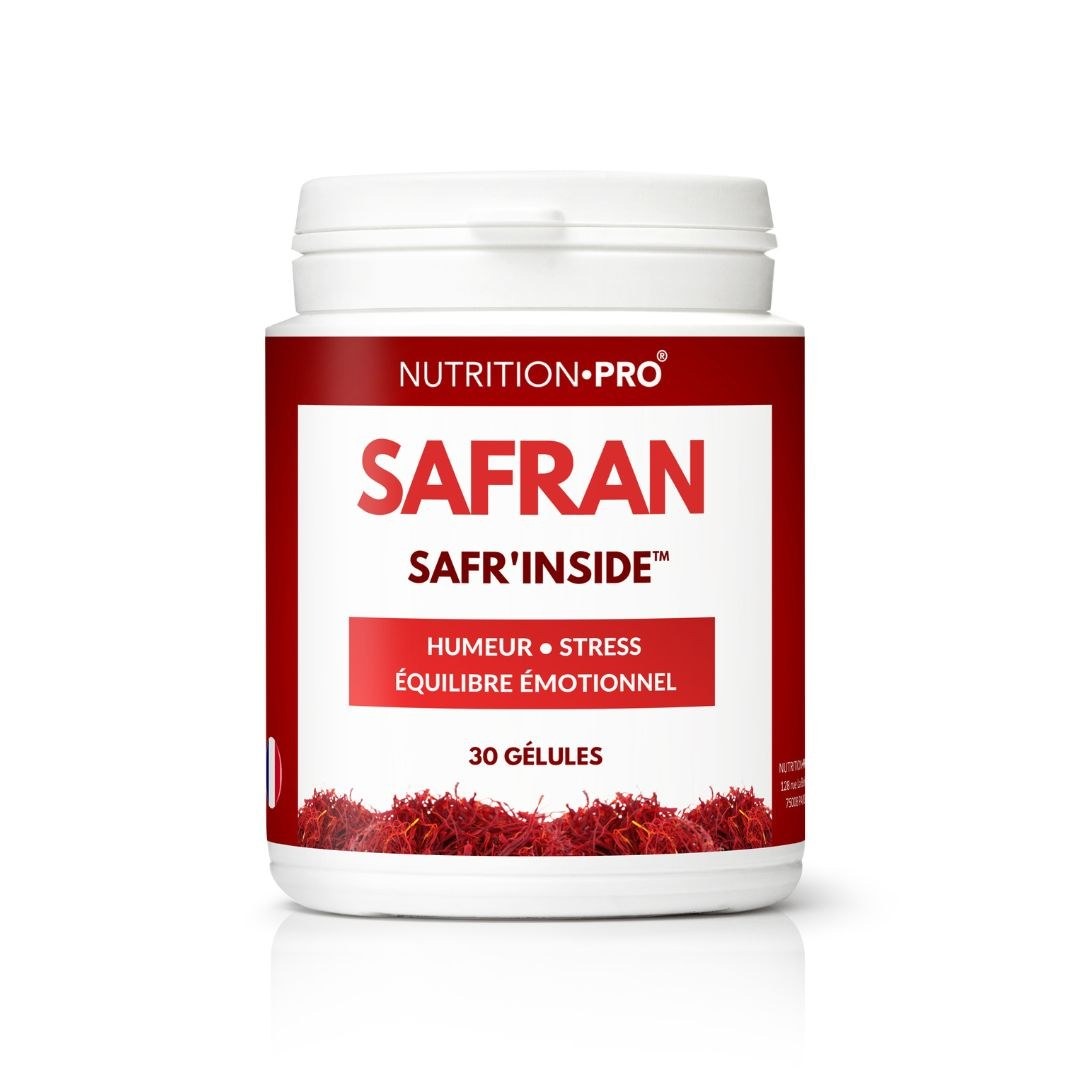
Nutrition•pro is a French brand based in Paris, which says it designs and makes its formulas in France. Its Saffron has a rare strength: it uses an extract backed by published trials.
- Safr’Inside: dry extract of Crocus sativus stigmas standardised in safranal, developed by the French lab Activ’Inside near Bordeaux;
- 1 capsule a day = 30 mg of extract, in the morning with a meal: exactly the dose used in the 2023 (stress) and 2025 (sleep) trials of this extract;
- single ingredient, vegetable capsule, free from gluten, lactose and preservatives; suitable for vegetarians and vegans;
- 30 capsules, a 30-day course (the brand suggests 1 to 3 months);
- €19.99 per jar (price checked on 22/11/2026), about €0.67 a day.
The brand also suggests a one-off capsule 30 minutes before a stressful event, matching the 2023 trial protocol. The depression and appetite studies above used other extracts or doses, so their results do not automatically apply here. The label lists sensible precautions: not for pregnant or breastfeeding women or children under 12, and ask your doctor if you take antidepressants, anti-anxiety drugs or blood thinners.
Promo code: SEOCONSULTINGSL for 10% off your order, €17.99 per jar, about €0.60 a day (as of 22/11/2026).
Partner link: we earn a commission if you order through this link, at no extra cost to you.
Our pick: Organic saffron Dynveo (Dynveo) See the product → Partner link
Frequently asked questions
What is saffron used for?
In the kitchen, for colour and flavour. As a supplement, mainly for mood, stress and sleep, where trials show modest benefits with standardised extracts.
What are the benefits of a saffron supplement?
Lower self-reported depression and anxiety scores, slightly better sleep and lower perceived stress in trials. One trial also found less snacking.
Is it safe to take saffron every day?
At supplement doses (20 to 30 mg of extract), trials of 4 to 8 weeks show good tolerance. Longer-term data are lacking, so keep to courses and the stated dose.
Who should not take saffron supplements?
Pregnant or breastfeeding women and children. Ask your doctor first if you take antidepressants, anti-anxiety drugs, blood thinners or blood pressure medication.
Does saffron in food have the same effect?
Nothing shows it: portions are small and the active content is not controlled. Trials used standardised extracts.
Sources
- Mahmoudi R. et al. Effect of saffron on depression, anxiety and mood disorder: a GRADE assessed systematic review and meta-analysis of 34 randomized controlled trials. Nutr Neurosci, 2026; 29(7): 816-837. PubMed 41693488
- Shafiee A. et al. Effect of Saffron Versus Selective Serotonin Reuptake Inhibitors (SSRIs) in Treatment of Depression and Anxiety: A Meta-analysis of Randomized Control Trials. Nutr Rev, 2025; 83(3): e751-e761. PubMed 38913392
- Kell G. et al. affron, a novel saffron extract (Crocus sativus L.) improves mood in healthy adults over 4 weeks. Complement Ther Med, 2017; 33: 58-64. PubMed 28735826
- Pouchieu C. et al. Acute Effect of a Saffron Extract (Safr’Inside) and Its Main Volatile Compound on the Stress Response in Healthy Young Men. Nutrients, 2023; 15(13): 2921. PubMed 37447245
- Lian J. et al. Effects of saffron supplementation on improving sleep quality: a meta-analysis of randomized controlled trials. Sleep Med, 2022; 92: 24-33. PubMed 35325766
- Pachikian B.D. et al. Effects of Saffron Extract on Sleep Quality: A Randomized Double-Blind Controlled Clinical Trial. Nutrients, 2021; 13(5): 1473. PubMed 33925432
- Schuster J. et al. Effect of a saffron extract on sleep quality in adults with moderate insomnia: a randomized, double-blind, placebo-controlled trial. Sleep Med X, 2025; 10: 100147. PubMed 40698027
- Gout B. et al. Satiereal, a Crocus sativus L extract, reduces snacking and increases satiety in a randomized placebo-controlled study of mildly overweight, healthy women. Nutr Res, 2010; 30(5): 305-13. PubMed 20579522
- Modaghegh M.H. et al. Safety evaluation of saffron (Crocus sativus) tablets in healthy volunteers. Phytomedicine, 2008; 15(12): 1032-7. PubMed 18693099
- Bostan H.B. et al. Toxicology effects of saffron and its constituents: a review. Iran J Basic Med Sci, 2017; 20(2): 110-121. PubMed 28293386
- Alshdefat A. et al. Saffron and Pregnancy: Cultural Practices, Beliefs, and Safety Evidence: An Integrative Review. J Evid Based Integr Med, 2026; 31. PubMed 42186868