Vitamin K2 (MK-7): benefits, foods, D3 and K2, and side effects with blood thinners
The short answer
Vitamin K2 (menaquinones, mainly MK-4 and MK-7) activates proteins that bind calcium in bone and help keep it out of artery walls. It is found in natto, aged cheeses, egg yolk and liver. As a supplement, the evidence is limited: one 3-year trial slowed bone loss after menopause, but other trials found nothing, and a large Danish trial found it did not slow aortic valve calcification. The main safety issue: with a vitamin K antagonist blood thinner such as warfarin, very small doses of K2 can lower your INR. If you take warfarin, do not take vitamin K2 without your doctor’s approval.
This article is for information and does not replace medical advice. If you take a blood thinner, have osteoporosis or heart disease, talk to your doctor or pharmacist.
What is vitamin K2?
Vitamin K is a family of molecules. Vitamin K1 (phylloquinone) comes from green vegetables; vitamin K2 covers the menaquinones, named MK-4 to MK-13 by the length of their side chain. They are mostly made by bacteria, which is why fermented foods contain them.
All of them help an enzyme activate so-called Gla proteins: clotting factors in the liver, osteocalcin in bone, and matrix Gla protein (MGP) in blood vessel walls, which slows calcification. That bone-and-arteries role is what vitamin K2 is taken for.
MK-7 vs MK-4
| MK-4 | MK-7 | |
|---|---|---|
| Source | Dairy and some meats | Natto (fermented soy), fermented foods |
| What we know | Used in Japan at pharmacological doses for osteoporosis | Very long half-life: stable blood levels, 7 to 8 times higher than K1 with ongoing use |
| Trial doses | Milligrams (Japanese drug) | 180 to 720 mcg a day |
Most K2 supplements use MK-7: it stays in the blood a long time, so low daily doses work. That is also why it has a stronger effect on clotting (see below).
How much do you need? The US Adequate Intake for vitamin K (all forms) is 120 mcg a day for men and 90 mcg for women. There is no separate target for K2, and no routine test for K2 deficiency.
Vitamin K2 benefits for bones: what studies show
A positive 3-year MK-7 trial
In the Netherlands, 244 healthy postmenopausal women took 180 mcg of MK-7 or a placebo for 3 years (Knapen et al., 2013). K2 slowed bone density loss at the lower spine and the femoral neck, but not at the total hip, and reduced height loss in some vertebrae. The authors say the results may not apply to men or other groups.
A negative trial in Norway
334 women in early menopause took 360 mcg of MK-7 (natto capsules) or a placebo for one year (Emaus et al., 2010). K2 activated osteocalcin but did not change bone loss at any site.
Fractures: weak evidence
A 2006 meta-analysis found large fracture reductions with MK-4, but all 7 trials were Japanese, and the integrity of some of that evidence was later questioned. The 2019 update (Mott et al., 36 trials) found no evidence of an effect on bone density or vertebral fractures in postmenopausal or osteoporotic women; an effect on other fractures is possible but unconfirmed.
| Trial | Dose and length | Result |
|---|---|---|
| Knapen 2013, 244 postmenopausal women | MK-7 180 mcg/day, 3 years | Slower bone loss (spine, femoral neck) |
| Emaus 2010, 334 postmenopausal women | MK-7 360 mcg/day, 1 year | No effect on bone loss |
| Mott 2019, meta-analysis of 36 trials | K1 or K2, various doses | No proven effect on density or vertebral fractures |
Calcium, vitamin D, protein and exercise remain the basics: see our guide to preventing osteoporosis and foods high in calcium.
Vitamin K2 and heart health: mixed results
The idea comes from the Rotterdam Study (4,807 people): those eating the most K2 had a 57% lower risk of dying from coronary heart disease (relative risk 0.43) and less aortic calcification (Geleijnse et al., 2004). But an observational study cannot prove K2 is the cause.
- Arterial stiffness: in the Dutch trial, 3 years of MK-7 (180 mcg) improved arterial stiffness, especially in women with the stiffest arteries (Knapen et al., 2015). That is a marker, not a prevented heart attack.
- Aortic valve: in 365 men aged 71 on average with a calcified valve, 720 mcg of MK-7 plus 25 mcg of vitamin D for 2 years did not slow calcification versus placebo (Diederichsen et al., 2022).
- Coronary arteries: in the same trial, coronary calcium progression was not significantly reduced (Hasific et al., 2023).
Bottom line: a plausible mechanism and encouraging observational data, but no trial has shown that K2 prevents heart attacks or strokes.
Vitamin D3 and K2: should you take them together?
Vitamin D increases calcium absorption; K2 activates the proteins that direct it to bone. Hence the many D3 + K2 products. The logic holds, but no trial has shown the combination beats vitamin D alone for fractures, and the one large trial of the combination was negative for the aortic valve. You can take them at the same time, with a meal containing some fat.
If you need vitamin D, that comes first: see our guide to vitamin D deficiency and supplements and our best vitamin D supplement comparison. A D3 + K2 product is an option, not a must, and should be avoided on warfarin.
Vitamin K2 side effects and who should not take it
Warfarin: the major interaction
Vitamin K antagonists (warfarin, and acenocoumarol or fluindione in Europe) thin the blood by blocking vitamin K. Taking extra vitamin K counteracts the treatment: INR drops and the clot risk rises.
- In volunteers on acenocoumarol, 10 mcg of MK-7 a day caused a clinically relevant INR drop in at least 40% of them, 20 mcg in at least 60%, and 45 mcg lowered INR by about 40% on average (Theuwissen et al., 2013). The authors conclude MK-7 supplements should be avoided with these drugs.
- Earlier work warned that 50 mcg a day or more of MK-7 may interfere with anticoagulant treatment in a clinically relevant way (Schurgers et al., 2007).
Most supplements provide 45 to 200 mcg per capsule, above these thresholds. On warfarin, do not start or stop vitamin K2 without your doctor, and keep your dietary vitamin K steady rather than cutting it out, as the Linus Pauling Institute advises (90 to 120 mcg a day). Direct oral anticoagulants (apixaban, rivaroxaban, dabigatran) do not work by blocking vitamin K, but still ask your doctor before adding any supplement.
Other side effects
According to the Linus Pauling Institute, no toxicity is known for high doses of K1 or K2, and no upper limit has been set; allergic reactions are possible. In the Danish trial, 720 mcg a day for 2 years did not cause more cardiovascular events or deaths than placebo. K2 does not make blood “too thick” in someone not on a blood thinner.
Pregnancy, breastfeeding, children: trials were in adults; ask your doctor or midwife first.
Vitamin K2 foods
K2 is found in meat, liver, butter, egg yolk, natto, cheese and curd cheese (Schurgers and Vermeer, 2000). After a natto meal, blood K2 rises about 10 times more than K1 after a spinach meal.
| Food | What it provides |
|---|---|
| Natto (Japanese fermented soy) | 998 mcg of MK-7 per 100 g: by far the richest source |
| Hard aged cheeses (Gouda, Comté, Emmental) | Main source of long-chain menaquinones in Western diets; richer than soft cheeses |
| Curd cheese, soft cheeses (Brie) | Moderate, highly variable |
| Egg yolk, butter, meat | MK-4, small amounts |
| Liver (beef liver) | Long-chain menaquinones (MK-7 to MK-13) |
Cheese content varies with type, ripening time, fat content and region (Vermeer et al., 2018). For sensible amounts, see how much cheese a day. Vitamin K1 comes from kale, spinach and broccoli; the body converts some of it to MK-4.
How to take vitamin K2
- Check your medicines first: on warfarin, no K2 without medical approval.
- Doses studied: 180 mcg of MK-7 a day for 3 years (positive bone trial), 360 mcg for 1 year (negative), 720 mcg with vitamin D for 2 years (negative for the aortic valve).
- Timing: vitamin K is fat-soluble: take it with a meal containing some fat.
- Duration: bone effects were measured after 2 to 3 years.
- Don’t stack: a D3 + K2 product, a multivitamin and a K2 supplement add up.
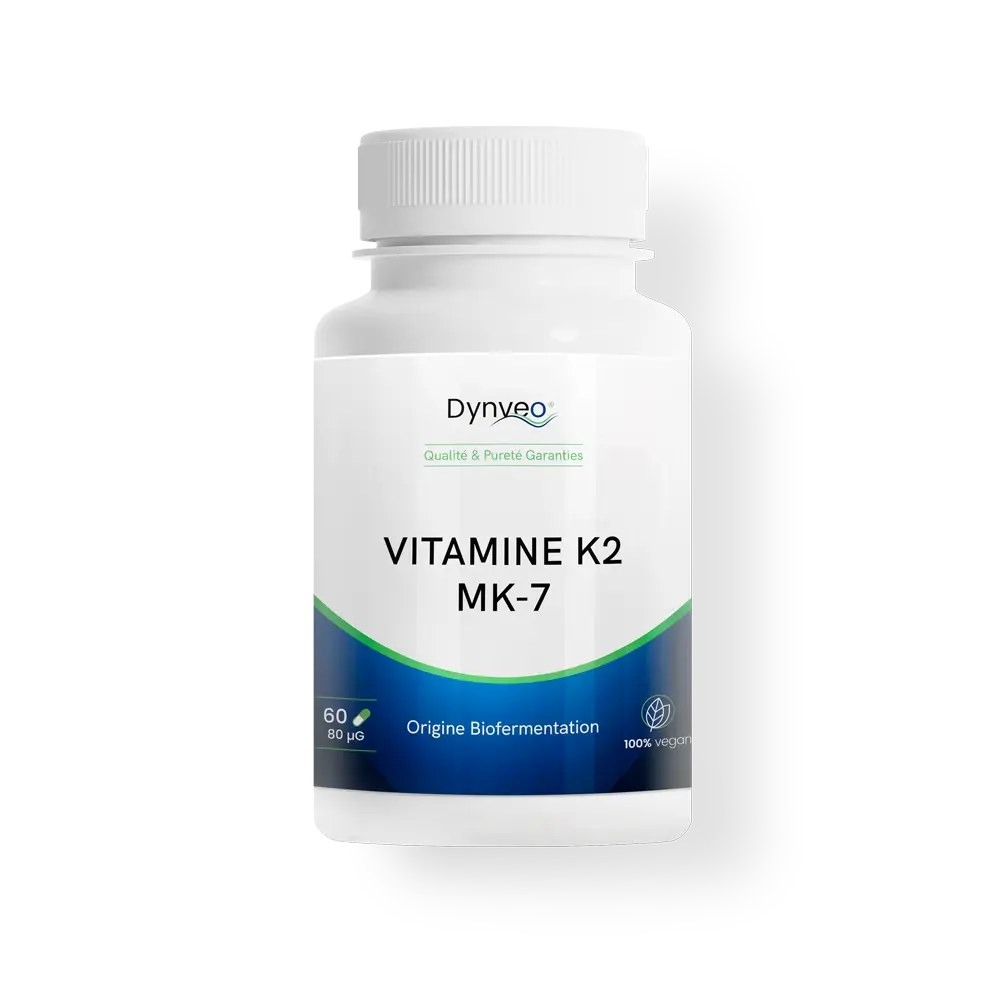
Dynveo: a pure 80 mcg vitamin K2 MK-7
If you want K2 on its own, to pair freely with your vitamin D or diet, Dynveo’s Vitamine K2 MK7 has a short, well-documented formula. Its product page lists:
- 80 mcg of vitamin K2 MK-7 per capsule, in the trans (active) form, made by fermenting chickpeas;
- menaquinone-7 purity stated above 96%, checked by HPLC on every batch;
- a short formula: acacia fiber and a plant capsule (pullulan), no additives, vegan;
- 1 capsule a day with a meal; 60 capsules, i.e. 2 months; adults only;
- Dynveo, a French lab, states French manufacturing as part of its “Clean Label” approach;
- €14.90 a jar (price checked on 22/11/2026), about €0.25 a day. Ships from France.
How does the dose compare? 80 mcg is less than half the 180 mcg of the Dutch bone trial: the product aims at a moderate daily intake rather than trial doses. The studies above did not use this product and do not guarantee its effect.
A strong point: the page clearly states the product is not recommended for people on anticoagulant treatment, in line with the research. During pregnancy or breastfeeding, the brand advises asking a health professional.
Partner link: we earn a commission if you order through this link, at no extra cost to you.
FAQ
What is vitamin K2 taken for?
Mainly bone and arterial health. One 3-year trial slowed bone loss after menopause, but other trials were negative, and no trial shows fewer heart attacks.
Should I take D3 and K2 at the same time?
You can, with a meal containing fat. But no trial shows the combination prevents more fractures than vitamin D alone, and it should be avoided on warfarin.
What are signs of K2 deficiency?
There is no routine test. Vitamin K deficiency mainly shows up as bleeding, which is rare in adults; the markers used in studies are research tools.
Who should not take vitamin K2?
People on warfarin or another vitamin K antagonist, unless their doctor agrees: as little as 10 to 20 mcg of MK-7 a day can lower INR. Ask first if you are pregnant or breastfeeding.
What foods are high in vitamin K2?
Natto (998 mcg per 100 g), hard aged cheeses, curd cheese, egg yolk, butter, meat and liver.
Sources
- Knapen M.H. et al. Three-year low-dose menaquinone-7 supplementation helps decrease bone loss in healthy postmenopausal women. Osteoporos Int, 2013; 24(9): 2499-507. PubMed 23525894
- Emaus N. et al. Vitamin K2 supplementation does not influence bone loss in early menopausal women: a randomised double-blind placebo-controlled trial. Osteoporos Int, 2010; 21(10): 1731-40. PubMed 19937427
- Mott A. et al. Effect of vitamin K on bone mineral density and fractures in adults: an updated systematic review and meta-analysis of randomised controlled trials. Osteoporos Int, 2019; 30(8): 1543-1559. PubMed 31076817
- Knapen M.H. et al. Menaquinone-7 supplementation improves arterial stiffness in healthy postmenopausal women. Thromb Haemost, 2015; 113(5): 1135-44. PubMed 25694037
- Diederichsen A.C.P. et al. Vitamin K2 and D in Patients With Aortic Valve Calcification: A Randomized Double-Blinded Clinical Trial. Circulation, 2022; 145(18): 1387-1397. PubMed 35465686
- Theuwissen E. et al. Effect of low-dose supplements of menaquinone-7 (vitamin K2) on the stability of oral anticoagulant treatment. J Thromb Haemost, 2013; 11(6): 1085-92. PubMed 23530987
- Schurgers L.J. et al. Vitamin K-containing dietary supplements: comparison of synthetic vitamin K1 and natto-derived menaquinone-7. Blood, 2007; 109(8): 3279-83. PubMed 17158229
- Geleijnse J.M. et al. Dietary intake of menaquinone is associated with a reduced risk of coronary heart disease: the Rotterdam Study. J Nutr, 2004; 134(11): 3100-5. PubMed 15514282
- Linus Pauling Institute, Micronutrient Information Center: Vitamin K. lpi.oregonstate.edu