Is Ginger Dangerous? Side Effects, Pregnancy, Medicines and Real Benefits
The short answer
Ginger is not dangerous in cooking, and it is well tolerated even at remedy doses. Its main drawback is digestive: heartburn, belching, nausea or discomfort, which the European Medicines Agency (EMA) classes as common at medicinal doses, meaning 1 to 10 people in 100. The EMA reports no known drug interactions, and one study with warfarin found no effect on blood clotting. Two precautions: as a remedy, the EMA prefers that it be avoided during pregnancy and advises against it during breastfeeding and under 18, except for motion sickness from age 6.
As for benefits, only one use is recognised as « well-established » by the EMA: preventing motion sickness. The others, digestion, colds, joint pain, rest on tradition, with studies showing modest results.
This article is for information only and does not replace medical advice.
Ginger in the kitchen and in the pharmacy
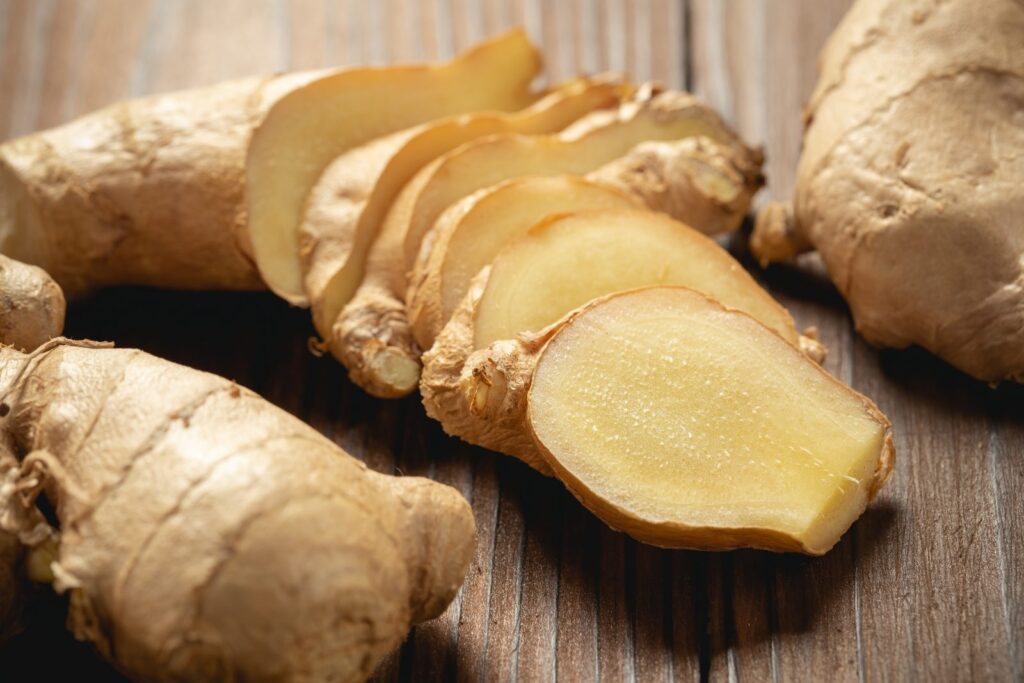
The ginger we eat is the rhizome, the underground stem of Zingiber officinale. It comes in three main forms:
- fresh, to grate or slice, full of water;
- dried and ground, as a powder, much more concentrated;
- in capsules, extracts or tinctures, sold as supplements or herbal medicines.
The question of danger is not the same for these three uses. A slice in a stir-fry has nothing in common with three capsules a day for weeks. That is why this article always separates culinary use from use as a remedy.
Fresh or ground: what it contains
| Per 100 g | Fresh ginger | Ground ginger |
|---|---|---|
| Water | 90.9 g | 9.9 g |
| Energy | 33 kcal | 335 kcal |
| Carbohydrate | 3.4 g | 58.3 g |
| Fibre | 2.7 g | 14.1 g |
| Protein | 1.1 g | 9 g |
| Potassium | 320 mg | 1,320 mg |
| Magnesium | 26 mg | 214 mg |
| Iron | 0.4 mg | 19.8 mg |
| Manganese | 7 mg | 33.3 mg |
These figures look impressive for the powder, but they have to be related to the amount actually eaten: ginger is used by the spoonful, not by the hundred grams.
| Portion | Weight | What it provides |
|---|---|---|
| 1 teaspoon ground ginger | 1.8 g | 6 kcal, 0.4 mg iron, 24 mg potassium |
| 1 teaspoon grated fresh ginger | 2 g | less than 1 kcal |
| 5 slices of fresh ginger, 2.5 cm in diameter | 11 g | 4 kcal, 35 mg potassium |
In short: ginger is a flavouring, not a significant source of nutrients. For details, see the pages on fresh ginger and ground ginger.
Fresh or dried, what is the equivalent? Fresh ginger contains about 91% water, the powder about 10%. In dry matter terms, 1 g of powder therefore corresponds roughly to 10 g of fresh ginger. This is an order of magnitude: drying also changes some compounds, and the EMA doses are expressed in dried rhizome powder.
What the European Medicines Agency says
In May 2025 the EMA revised its monograph on ginger rhizome used as a herbal medicine. It is the official European reference on its uses, doses and safety. It recognises six uses:
| Use | Status | Adult dose, rhizome powder |
|---|---|---|
| Prevention of nausea and vomiting from motion sickness | well-established use, based on studies | 1 to 2 g, 1 hour before departure |
| Relief of motion sickness | traditional use | 500 to 750 mg half an hour before, then every 4 hours if needed, up to 2.5 g a day |
| Bloating, wind, mild digestive problems | traditional use | 0.18 to 1 g, 3 times a day |
| Temporary loss of appetite | traditional use | 0.25 to 1 g, 3 times a day |
| Minor joint pain | traditional use | 0.25 to 1 g, 3 times a day |
| Cold symptoms | traditional use | 0.25 to 1 g, 3 times a day |
« Traditional use » means the EMA accepts it on the basis of long and well-documented use, without effectiveness having been shown in clinical trials. Only the prevention of motion sickness rests on enough studies to be described as « well-established » use.
In spoonfuls, with a teaspoon of ground ginger weighing 1.8 g: the 1 to 2 g dose against motion sickness corresponds to about half a teaspoon to one teaspoon, and the maximum of 2.5 g a day to a little less than one and a half teaspoons. These guides apply to pure powder; capsules state their dose on the packaging.
The monograph also sets durations beyond which you should see a doctor: 2 weeks for digestive problems and loss of appetite, 4 weeks for joint pain, 1 week for a cold. Joint pain with swelling, redness or fever should be examined by a doctor.
Side effects
The monograph lists a single group, all digestive, with a frequency described as common, between 1 and 10 people in 100:
- stomach ache;
- belching;
- difficult digestion;
- heartburn;
- nausea.
A paradox: ginger, taken against nausea, can itself cause it in some people. These effects relate to remedy doses; at culinary quantities they are rare.
A meta-analysis on osteoarthritis, pooling 5 trials and 593 patients, gives a concrete figure: patients taking ginger were 2.3 times more likely to stop the treatment than those on placebo. The authors still consider ginger « reasonably safe ».
No case of overdose has been reported. The only official contraindication is ginger allergy. If you have reflux or a sensitive stomach, it is therefore the quantity you need to watch: see also our guide on peppermint, another digestive herb that can make heartburn worse.
Ginger and medicines, including blood thinners
You often read that ginger « thins the blood » and would be dangerous with anticoagulants. The EMA, for its part, states no known interaction, for either the well-established use or the traditional use.
An Australian study published in 2005 tested the question directly: 12 healthy volunteers took ginger at the recommended doses for a week, then a dose of warfarin, then another week of ginger. Result: ginger changed neither the INR, the test that measures clotting, nor platelet aggregation, nor the elimination of the drug. Taken alone, it did not change clotting either.
This is still a small study, in healthy men, with a single dose of warfarin. If you take an anticoagulant and want to try a course of ginger capsules, talk to your doctor, as for any supplement; ginger on your plate poses no known problem. By comparison, turmeric is the subject of a warning from Anses (the French food safety agency) about anticoagulants.
Ginger and pregnancy: two opinions to know about
This is the most frequent question, because ginger is often recommended against nausea in early pregnancy.
| Source | What it says |
|---|---|
| EMA, 2025 | data on 300 to 1,000 pregnancies show neither malformation nor toxicity for the baby, but as a precaution it is preferable to avoid ginger as a medicine during pregnancy |
| French National College of Gynaecologists and Obstetricians (CNGOF), 2022 | for mild nausea, ginger can be used, even though there is no proof of benefit |
| Meta-analysis of 12 trials, 1,278 pregnant women, 2014 | ginger improved nausea compared with placebo, with no significant reduction in vomiting, and no significant risk identified |
These opinions do not contradict each other as much as it seems. The EMA reasons as a medicines authority: lacking sufficient animal studies, it applies the precautionary principle. The French gynaecologists reason as clinicians: faced with mild nausea, ginger is a low-risk option, to try before medicines. The 2014 meta-analysis also notes that doses below 1.5 g a day seemed enough for nausea.
The same French consensus states that more severe nausea needs medical care, with a severity score, the PUQE score, and suitable treatments. If you have repeated vomiting, weight loss or cannot drink, see a doctor without delay.
In practice: ginger in cooking is not a problem. For use against nausea, in capsules or concentrated herbal tea, ask your midwife or doctor for advice. See our guide to eating during pregnancy.
The benefits: what the studies really show
Ginger has a reputation for curing everything. Here is what the study reviews say, use by use.
| Use | What the studies show | Our reading |
|---|---|---|
| Motion sickness | well-established use for the EMA; in the laboratory, 1 to 2 g reduced induced nausea in 13 volunteers | 🟢 the best-supported use |
| Pregnancy nausea | improvement in nausea, not in vomiting, across 12 trials | 🟢 an option for mild nausea |
| Nausea after surgery | no significant difference from placebo at 1 g, across 3 trials | 🔴 not shown |
| Osteoarthritis | small reduction in pain and disability across 5 trials, but 2.3 times more drop-outs | 🟠 modest effect |
| Painful periods | reduced pain compared with placebo with 750 to 2,000 mg over the first 3 to 4 days | 🟠 encouraging results, small trials |
| Weight loss | about 1.5 kg less on average across 27 trials, low to very low certainty | 🟠 weak and uncertain effect |
Motion sickness
In an American double-blind study, 13 volunteers prone to motion sickness were exposed to a rotating visual stimulus that causes nausea. Taken beforehand, 1,000 or 2,000 mg of ginger reduced the nausea, delayed its onset and shortened recovery. An older German study showed that ginger did not act on the inner ear or the brain, unlike conventional motion sickness drugs: its effect would instead work through the stomach. The EMA also states that it has no effect, or a negligible one, on the ability to drive.
Osteoarthritis
The 2015 meta-analysis concludes there is a « modest » effect on pain and disability, with moderate-quality evidence. Another review, in 2020, limited to knee osteoarthritis and to low-quality studies, found insufficient evidence of improvement compared with placebo. Ginger therefore does not replace treatment for osteoarthritis.
Painful periods
Two meta-analyses, in 2015 and 2016, find reduced pain compared with placebo, and in two small trials, an effectiveness comparable to an anti-inflammatory, mefenamic acid. The trials are few and small: this is a lead, not a certainty.
Weight loss
The most recent review, in 2024, pools 27 trials and 1,309 participants: ginger supplements were associated with an average loss of about 1.5 kg, especially beyond 8 weeks and at around 2 g a day. But the authors judge the certainty of the evidence to be low to very low. Ginger is not a « fat burner »: 1.5 kg over several weeks is little, and uncertain.
The ginger traffic light
| Situation | Verdict | Why |
|---|---|---|
| Ginger in cooking, fresh or ground | 🟢 no problem | culinary quantities |
| Against motion sickness, adult | 🟢 recognised use | only well-established use for the EMA |
| Child aged 6 to 12, motion sickness | 🟢 possible | 250 to 500 mg half an hour before, up to 1.5 g a day |
| Child under 6, as a remedy | 🔴 not recommended | not enough data |
| Sensitive stomach, reflux | 🟠 go easy | heartburn is common at remedy doses |
| Pregnancy, as a remedy | 🟠 with medical advice | EMA cautious, French gynaecologists in favour for mild nausea |
| Breastfeeding, as a remedy | 🟠 not advised by the EMA | not enough data |
| Anticoagulant and ginger capsules | 🟠 talk to your doctor | no known interaction, but limited data |
| Ginger allergy | 🔴 contraindicated | only official contraindication |
Common myths about ginger
- « Ginger thins the blood »: the EMA reports no interaction, and the study with warfarin found no effect on clotting.
- « Ginger makes you lose weight »: the measured effect is small, about 1.5 kg on average, and the evidence is unreliable.
- « The more you take, the better »: beyond the EMA doses, you mainly increase the risk of heartburn, with no demonstrated benefit.
- « Ginger is forbidden during pregnancy »: no. In cooking there is no restriction; as a remedy, opinions differ but the available data show no malformation.
- « A ginger shot boosts immunity »: no study shows this. Colds are among the traditional uses, without enough clinical proof.
On your plate
Fresh, grated into a stir-fry, ground in a curry or infused as a herbal tea, ginger is eaten in small amounts, and that is how it stays risk-free. A few ideas:
- As an infusion: a few slices of fresh ginger in simmering water, left to steep for a few minutes, with a squeeze of lemon.
- In dishes: a grated piece added at the end of cooking a vegetable stir-fry or a broth.
- Ground: a pinch in stewed fruit, porridge or cake batter.
A few recipes on the site where it belongs: chicken noodle soup, homemade teriyaki sauce, bò kho, fish balls in coconut curry.
Frequently asked questions
Is ginger dangerous?
Not in cooking. At remedy doses, it can cause digestive problems, mainly heartburn, in 1 to 10 people in 100.
How much ginger a day?
At medicinal doses, the EMA allows up to 2.5 g of powder a day against motion sickness in adults, a little less than one and a half teaspoons, and 0.25 to 1 g three times a day for the other uses.
Does ginger thin the blood?
The EMA reports no known interaction, and one study found no effect on clotting with warfarin. If you are on anticoagulant treatment, tell your doctor about any course of capsules.
Can you eat ginger when pregnant?
Yes in cooking. As a remedy for nausea, French gynaecologists accept it for mild nausea, whereas the EMA prefers to avoid it as a precaution: ask your midwife for advice.
Does ginger cause heartburn?
Yes, it is one of its common side effects at remedy doses. Cut down the amount if so.
Is ginger suitable for children?
For motion sickness from age 6, yes, at a suitable dose. For other remedy uses, the EMA advises against it under 18.
Does ginger make you lose weight?
The measured effect is small, about 1.5 kg on average over several weeks of supplements, with unreliable evidence.
Does ginger make you sleepy or drowsy?
The EMA states that it has no effect, or a negligible one, on the ability to drive. One study found no effect on the inner ear, unlike conventional motion sickness drugs.
Fresh or ground ginger, which to choose?
For cooking, both work. For use as a remedy, the EMA doses are expressed in dried powder, about ten times more concentrated in dry matter than fresh ginger.
Our sources
- European Medicines Agency, HMPC. European Union herbal monograph on Zingiber officinale Roscoe, rhizoma. Revision 1, EMA/HMPC/885789/2022, 7 May 2025.
- Table Ciqual 2025 (Anses): gingembre, racine fraîche; gingembre, poudre.
- USDA, FoodData Central, SR Legacy: Spices, ginger, ground; Ginger root, raw (portion weights).
- Jiang X et al. Effect of ginkgo and ginger on the pharmacokinetics and pharmacodynamics of warfarin in healthy subjects. Br J Clin Pharmacol, 2005 (PMID 15801937).
- Deruelle P et al. Consensus formalisé d’experts du CNGOF : prise en charge des nausées et vomissements gravidiques et de l’hyperémèse gravidique. Gynecol Obstet Fertil Senol, 2022 (PMID 36150647).
- Viljoen E et al. A systematic review and meta-analysis of the effect and safety of ginger in the treatment of pregnancy-associated nausea and vomiting. Nutr J, 2014 (PMID 24642205).
- Lien HC et al. Effects of ginger on motion sickness and gastric slow-wave dysrhythmias induced by circular vection. Am J Physiol Gastrointest Liver Physiol, 2003 (PMID 12576305).
- Holtmann S et al. The anti-motion sickness mechanism of ginger: a comparative study with placebo and dimenhydrinate. Acta Otolaryngol, 1989 (PMID 2683568).
- Ernst E, Pittler MH. Efficacy of ginger for nausea and vomiting: a systematic review of randomized clinical trials. Br J Anaesth, 2000 (PMID 10793599).
- Bartels EM et al. Efficacy and safety of ginger in osteoarthritis patients: a meta-analysis of randomized placebo-controlled trials. Osteoarthritis Cartilage, 2015 (PMID 25300574).
- Araya-Quintanilla F et al. Effectiveness of ginger on pain and function in knee osteoarthritis. Pain Physician, 2020 (PMID 32214292).
- Daily JW et al. Efficacy of ginger for alleviating the symptoms of primary dysmenorrhea. Pain Med, 2015 (PMID 26177393); Chen CX et al., Evid Based Complement Alternat Med, 2016 (PMID 27274753).
- Rafieipour N et al. Ginger intervention on body weight and body composition in adults: a GRADE-assessed systematic review and dose-response meta-analysis of 27 randomized controlled trials. Nutr Rev, 2024 (PMID 38261398).