Group · Cereals & grains
Granola
Granola is a mixture of oat flakes, nuts and seeds, bound with a sweetening syrup and then baked until it forms crunchy clusters. It is this baking with a fat and a sweetener that sets it apart from a flaky muesli, and that explains its density.
In terms of nutrition facts: 450 kcal per 100 g, with 61.2 g of carbohydrate of which 17.2 g sugars, 16.5 g of fat and 10 g of protein. It provides 6.7 g of fibre, 93 mg of magnesium and 2.7 mg of iron per 100 g.

Macronutrient breakdown
Nutrition table per 100 g
| Calories | 450 kcal |
| Kilojoules | 1890 kJ |
| Protein | 10 g |
| Carbohydrate | 61,2 g |
| Fat | 16,5 g |
| Fibre | 6,7 g |
Micronutrients per 100 g
All measured nutrients, ranked by share of the daily reference intake.
- Manganese2,6 mg130 %
- Vitamin E13,7 mg114 %
- Phosphorus270 mg39 %
- Copper0,38 mg38 %
- Omega-6 LA3,68 g37 %
- Magnesium93 mg25 %
- Zinc2,3 mg23 %
- Vitamin B10,23 mg21 %
- Vitamin B9dietary folate equivalents24 µg
See the other 11 nutrients
- Iron2,7 mg19 %
- Potassium318 mg16 %
- Selenium7 µg13 %
- Vitamin B60,1 mg7 %
- Calcium44,5 mg6 %
- Vitamin K14 µg5 %
- Vitamin B50,24 mg4 %
- Omega-3 ALA0,08 g4 %
- Vitamin B20,05 mg4 %
- Vitamin B30,54 mg3 %
- Vitamin A9,25 µg1 %
Anses Ciqual 2025. Source: Anses, 2025, Ciqual food composition table
Tips
450 kcal per 100 g: the portion decides everything. A bowl filled to the brim easily weighs 80 g, or 360 kcal before the milk. Weigh it once, just once, to calibrate your eye: 40 g is already a generous portion.
The fat comes from nuts, and that is rather good news. 16.5 g of fat, but only 2.65 g saturated fatty acids: most of it comes from almonds, nuts and seeds. That is a much more favourable profile than a pastry with equal calories.
The sugar, on the other hand, deserves attention. 17.2 g per 100 g, almost always added in the form of honey or syrup. It is the first sorting criterion on the shelf: the gap between brands ranges from one to three.
Homemade, it costs three times less. Rolled oats, nuts, a spoonful of oil and one of honey, twenty minutes at 160°C, stirring. You control the sugar completely, and the result is better.
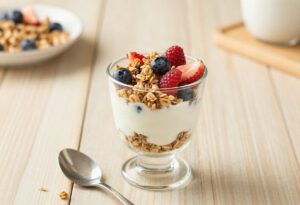
Eat it with a source of protein. On its own, even at 10 g of protein per 100 g, it does not last until lunch. On fromage blanc or plain yoghurt with red berries, it is a completely different breakfast.
Sources
Average nutritional values per 100 g, provided for guidance only (may vary by brand, cut and preparation).