Group · Meat
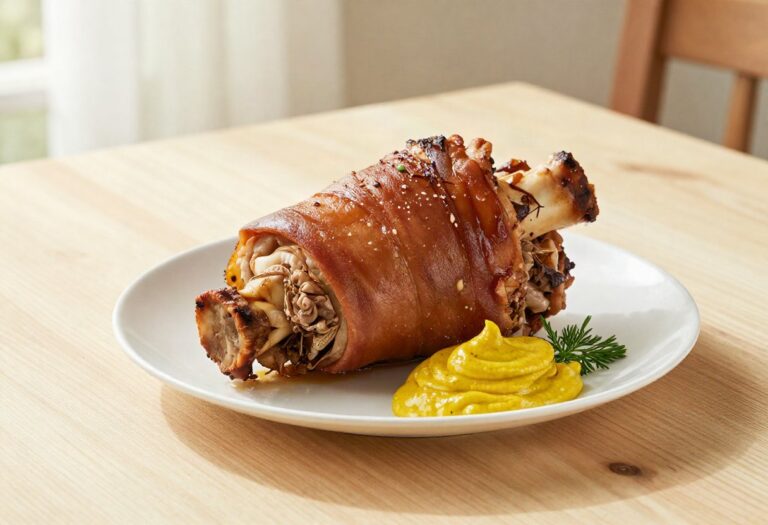
Cooked ham hock
Jambonneau (ham hock) is the lower part of the ham, around the shank. Sold cooked and pressed in jelly, it is a popular, inexpensive cold meat, and much leaner than most products at its counter.
As for nutrition facts, cooked: 157 kcal per 100 g, with 20 g of protein and only 6 g of fat including 2.25 g of saturated fat. It provides 123 mg of phosphorus and 4.2 mg of vitamin B3 per 100 g, and contains 1.99 g of salt.
Macronutrient breakdown
Nutrition table per 100 g
| Calories | 157 kcal |
| Kilojoules | 658 kJ |
| Protein | 20 g |
| Carbohydrate | 5,5 g |
| Fat | 6 g |
| Fibre | 0,4 g |
Micronutrients per 100 g
All measured nutrients, ranked by share of the daily reference intake.
- Vitamin B21,81 mg129 %
- Vitamin B10,4 mg36 %
- Vitamin B34,2 mg26 %
- Vitamin B60,29 mg21 %
- Phosphorus123 mg18 %
- Vitamin B120,32 µg13 %
- Omega-6 LA0,56 g6 %
- Omega-3 ALA0,04 g2 %
Anses Ciqual 2025. Source: Anses, 2025, Ciqual food composition table
Tips
6 g of fat: one of the leanest cold meats in the database. Four times less than a rosette, five times less than a Morteau. With 20 g of protein, the ratio is very favourable.
1.99 g of salt remains the point of caution. A 60 g slice provides 1.2 g of salt, a quarter of the daily guideline. That is the limit of all cold meats, lean ones included.
The jelly is not fat. It is collagen in solution: it provides few calories and holds the product together. You can remove it, but with little nutritional benefit.
It counts towards the processed meat guideline. 150 g a week, all products combined, according to the Programme national nutrition santé. Its leanness does not exempt it: it is the salt and nitrites that are targeted.
Cold, in a salad, with mustard. Its firmness suits composed salads: with lentils, gherkins and a vinaigrette made with mustard, it makes a complete dish at low cost.