Group · Fruit
Apricot
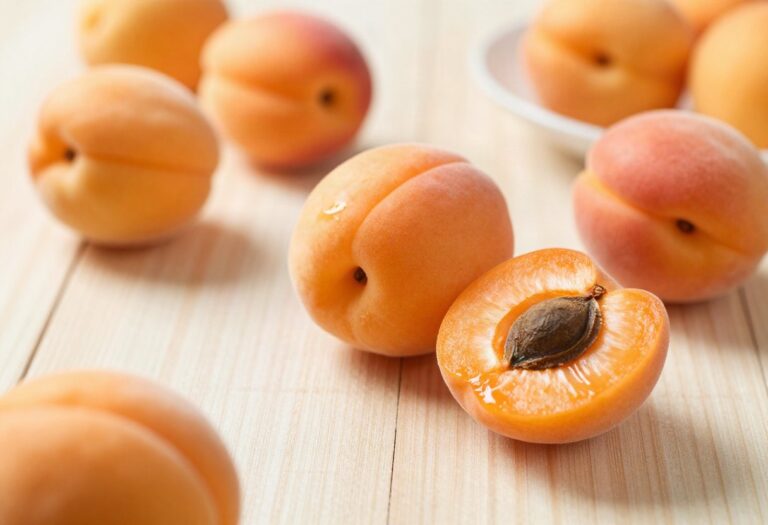
The apricot is an orange stone fruit, a member of the large Prunus family, like the peach, the plum and the nectarine. Fleshy, sweet and delicately fragrant, it is eaten mostly from May to August, in the height of summer. You can find it fresh at market stalls, but also dried, as jam or in syrup. Low in calories (around 44.1 kcal per 100 g), it fits easily into a varied, balanced diet. With 1.7 g of fibre and a good level of provitamin A (beta-carotene) and potassium, the apricot combines pleasure and nutritional value. It is a handy, compact fruit, ideal for a fresh, thirst-quenching snack when the warm days return.
Macronutrient breakdown
Nutrition table per 100 g
| Calories | 44 kcal |
| Kilojoules | 187 kJ |
| Protein | 0,9 g |
| Carbohydrate | 9,1 g |
| Fat | 0,4 g |
| Fibre | 1,7 g |
Micronutrients per 100 g
All measured nutrients, ranked by share of the daily reference intake.
- Vitamin A196 µg25 %
- Potassium260 mg13 %
- Copper0,06 mg6 %
- Vitamin E0,7 mg6 %
- Vitamin B60,05 mg4 %
- Manganese0,07 mg4 %
- Vitamin C2,55 mg3 %
- Vitamin B50,19 mg3 %
- Vitamin B9dietary folate equivalents7,6 µg
See the other 8 nutrients
- Phosphorus22 mg3 %
- Vitamin B10,03 mg3 %
- Magnesium8,4 mg2 %
- Calcium15 mg2 %
- Iron0,19 mg1 %
- Total omega-30,03 g1 %
- Vitamin B20,01 mg1 %
- Zinc0,09 mg1 %
Anses Ciqual 2025. Source: Anses, 2025, Ciqual food composition table
Tips
Choose apricots that are soft to the touch, with velvety, well-coloured skin: this is a sign of good ripeness and maximum flavour. A portion of 2 to 3 fruits (about 100 to 150 g) is enough to enjoy their nutritional value without overdoing it. Eat them plain, chopped into a yoghurt, blended into a smoothie, or lightly poached to keep their melting texture.
Nutritionally, the apricot provides carbohydrate (about 9.01 g per 100 g) in the form of natural, easily absorbed sugars, fibre that helps digestive comfort, plus potassium and provitamin A, the pigment responsible for its orange colour. Its glycaemic index stays moderate when eaten fresh and whole, with the skin on.
- Cooking: in a tart, a clafoutis or roasted in the oven with a drizzle of honey, the apricot develops more intense aromas. To keep vitamins and flavour, choose gentle cooking and keep it brief.
- Storage: at room temperature to finish ripening, then a few days in the fridge. You can also freeze them stoned.
- Pairings: almonds, fresh cheese, rosemary or poultry, in sweet and savoury recipes.
For sport, the apricot is a handy snack before or after exercise thanks to its carbohydrate and its potassium, which helps maintain fluid and mineral balance. For a more complete recovery, pair it with a source of protein: a few apricots with some fromage blanc make a simple, effective protein snack. Endurance athletes also appreciate the dried version, which is more concentrated in energy for long outings.
Be careful, though, with dried apricots, which are much denser in sugar and calories than the fresh fruit: enjoy them in small amounts if you are watching your weight. Prefer the fresh fruit, or compare its calories with other seasonal fruits such as the peach or the nectarine using our food calorie table.
To add variety and make the most of the benefits of fresh fruit, explore the whole fruit family and build a colourful, balanced plate every day.