Group · Vegetables
Rhubarb
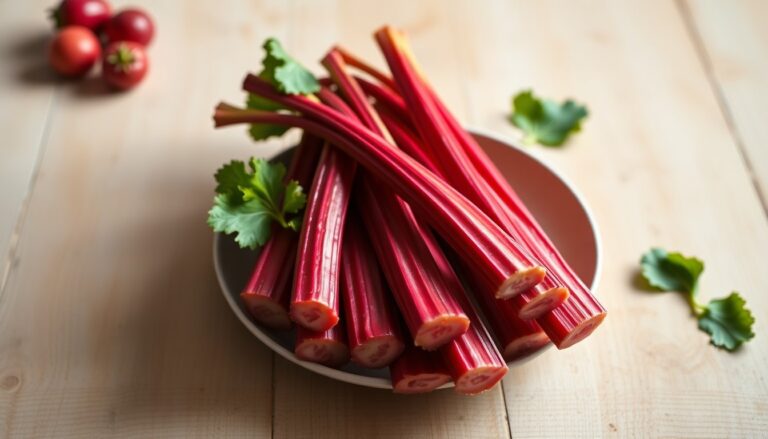
Surprisingly, rhubarb is botanically a vegetable, even though it is most often cooked like a fruit. It is the long, fleshy stalks (or petioles), ranging from green to pinkish red, that are eaten, as the leaves are not edible. With a very tart flavour, it suits sweet preparations (compotes, tarts, crumbles) as well as original savoury recipes. With only 18.8 kcal per 100 g, it is low in calories and rich in water. It provides fibre (2.3 g), a little carbohydrate (1.35 g) and very little fat. It is a useful ally of a balanced diet, as long as you watch the added sugar during cooking.
Macronutrient breakdown
Nutrition table per 100 g
| Calories | 19 kcal |
| Kilojoules | 79 kJ |
| Protein | 1 g |
| Carbohydrate | 1,4 g |
| Fat | 0,2 g |
| Fibre | 2,3 g |
Micronutrients per 100 g
All measured nutrients, ranked by share of the daily reference intake.
- Total omega-30,45 g18 %
- Potassium313 mg16 %
- Vitamin C9,85 mg12 %
- Calcium65,5 mg8 %
- Vitamin K15 µg7 %
- Vitamin B60,05 mg4 %
- Manganese0,07 mg4 %
- Phosphorus22,6 mg3 %
- Vitamin B9dietary folate equivalents70,8 µg
See the other 6 nutrients
- Copper0,03 mg3 %
- Magnesium10,5 mg3 %
- Vitamin E0,31 mg3 %
- Vitamin B50,07 mg1 %
- Vitamin B10,01 mg1 %
- Vitamin A3,5 µg0 %
Anses Ciqual 2025. Source: Anses, 2025, Ciqual food composition table
Tips
Rhubarb is harvested mainly in spring and early summer, from April to June. Choose firm, well-coloured stalks. Before cooking, remove the leaves (which are toxic) and, if needed, string the most fibrous stalks. It keeps for a few days in the fridge wrapped in a damp cloth, and freezes very well once cut into pieces.
As for nutritional values, rhubarb is valued for its very low calorie density and its fibre, which supports digestion and fullness. It also contains vitamin C, vitamin K and potassium. Its glycaemic index is low, but beware: its acidity often leads people to add a lot of sugar. For a lighter version, rely on gentle cooking with a little honey, vanilla or a natural sweetener, or combine it with a sweet fruit such as strawberry or apple.
- Compote and coulis: stew it with very little sugar, ideal on plain yoghurt or fromage frais.
- Tarts and crumbles: enjoy in moderation, as these desserts concentrate added calories.
- Savoury: as a chutney or tangy condiment to go with meat and fish.
To discover other low-calorie vegetables to include in your meals, browse the vegetables family. Rhubarb also works very well in fresh plates alongside raw fennel or as a complement to raw vegetables such as beetroot, whose sweetness balances its acidity.
For active people, rhubarb is not a major source of energy: low in carbohydrate and protein, it is not suitable as a snack before exercise. However, its fibre and water make it a refreshing dessert after training, to combine with a protein source (fromage frais, Greek yoghurt) to support recovery. If you are looking for more complete ideas, see our protein snack recipes.
In short, rhubarb is a weight-loss asset as long as you keep the sugar under control. Gentle cooking best preserves its qualities: discover our tips on gentle cooking for tasty, sensible preparations. Varied and original, it brings freshness to your diet without adding to the calorie count.