Resveratrol: proven benefits, side effects, bioavailability and dosage
The short answer
Resveratrol is a polyphenol found in black grape skins, peanuts and some berries, made famous by red wine and by ageing studies in animals. In humans, the picture is more modest: a large 2026 review found only four effects backed by high-certainty evidence, all small, such as lower blood pressure in people with diabetes and a slightly smaller waist. Its main weakness is very low bioavailability: it is well absorbed but almost immediately transformed by the gut and liver. It is well tolerated at usual doses, but it can interact with medicines. And no, it is not a reason to drink wine.
This article is for information and does not replace medical advice. If you take long-term medication, ask your doctor or pharmacist.
What is resveratrol?
Resveratrol belongs to the stilbene family. Grapevines make it to defend themselves against fungi and stress, which is why levels vary a lot depending on terroir, growing practices and winemaking (Bavaresco et al., 2016). It is found mainly in the skin of black grapes, and in small amounts in peanuts and some berries such as blueberries.
Trans-resveratrol vs cis-resveratrol
The molecule exists in two forms, “trans” and “cis”, which differ only in the orientation of one bond. Trans-resveratrol is the form used in most supplements and studies. On a label, a percentage (for example “trans-resveratrol 98%”) shows how pure the powder is.
Resveratrol and red wine: a bad trade
Resveratrol is often linked to the “French paradox” and red wine. But a glass provides far less than trial doses, and alcohol has its own harms, starting with a higher risk of several cancers. Drinking wine for resveratrol makes no sense: fresh black grapes provide it without alcohol. For everyday polyphenol sources, see our guide to antioxidant foods.
Resveratrol bioavailability: its weak spot
A US study traced labelled resveratrol in 6 volunteers (Walle et al., 2004). The result was a paradox: at least 70% of a 25 mg dose was absorbed, but only trace amounts of intact resveratrol reached the blood. Most of it is quickly converted by the gut and liver into sulfate and glucuronide forms. In a repeat-dose trial (Brown et al., 2010), these metabolites were up to 20 times more abundant than resveratrol itself.
A 2025 meta-analysis (Szymkowiak et al.) pooled 84 oral doses from 25 to 5,000 mg in healthy adults. The amount of free resveratrol reaching the blood rises with the dose, and medium doses of 100 to 500 mg give a peak close to the average across all studies. The authors consider these doses appropriate given bioavailability and a very low risk of side effects.
What this means: the striking effects seen in the lab, on cells bathed in pure resveratrol, do not carry over to what happens after a capsule. Some effects may come from the metabolites, but this is still debated.
Resveratrol benefits: what human trials show
The most complete summary so far (Sun et al., Nutrition Journal, 2026) pooled 45 systematic reviews of randomised trials. Of 129 associations, 35 were significant, but only 4 rest on high-certainty evidence:
| Effect (high certainty) | Population | Average effect |
|---|---|---|
| Systolic blood pressure | Type 2 diabetes | -7.97 mmHg |
| Diastolic blood pressure | Type 2 diabetes | -3.55 mmHg |
| Total cholesterol | Adults with overweight | -0.19 mmol/L (about -7 mg/dL) |
| Waist circumference | All trials | -0.80 cm (about 0.3 in) |
Other effects have moderate certainty: glucose metabolism, kidney function, blood vessel health, fatty liver, inflammation and working memory. These are leads, not certainties. The blood pressure drop in people with diabetes is the most meaningful result, but it does not replace treatment or diet: the DASH diet remains the foundation, along with foods to lower cholesterol.
Resveratrol for weight loss
A meta-analysis of 23 trials in 1,005 people with overweight (Setayesh et al., 2026) found no significant effect on weight, BMI or fat mass. Only waist size dropped, by about 2 cm (under 1 inch). It is not a weight-loss supplement.
Resveratrol, longevity and sirtuins
Resveratrol’s anti-ageing reputation comes from its effect on sirtuins, enzymes linked to ageing in yeast, worms and mice. In humans, a meta-analysis of 11 trials (Mansouri et al., 2025) found no significant effect on sirtuin 1, whether gene expression, protein or blood levels. No trial shows resveratrol extends human lifespan. Trendy pairings with NMN or NAD+ have no better evidence.
What about skin?
Resveratrol is widely used in skincare, applied directly to the skin. Data on skin effects from capsules are too thin to draw conclusions. These are two different uses.
Resveratrol side effects and safety
Well tolerated at usual doses
In the Brown trial (40 healthy volunteers, 29 days), resveratrol was well tolerated, but doses of 2.5 and 5 g a day caused mild to moderate digestive symptoms. At typical supplement doses (a few hundred milligrams), side effects are rare.
Drug interactions
In 42 healthy volunteers, 1 g a day for 4 weeks slowed three liver enzymes that clear many drugs (CYP3A4, CYP2D6 and CYP2C9) and sped up another (CYP1A2) (Chow et al., 2010). The authors themselves warn of possible side effects or changes in how well some drugs work. Be careful with:
- blood thinners, especially warfarin, which is cleared by CYP2C9, and antiplatelet drugs;
- narrow-margin drugs cleared by these enzymes: some immunosuppressants, anti-epileptics, antiarrhythmics and antidepressants;
- blood pressure and diabetes medicines, whose effect it may add to.
Supplement doses are lower than in that study, but caution still applies. As with berberine, talk to your doctor or pharmacist if you take long-term medication.
Pregnancy, breastfeeding, children, serious illness
With no data, resveratrol supplements are not recommended during pregnancy or breastfeeding, or for children. If you are being treated for cancer or a chronic disease, your care team’s advice comes before any supplement.
How to take resveratrol (dosage)
- Dose: trials range from tens of milligrams to several grams. The bioavailability meta-analysis considers 100 to 500 mg a day appropriate.
- Form: trans-resveratrol, with a stated purity.
- Timing: follow the label, with a large glass of water.
- Duration: effects were measured over weeks to months; in the weight meta-analysis, effects were clearer beyond 12 weeks.
Nutrition•pro: 98% trans-resveratrol made in France
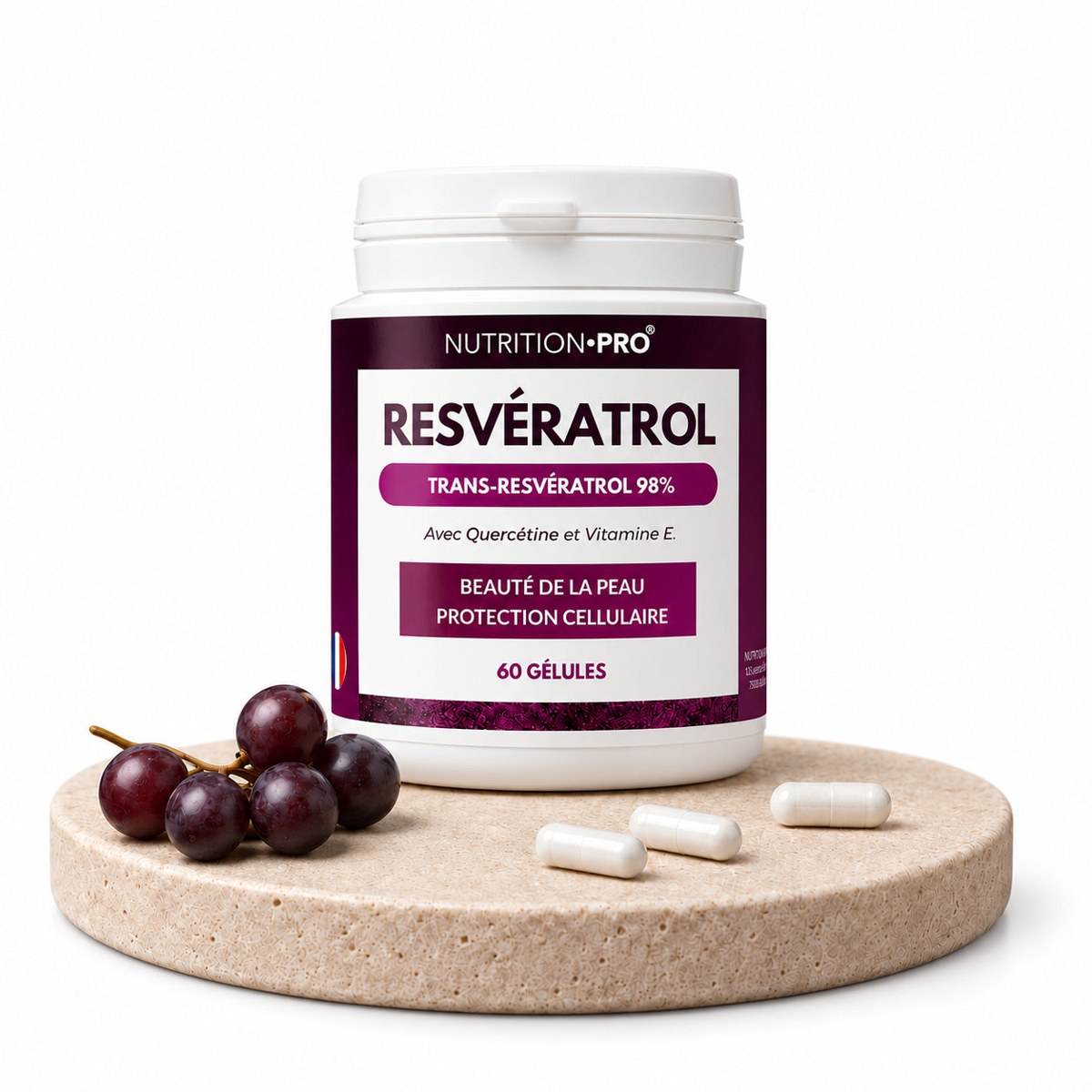
Nutrition•pro is a French brand based in Paris, which says it designs and makes its formulas in France. Its Resveratrol focuses on purity and a dose right in the range considered appropriate:
- 98% trans-resveratrol, the form used in most studies;
- 2 capsules a day with a large glass of water, for 250 mg of trans-resveratrol;
- combined with 250 mg of quercetin (standardised Sophora japonica flower extract) and 12 mg of vitamin E (100% of the reference intake), which contributes to the protection of cells from oxidative stress;
- vegetable capsules;
- 60 capsules, a 30-day course;
- €29.99 per jar (price checked on 22/11/2026), about €1.00 a day.
How does this dose compare? 250 mg of trans-resveratrol a day sits right in the 100 to 500 mg range the bioavailability meta-analysis considers appropriate, and well below the multi-gram doses that caused digestive symptoms. The trials above used resveratrol alone at various doses: their results do not automatically apply to this formula, and the quercetin combination was not assessed in those studies. The same precautions apply, especially if you take a blood thinner.
Promo code: SEOCONSULTINGSL for 10% off your order, €26.99 per jar, about €0.90 a day (as of 22/11/2026).
See Nutrition•pro Resveratrol →
Partner link: we earn a commission if you order through this link, at no extra cost to you.
Frequently asked questions
What are the benefits of resveratrol?
With high-certainty evidence: lower blood pressure in people with type 2 diabetes, slightly lower total cholesterol in adults with overweight and a slightly smaller waist. Other effects (blood sugar, liver, inflammation) are possible but less solid.
What are the side effects of resveratrol?
It is well tolerated at usual doses. Digestive symptoms appear mainly from 2.5 g a day. The real risk is interactions with some medicines.
Who should not take resveratrol?
Pregnant or breastfeeding women and children, for lack of data. Medical advice is essential if you take a blood thinner or a drug cleared by CYP3A4, CYP2D6 or CYP2C9.
What foods contain resveratrol?
Black and red grape skins, peanuts and some berries such as blueberries, in small amounts. Red wine contains some too, but the alcohol cancels out the benefit: choose grapes.
Is trans-resveratrol better?
It is the form used in most studies and supplements, so it is the one to look for on a label, with its purity stated.
Sources
- Sun J.N. et al. Effects of resveratrol supplementation on multiple health outcomes: an umbrella review of systematic reviews and meta-analyses of randomized controlled trials. Nutr J, 2026; 25(1): 63. PubMed 41987155
- Walle T. et al. High absorption but very low bioavailability of oral resveratrol in humans. Drug Metab Dispos, 2004; 32(12): 1377-82. PubMed 15333514
- Szymkowiak I. et al. Resveratrol Bioavailability After Oral Administration: A Meta-Analysis of Clinical Trial Data. Phytother Res, 2025; 39(1): 453-464. PubMed 39557444
- Setayesh A. et al. The effect of resveratrol supplementation on anthropometric indices, adiponectin and leptin levels in individuals with overweight and obesity. Int J Obes, 2026; 50(3): 492-506. PubMed 41455817
- Mansouri F. et al. Impact of Resveratrol Supplementation on Human Sirtuin 1: a GRADE-Assessed Systematic Review and Dose-Response Meta-Analysis of Randomized Controlled Trials. J Acad Nutr Diet, 2025; 125(9): 1299-1314. PubMed 40158656
- Brown V.A. et al. Repeat dose study of the cancer chemopreventive agent resveratrol in healthy volunteers: safety, pharmacokinetics, and effect on the insulin-like growth factor axis. Cancer Res, 2010; 70(22): 9003-11. PubMed 20935227
- Chow H.H. et al. Resveratrol modulates drug- and carcinogen-metabolizing enzymes in a healthy volunteer study. Cancer Prev Res, 2010; 3(9): 1168-75. PubMed 20716633
- Bavaresco L. et al. Wine Resveratrol: From the Ground Up. Nutrients, 2016; 8(4): 222. PubMed 27089363