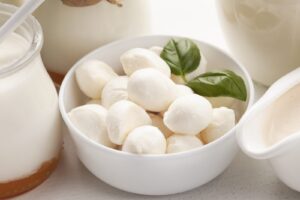
Group · Dairy
Brousse
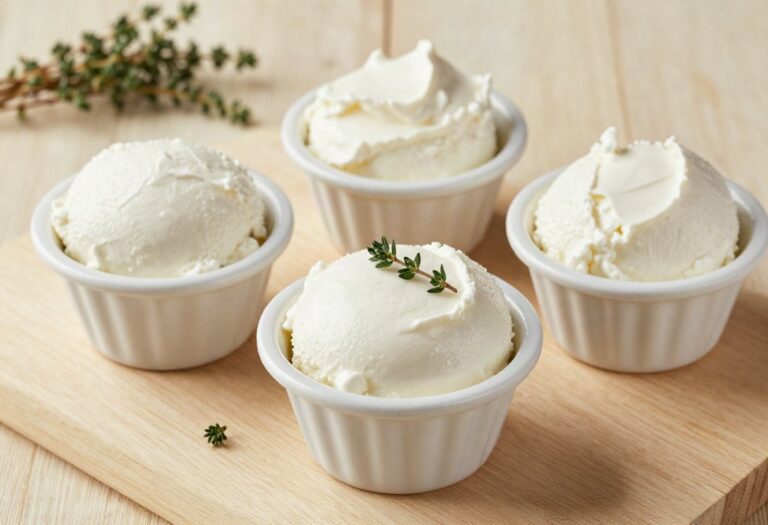
Brousse is a Provençal fresh cheese made by heating the whey left over from another cheesemaking process. It follows the same principle as Italian ricotta: it is a by-product, and its make-up shows it.
In terms of nutrition facts: 142 kcal per 100 g, with 9.36 g of fat of which 5.7 g is saturated, 9.19 g of protein and 4.81 g of carbohydrate. It provides 260 mg of calcium, 175 mg of phosphorus and 43.9 µg of iodine per 100 g, with 0.76 g of salt.
Macronutrient breakdown
Nutrition table per 100 g
| Calories | 142 kcal |
| Kilojoules | 590 kJ |
| Protein | 9,2 g |
| Carbohydrate | 4,9 g |
| Fat | 9,4 g |
Micronutrients per 100 g
All measured nutrients, ranked by share of the daily reference intake.
- Calcium260 mg33 %
- Iodine43,9 µg29 %
- Phosphorus175 mg25 %
- Vitamin B20,22 mg16 %
- Vitamin A87,8 µg11 %
- Selenium5,2 µg9 %
- Potassium168 mg8 %
- Zinc0,83 mg8 %
- Vitamin B9dietary folate equivalents4,95 µg
See the other 10 nutrients
- Vitamin B120,19 µg8 %
- Vitamin E0,84 mg7 %
- Magnesium22,8 mg6 %
- Vitamin B50,29 mg5 %
- Vitamin B10,05 mg5 %
- Omega-3 ALA0,07 g3 %
- Copper0,03 mg3 %
- Vitamin B60,04 mg3 %
- Omega-6 LA0,17 g2 %
- Vitamin K10,9 µg1 %
Anses Ciqual 2025. Source: Anses, 2025, Ciqual food composition table
Tips
142 kcal: this is a light cheese. Half as much as a soft cheese and a quarter of a pressed cheese, while still providing 9.19 g of protein and 260 mg of calcium. The ratio is excellent.
It is low in salt. 0.76 g per 100 g, which makes it usable in quantity, including on a low-sodium diet.
Sweet or savoury, it works both ways. With honey and berries as a dessert, or with olive oil, pepper and herbs as a starter.
It replaces cream in a filling. In ravioli, a vegetable tart or a gratin, it brings creaminess for a third of the fat of cream. The same logic as ricotta.
It keeps for three days. An unmatured fresh cheese, rich in water, it goes off quickly and cannot be frozen. Buy it as you need it, ideally from a cheesemonger.