Group · Seafood
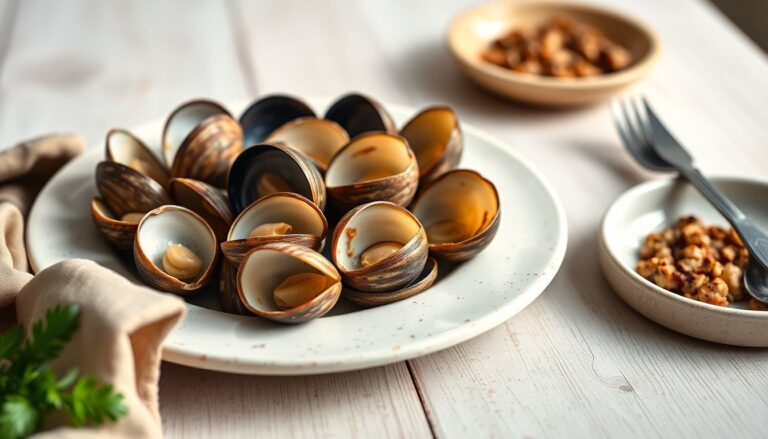
Cooked clam
The cooked clam is a bivalve shellfish much loved along the coasts, found in traditional dishes as well as in lighter cooking. Once cooked, its flesh becomes tender and tasty, ideal in a marinière, on the plancha or added to a pasta dish. Nutritionally, it stands out for its good richness in protein (about 16.2 g per 100 g) and its low fat content (under 1.48 g), while staying moderate in calories (99.2 kcal). A source of minerals such as iron, zinc and selenium, the cooked clam has its place in a balanced diet, whether it accompanies the pleasure of the table or a fitness goal.
Macronutrient breakdown
Nutrition table per 100 g
| Calories | 99 kcal |
| Kilojoules | 420 kJ |
| Protein | 16,2 g |
| Carbohydrate | 5,4 g |
| Fat | 1,5 g |
Micronutrients per 100 g
All measured nutrients, ranked by share of the daily reference intake.
- Vitamin B1239,5 µg1580 %
- Selenium51,8 µg94 %
- Iron9,67 mg69 %
- EPA0,16 g64 %
- DHA0,14 g56 %
- Iodine80 µg53 %
- Copper0,5 mg50 %
- Manganese0,75 mg38 %
See the other 14 nutrients
- Phosphorus231 mg33 %
- Vitamin C22,1 mg28 %
- Potassium432 mg22 %
- Vitamin B20,29 mg21 %
- Zinc2,05 mg21 %
- Vitamin B32,03 mg13 %
- Total omega-30,3 g12 %
- Vitamin A81 µg10 %
- Vitamin B920,1 µg10 %
- Vitamin B10,11 mg10 %
- Vitamin B60,13 mg9 %
- Calcium72,5 mg9 %
- Vitamin B50,47 mg8 %
- Magnesium12,9 mg3 %
Anses Ciqual 2025. Source: Anses, 2025, Ciqual food composition table
Tips
The cooked clam is one of the most interesting seafoods when you are watching what you eat: low in calories, almost free of carbohydrate outside the preparation, and very rich in protein. To get the most from its nutritional values, favour short, gentle cooking, for example opened by steaming or quickly seared, to preserve its texture and minerals. A gentle cooking method stops the flesh turning rubbery and limits the use of added fat.
How to eat cooked clams? A portion of 100 to 150 g works well as a main course with vegetables or a wholegrain starchy food. Think of the classic pairings:
- in a marinière with garlic, parsley and a dash of white wine;
- in spaghetti alle vongole (spaghetti), measuring out the olive oil;
- in a quick stir-fry with tomatoes, lemon and fresh herbs.
On storage, eat them quickly after cooking and keep them chilled. Always check their freshness before preparing them: a clam that does not open during cooking should be thrown away.
Key nutrients. The clam provides complete, good-quality protein, iron (useful for oxygen transport), zinc, selenium and vitamin B12. Its glycaemic index is negligible and it contains no fibre: for a filling meal, pair it with green vegetables or pulses. You can vary things with other shellfish such as cooked mussels or explore raw clams, and discover the whole seafood family to diversify your intake.
For active people. With about 16.2 g of protein per 100 g and little fat, the cooked clam is an excellent recovery ally. Include it in a post-exercise meal with a source of carbohydrate (rice, potatoes) to replenish glycogen and support muscle repair. Its iron and B12 content contributes to energy, which complements a routine of regular physical activity well. When you are cutting, it is a good replacement for fattier proteins.
Weight control. The food itself is light; it is mainly the preparation that tips the scales. Limit butter, cream and bread dunked in the cooking juices if you are watching your figure. For a slimming meal, rely on lemon, herbs and well-controlled cooking. To see how its calories compare with other foods, see the calorie table.