Group · Herbs & spices
Fresh parsley
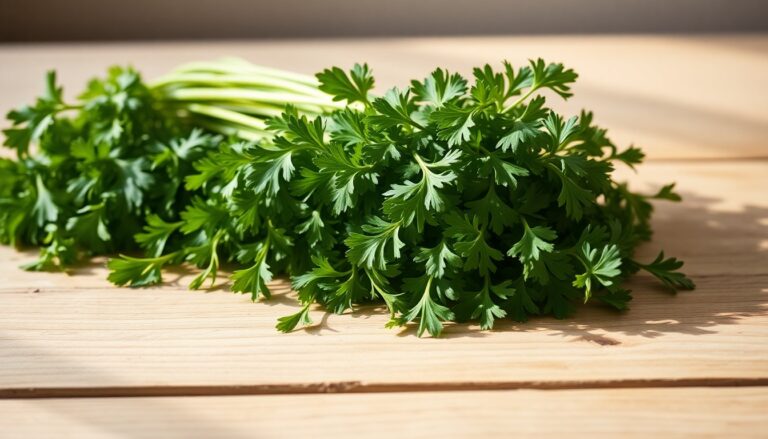
Fresh parsley is one of the most widely used aromatic herbs in French cooking. It comes in two main forms: flat-leaf parsley, with a stronger flavour, and curly parsley, prized for garnishing plates. Always bright green and fragrant, it brightens up stocks, sauces, salads and slow-cooked dishes. Beyond its fresh flavour, fresh parsley has interesting nutrition facts for just 42.5 kcal per 100 g: it provides fibre, a little plant protein and many micronutrients. Very low in calories, it fits perfectly into a balanced diet and lets you lift dishes without adding fat or unnecessary salt.
Macronutrient breakdown
Nutrition table per 100 g
| Calories | 43 kcal |
| Kilojoules | 178 kJ |
| Protein | 3 g |
| Carbohydrate | 4,1 g |
| Fat | 0,7 g |
| Fibre | 4,3 g |
Micronutrients per 100 g
All measured nutrients, ranked by share of the daily reference intake.
- Vitamin K11640 µg2187 %
- Vitamin C133 mg166 %
- Manganese1,7 mg85 %
- Vitamin A422 µg53 %
- Iron6,2 mg44 %
- Potassium554 mg28 %
- Calcium138 mg17 %
- Copper0,15 mg15 %
- Vitamin B9dietary folate equivalents152 µg
See the other 12 nutrients
- Magnesium50 mg13 %
- Zinc1,07 mg11 %
- Phosphorus58 mg8 %
- Vitamin B31,31 mg8 %
- Vitamin B10,09 mg8 %
- Vitamin B20,1 mg7 %
- Vitamin B50,4 mg7 %
- Vitamin B60,09 mg6 %
- Vitamin E0,75 mg6 %
- Omega-3 ALA0,08 g4 %
- Selenium0,66 µg1 %
- Omega-6 LA0,05 g0 %
Anses Ciqual 2025. Source: Anses, 2025, Ciqual food composition table
Tips
Fresh parsley is mostly eaten raw or added at the end of cooking, to preserve its aroma and its vitamin C, which is sensitive to heat. Chop it finely just before serving: over an omelette, in a vinaigrette, on steamed vegetables or a piece of fish. It features in classic preparations such as persillade (parsley and garlic), tabbouleh, green sauce or a bouquet garni. A typical portion is a few tablespoons, or 10 to 30 g.
Nutrition facts and benefits: with 42.5 kcal, 4.1 g of carbohydrate, 2.97 g of protein and 4.3 g of fibre per 100 g, fresh parsley is a light herb. It contains vitamin C, vitamin K, carotenoids and minerals such as iron and potassium. Its very low calorie density makes it a great way to lift your slimming dishes guilt-free, as part of a gradual balanced diet.
- Storage: keep the bunch in the fridge, stems in a glass of water or wrapped in a damp cloth. You can also freeze it chopped in an ice cube tray with a little water or oil.
- Pairings: it goes well with garlic, lemon and other herbs. Try it with coriander in a green sauce, or with chives to flavour fromage frais.
- Flavour: add it as a finishing touch to enjoy its fresh taste and lovely colour.
For active people: fresh parsley provides no significant energy, but it lets you vary flavours and limit salt in a performance-oriented diet. Slip it into your quinoa salads, pulse bowls or protein-rich dishes, ideal as a complement to nutrition for fitness. It makes meals more appetising during a cutting phase, when every calorie counts.
Weight control: nothing in particular to watch, as parsley is one of the lowest-calorie herbs. The only pitfall is what goes with it: a persillade can easily be drowned in butter. Favour olive oil in measured amounts and rely on herbs to cut down on added salt.
To discover other fragrant herbs, explore the herbs and spices family, or compare the calorie content of your foods using the calorie table.