Group · Bread
Panini bread
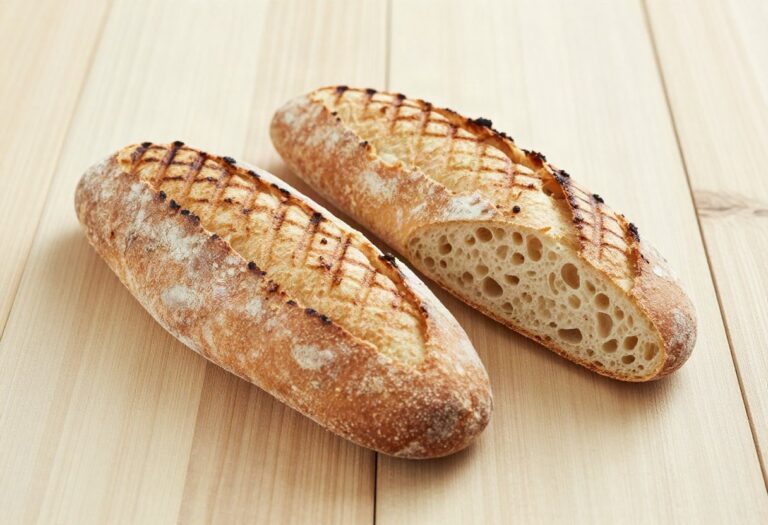
Panini bread is a flat, elongated Italian bread with a fine crumb and soft crust, designed to be filled and then pressed on a grill. Its shape and thinness are functional.
In terms of nutrition facts: 254 kcal per 100 g, with 50.6 g of carbohydrates, 8.2 g of protein, 4.2 g of fibre and only 1.1 g of fat. It provides 39 µg of vitamin B9, 29 mg of magnesium and 118 mg of phosphorus per 100 g, and contains 0.98 g of salt.
Macronutrient breakdown
Nutrition table per 100 g
| Calories | 254 kcal |
| Kilojoules | 1070 kJ |
| Protein | 8,2 g |
| Carbohydrate | 50,6 g |
| Fat | 1,1 g |
| Fibre | 4,2 g |
Micronutrients per 100 g
All measured nutrients, ranked by share of the daily reference intake.
- Vitamin B939 µg20 %
- Phosphorus118 mg17 %
- Vitamin B60,17 mg12 %
- Vitamin B10,1 mg9 %
- Magnesium29 mg8 %
- Potassium148 mg7 %
- Vitamin B20,1 mg7 %
- Vitamin B50,4 mg7 %
See the other 4 nutrients
- Iron0,9 mg6 %
- Vitamin B30,8 mg5 %
- Calcium34,5 mg4 %
- Vitamin B120,1 µg4 %
Anses Ciqual 2025. Source: Anses, 2025, Ciqual food composition table
Tips
The bread is never the problem with a panini. 254 kcal per 100 g, the same as a country loaf. A panini weighs 100 to 120 g: it is the filling, whether processed cheese, cured meats or sauce, that makes up the total.
0.98 g of salt: less than most breads. A white bread has 1.51 g. The difference matters little in a sandwich whose filling is itself salty.
The heated press needs no fat. Many recipes brush the bread with oil or butter before pressing: it is unnecessary for crispness and adds 90 kcal per panini.
A vegetable filling changes everything. Grilled tomatoes, courgette, rocket, mozzarella: the same bread becomes a balanced meal rather than a heavy sandwich.
4.2 g of fibre: decent. On a par with a country loaf, which is unexpected for what looks like a white bread.