Group · Vegetables
Parsnip
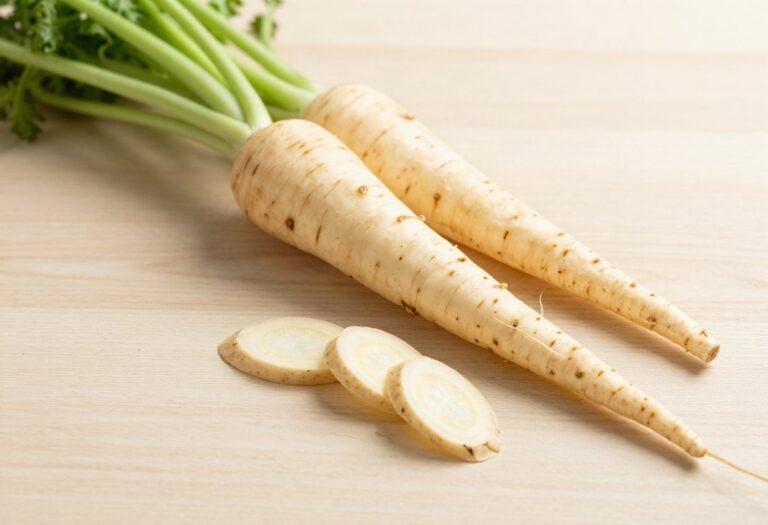
The parsnip is a root vegetable from the Apiaceae family, a cousin of the carrot, with creamy flesh and a mild, slightly sweet aroma. Long forgotten, it is making a strong comeback in our autumn and winter kitchens. Its long, tapering shape recalls that of a large white carrot, and its flavour, halfway between hazelnut and celery, intensifies after the first frosts. With around 91.2 kcal per 100 g, the parsnip provides carbohydrate (16.6 g), little fat (0.5 g) and good amounts of fibre (5.6 g). Versatile and comforting, it naturally has a place in a balanced diet, as a soup, a mash or roasted, and pleases food lovers and athletes alike.
Macronutrient breakdown
Nutrition table per 100 g
| Calories | 91 kcal |
| Kilojoules | 384 kJ |
| Protein | 2 g |
| Carbohydrate | 16,6 g |
| Fat | 0,5 g |
| Fibre | 5,6 g |
Micronutrients per 100 g
All measured nutrients, ranked by share of the daily reference intake.
- Potassium510 mg26 %
- Vitamin E1,83 mg15 %
- Copper0,14 mg14 %
- Phosphorus74 mg11 %
- Vitamin C7,92 mg10 %
- Vitamin B31,53 mg10 %
- Vitamin B10,09 mg8 %
- Manganese0,16 mg8 %
- Vitamin B9dietary folate equivalents80,1 µg
See the other 11 nutrients
- Vitamin B50,41 mg7 %
- Magnesium25 mg7 %
- Vitamin B60,08 mg6 %
- Calcium44 mg6 %
- Vitamin B20,06 mg4 %
- Zinc0,35 mg4 %
- Iron0,37 mg3 %
- Omega-6 LA0,22 g2 %
- Total omega-30,03 g1 %
- Omega-3 ALA0,01 g1 %
- Vitamin A0,21 µg0 %
Anses Ciqual 2025. Source: Anses, 2025, Ciqual food composition table
Tips
To make the most of the nutritional values of parsnip, a portion of 150 to 200 g is perfect as a side. Scrub it under water, peel it thinly (most of the nutrients lie just under the skin) and remove the fibrous core from the largest ones. Its season runs from autumn to midwinter, when its flesh holds the most natural sugars.
- Cooking: roasted in the oven with a drizzle of oil and thyme, as a smooth mash, in a soup, steamed or pan-fried. Gentle steaming best preserves its vitamins and its sweetness.
- Pairings: it goes wonderfully with carrot, leek or potato in a pot-au-feu, and readily takes spices such as nutmeg and curry.
- Storage: several weeks in the fridge salad drawer, or longer cut and frozen.
Nutritionally, the parsnip is an interesting root: it provides fibre that supports fullness and digestive comfort, vitamin C, B vitamins, potassium and a little manganese. Its glycaemic index is moderate, and lower still when it is cooked al dente and combined with protein or a little fat. Its carbohydrate, higher than in most green vegetables, makes it a fairly nourishing root vegetable, to include in a colourful plate alongside other seasonal vegetables.
For active people, the parsnip is a source of complex carbohydrate useful for replenishing energy reserves after exercise. As a homemade mash after a session, combined with a protein source (fish, poultry, eggs), it contributes to good recovery while staying digestible. It is a gentle alternative to potato in a well-built sports nutrition plan.
Weight control: with around 91.2 calories per 100 g, the parsnip remains reasonable, but its carbohydrate makes it a denser vegetable than courgette or cucumber. The main thing to watch is how you prepare it: parsnip chips fried in oil or a generously buttered mash push up the calorie count. Prefer light roasting or steaming. To compare other foods, the calorie table helps you measure your portions. Included in a balanced diet, the parsnip brings variety, fibre and comfort without excess.