Group · Dairy
Quail egg
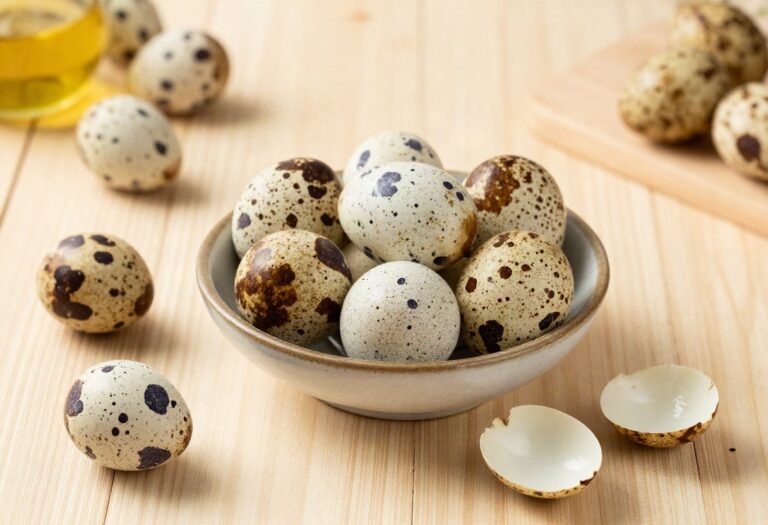
Small but remarkably rich, the quail egg is a delicate food enjoyed in fine dining as much as on party platters. Recognisable by its speckled beige and brown shell, it weighs on average 9 to 12 grams, about five times less than a hen’s egg. Its melting flesh and slightly stronger taste appeal to lovers of fine flavours. Nutritionally, the quail egg provides 154 kcal per 100 g, around 13.1 g of protein, 11.1 g of fat and almost no carbohydrate. A source of complete protein, vitamins and minerals, it fits easily into a balanced diet, as long as you keep to sensible portions.
Macronutrient breakdown
Nutrition table per 100 g
| Calories | 154 kcal |
| Kilojoules | 639 kJ |
| Protein | 13,1 g |
| Carbohydrate | 0,5 g |
| Fat | 11,1 g |
Micronutrients per 100 g
All measured nutrients, ranked by share of the daily reference intake.
- Vitamin B121,58 µg63 %
- Vitamin B20,79 mg56 %
- Vitamin B966 µg33 %
- Phosphorus226 mg32 %
- Vitamin B51,76 mg29 %
- Vitamin D1,4 µg28 %
- Iron3,65 mg26 %
- Vitamin A156 µg20 %
See the other 11 nutrients
- Zinc1,47 mg15 %
- Vitamin B10,13 mg12 %
- Vitamin B60,15 mg11 %
- Vitamin E1,08 mg9 %
- Calcium64 mg8 %
- Potassium132 mg7 %
- Copper0,06 mg6 %
- Magnesium13 mg3 %
- Manganese0,04 mg2 %
- Vitamin B30,15 mg1 %
- Vitamin K10,3 µg0 %
Anses Ciqual 2025. Source: Anses, 2025, Ciqual food composition table
Tips
Quail eggs can be enjoyed in many ways: hard-boiled in a salad, soft-boiled on toast, poached, fried as a bite-sized snack or raw in some Japanese dishes. Hard-boiling takes only 3 to 4 minutes in boiling water, while a soft-boiled egg takes about 2 minutes. Peeling is easier after a quick pass under cold water. For a refined nibble, serve them with a pinch of celery salt or smoked paprika.
Nutrition facts and benefits. The quail egg provides complete protein containing all the essential amino acids, as well as iron, selenium, phosphorus and B vitamins (B12 in particular) and vitamin A. Its zero glycaemic index makes it a useful food for keeping blood sugar steady. Like the hen’s egg, its fat is concentrated in the yolk, which is rich in choline. Three to four quail eggs are roughly equivalent to one hen’s egg in terms of intake.
- Recommended portion: 4 to 6 quail eggs depending on the meal, as a starter or a protein side.
- Smart pairings: crunchy vegetables, fresh herbs, wholemeal bread for a filling meal.
- Storage: in the fridge, up to 3 weeks raw, 2 to 3 days once hard-boiled.
For active people. With around 13.1 g of protein per 100 g, the quail egg is a handy snack that is low in calories per egg. A few hard-boiled eggs after a session round out a protein snack and contribute to muscle recovery. To vary your intake, you can alternate them with the classic hen’s egg or a high-protein 0% fat fromage blanc. Also discover the principles of nutrition for fitness to adjust to your needs.
Weight control. Although filling, the quail egg is still relatively high in fat: go easy on fried or very fatty preparations and favour gentle cooking, hard-boiled or poached. Its small size can encourage you to eat a lot of them with drinks, so watch the quantities. To place this food among others, check the calorie table or explore the dairy products and eggs family. Eaten in moderation, the quail egg offers an excellent balance between enjoyment and nutritional quality.