Strawberries and diabetes: the easiest fruit, and red fruits
The short answer
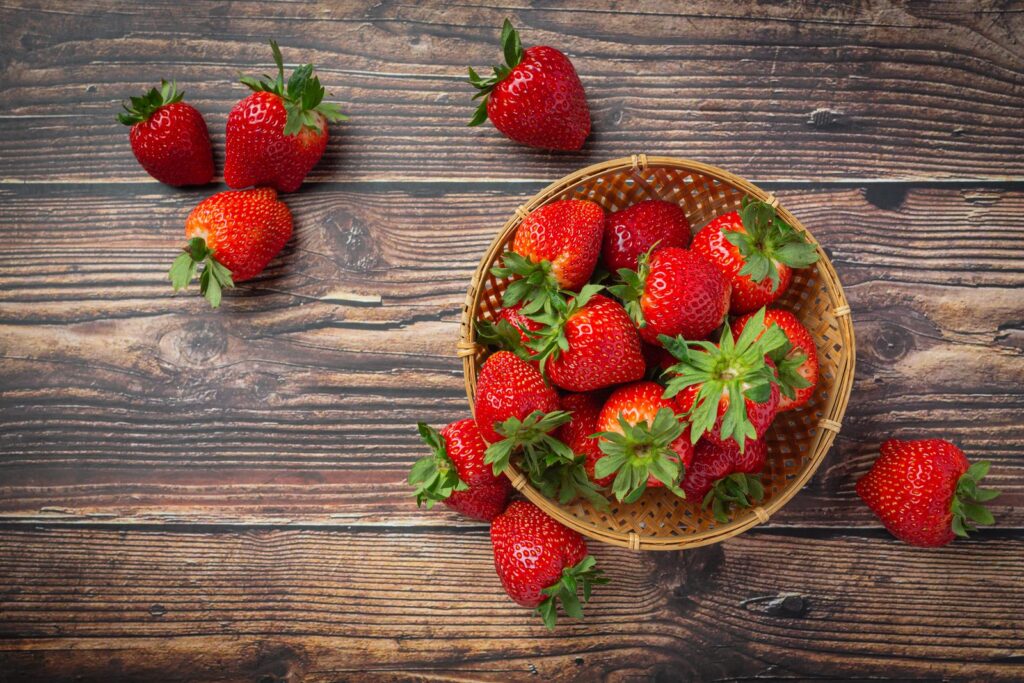
Yes, strawberries are one of the best fruits with diabetes. They contain very little carbohydrate, 6 g per 100 g, half as much as an apple, and their glycaemic index is low, 40. A 250 g punnet does not exceed one portion of fruit: 15 g of carbohydrate, a glycaemic load of 6, and 169% of the day’s vitamin C. The other red fruits, raspberries, blackberries, redcurrants, are just as easy; blueberries and especially cherries need more attention. The real trap is added sugar: whipped cream, syrup, jam.
This guide gives general guidelines. If you are treated with insulin or with a medicine that can cause hypoglycaemia, your carbohydrate amount per meal should be set with your doctor or dietitian.
What strawberries contain
| For | Calories | Carbohydrate | Fibre | Vitamin C |
|---|---|---|---|---|
| One medium strawberry, 12 g | 4 kcal | 0.7 g | 0.5 g | 6 mg |
| 100 g of strawberries | 35 kcal | 6.0 g | 3.8 g | 54 mg |
| One bowl, 150 g | 53 kcal | 9.0 g | 5.7 g | 81 mg |
| One punnet, 250 g | 88 kcal | 15.1 g | 9.5 g | 135 mg |
The Fédération Française des Diabétiques (the French diabetes federation) defines a portion of fruit as 15 to 20 g of carbohydrate, and cites the 250 g punnet among its examples for soft fruit. With strawberries, that whole punnet fits in one portion. It is the fruit that gives you the most for the least carbohydrate. And its 9.5 g of fibre covers nearly a third of the 30 g advised by Anses.
Glycaemic index and glycaemic load of strawberries
The international glycaemic index tables (Atkinson, Foster-Powell and Brand-Miller, 2008) give raw strawberry a GI of 40, measured in Australia in 10 people without diabetes; there is no measurement in people with diabetes. The glycaemic load of a 120 g portion is rated 1 there, one of the lowest in the whole table.
| Portion | Carbohydrate | Glycaemic load |
|---|---|---|
| 10 strawberries, 120 g | 7.2 g | 3 |
| One bowl, 150 g | 9.0 g | 4 |
| One punnet, 250 g | 15.1 g | 6 |
| Two punnets, 500 g | 30.2 g | 12 |
Even a whole punnet stays at a low glycaemic load. Strawberries owe this performance to three things: few sugars (5.6 g per 100 g), a little more fructose than glucose, and plenty of fibre for such a light fruit. For the notion of GI, see our guide to the glycaemic index.
The other red fruits
| 100 g of | Carbohydrate | Fibre | Vitamin C | Portion of fruit (15 to 20 g of carbohydrate) |
|---|---|---|---|---|
| Raspberry | 5.8 g | 4.3 g | 19 mg | 250 to 340 g |
| Strawberry | 6.0 g | 3.8 g | 54 mg | 250 to 330 g |
| Blackberry | 6.5 g | 5.2 g | 10 mg | 230 to 305 g |
| Redcurrant | 7.1 g | 4.6 g | 30 mg | 210 to 280 g |
| Blackcurrant | 9.7 g | 7.1 g | 181 mg | 155 to 205 g |
| Blueberry | 10.6 g | 2.4 g | 10 mg | 140 to 190 g |
| Cherry | 13.0 g | 1.6 g | 4 mg | 115 to 155 g |
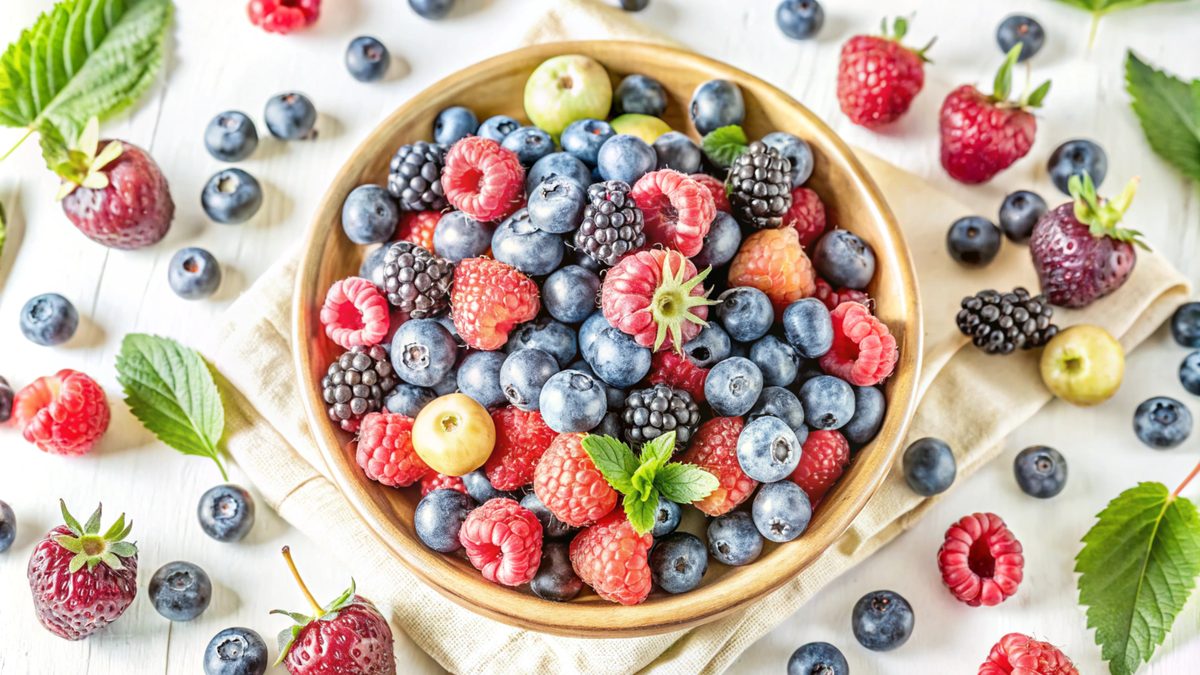
- Raspberries, blackberries and redcurrants are as low in carbohydrate as strawberries and even richer in fibre: a 250 g punnet fits in one portion.
- Blackcurrants are the vitamin C champion, 181 mg per 100 g, more than three times the orange, with 7.1 g of fibre.
- Blueberries contain almost twice as much carbohydrate as strawberries. Measured in people without diabetes in Canada, wild blueberries have a GI of 53. A 250 g punnet provides 26.5 g of carbohydrate, more than one portion: count 150 g instead. Yet it is the best-placed fruit in the Muraki study (see below).
- Cherries are the sweetest of the group, 13 g of carbohydrate per 100 g. The Fédération Française des Diabétiques advises sticking to 100 g, about a dozen cherries. Their GI varies a lot: 22 for sour cherries in people with diabetes in Canada, 63 for black cherries in people without diabetes in Australia.
What the long-term studies say
In the study by Muraki et al. (BMJ, 2013), which followed more than 187,000 people for up to 24 years, blueberries were the fruit most strongly associated with a lower risk of type 2 diabetes: 26% lower per three portions a week. Strawberries were associated with neither a higher nor a lower risk. Fruit juice, on the other hand, was associated with an 8% increased risk.
Should you limit fruit once diabetes is established? No: a Danish randomised trial (Christensen et al., 2013) in 63 people newly diagnosed with type 2 diabetes found no difference in HbA1c between the group that ate at least two fruits a day and the one that ate at most two.
The trials on strawberries and blood sugar
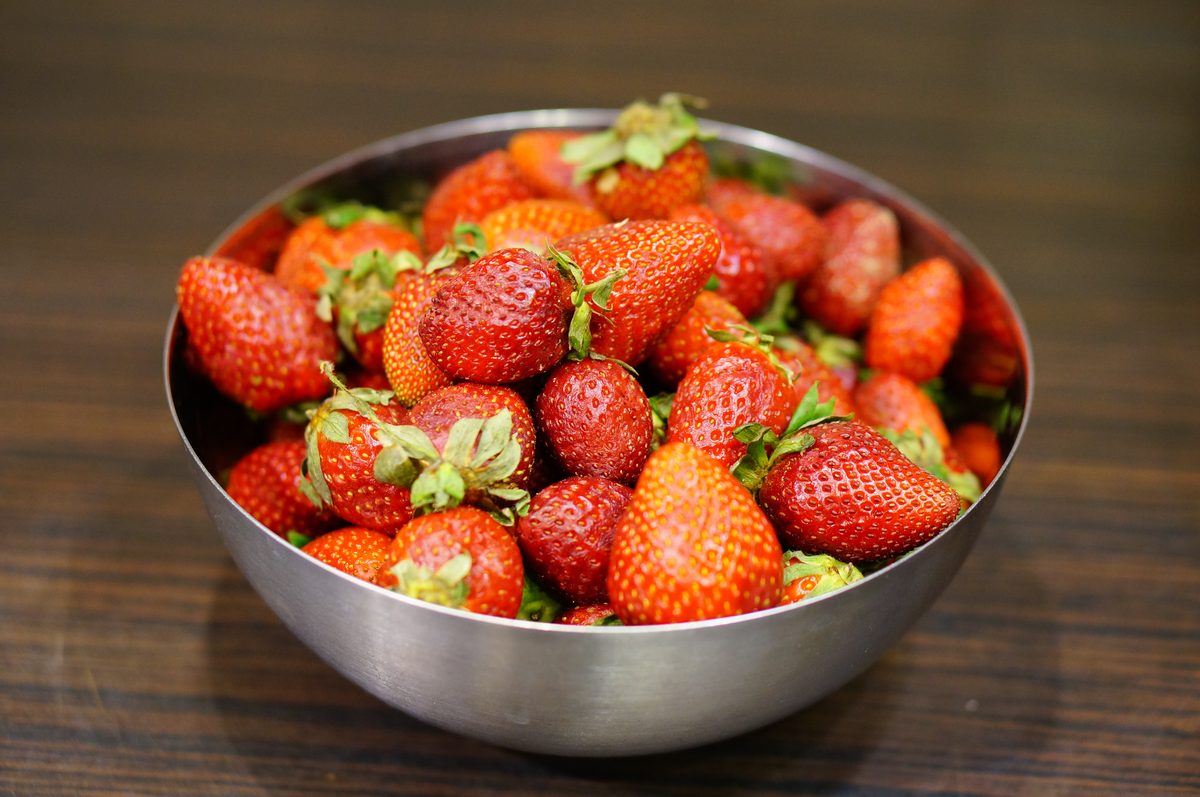
Beyond cohorts, several trials have directly tested the effect of strawberries on blood sugar or insulin. They are small, often done with purées or powders, but their results point the same way.
- Strawberries with white bread (Törrönen et al., Journal of Nutrition, 2013). Healthy women ate white bread, either on its own or with 150 g of strawberry purée. With the strawberries, less insulin was needed to handle the same meal, and the blood sugar profile improved by 36%. Of the six berries tested one by one, strawberry was the only one to improve this profile.
- Berries with sugar (Törrönen et al., British Journal of Nutrition, 2010). Twelve adults without diabetes swallowed 35 g of sugar, either on its own or in 150 g of a purée of blueberries, blackcurrants, cranberries and strawberries. With the berries, blood sugar was lower at 15 and 30 minutes, the peak came later, at 45 minutes instead of 30, and it was 1.0 mmol/L lower.
- In people with type 2 diabetes (Moazen et al., Annals of Nutrition and Metabolism, 2013). 36 people drank every day for 6 weeks a freeze-dried strawberry drink, 50 g of powder, equivalent to 500 g of fresh strawberries, or a placebo. CRP, a marker of inflammation, fell from 2.5 to 2.04 mg/L, and HbA1c tended to fall. Fasting blood sugar did not change.
- In insulin-resistant adults (Paquette et al., British Journal of Nutrition, 2017). 41 overweight people without diabetes drank for 6 weeks a drink providing 333 mg of strawberry and cranberry polyphenols. Their insulin sensitivity, measured by the reference method, improved compared with the control group.
What to take from this: strawberries do not only raise blood sugar very little; eaten with a sugary or starchy food, they seem to blunt its effect a little. But the long trials use concentrated doses, 500 g of strawberries a day, which do not correspond to normal consumption. Strawberries go alongside treatment, they do not replace it.
The real trap: what you add
| Product | Carbohydrate per 100 g | What to know |
|---|---|---|
| Plain strawberries | 6.0 g | a whole punnet = one portion of fruit |
| Reduced-sugar strawberry jam | 40.3 g | less sweet, but still seven times more than the fruit |
| Regular strawberry jam | 60.5 g | ten times the fruit; 20 g on a slice of toast = 12 g of carbohydrate |
Caster sugar sprinkled on strawberries adds directly to their carbohydrate. Sweetened whipped cream, coulis and tarts also add sugar and fat. To sweeten without sugar, see our view on stevia; otherwise, plain fromage blanc (a fresh soft cheese) or a few mint leaves are often enough to make strawberries feel indulgent. Frozen red fruits, with no added sugar, keep their qualities and are available all year round.
Coulis, nectar, sorbet, tart: processed strawberry
Jam is not the only form of sweetened strawberry. Here is what Ciqual measures in the other common products:
| 100 g of | Carbohydrate | Fibre | Compared with plain strawberries |
|---|---|---|---|
| Raw strawberries | 6.0 g | 3.8 g | reference |
| Sweetened strawberry milk drink | 10.7 g | 0.03 g | nearly twice as much carbohydrate, no fibre |
| Strawberry nectar | 11.3 g | 0.1 g | nearly twice as much, no fibre |
| Red fruit coulis | 27.7 g | 1.8 g | more than four times as much |
| Sorbet, tub | 28.7 g | 1.0 g | nearly five times as much |
| Handmade strawberry tart | 31.0 g | 1.5 g | more than five times as much, with 19.8 g of fat |
30 g of coulis on fromage blanc thus provides 8 g of carbohydrate, almost as much as a 150 g bowl of whole strawberries, 9 g. For a homemade coulis, simply blend very ripe strawberries, with no sugar: you keep the fruit’s 6 g of carbohydrate per 100 g. And for a frozen dessert, frozen strawberries blended with plain yoghurt are a better substitute for sorbet.
How much a day and when
The Fédération Française des Diabétiques advises spreading fruit through the day. A punnet of strawberries or raspberries counts as one fruit; you can split it between two moments, half at breakfast and half as an afternoon snack.
- At breakfast, in plain yoghurt or porridge.
- For dessert, plain or with fromage blanc.
- As an afternoon snack, with a few almonds.
Thanks to their very low glycaemic load, strawberries are among the few fruits you can eat on their own as a snack without any particular worry.
Strawberry or another fruit
| 100 g of | Carbohydrate | Glycaemic index | Glycaemic load |
|---|---|---|---|
| Banana | 19.7 g | 48 (people with diabetes) | 9.5 |
| Charentais melon | 14.8 g | 65 to 70* | 10 |
| Apple | 11.9 g | 36 (people with diabetes) | 4.3 |
| Orange | 8.0 g | 45 (people with diabetes) | 3.6 |
| Strawberry | 6.0 g | 40* | 2.4 |
Weight for weight, strawberry has the lowest glycaemic load of all the fruits in our series. See also our guides apple and diabetes, orange and diabetes and melon and diabetes, and our ranking of the least sugary fruits.
Special cases
Gestational diabetes
Strawberries and red fruits are among the easiest fruits to include during pregnancy. Wash them carefully before eating them, especially if eaten raw, to limit the risk of toxoplasmosis from soil. See eating during pregnancy.
Allergy
Strawberry is one of the fruits that sometimes cause reactions, often itching around the mouth. If you have any symptom, talk to your doctor before eating it again.
Prediabetes
Replacing a sugary dessert with a punnet of red fruits is one of the simplest swaps. See type 2 diabetes: diet and prevention.
3 ideas for eating them
- Strawberries, fromage blanc and mint: a dessert in two minutes, with no added sugar.
- Vanilla chia pudding topped with red fruits: extra fibre, prepared the night before.
- A spinach, strawberry and feta salad: strawberry as a starter, with a drizzle of balsamic vinegar.
More ideas in our low glycaemic index recipes.
Our strawberry and red fruit recipes, in carbohydrate per serving
These values are calculated from Ciqual for each ingredient. They show the gap between a recipe where the strawberry is on its own and one where it comes with sugar, pastry or cereals.
- Spinach, strawberry and feta salad: 4.7 g of carbohydrate per serving. Strawberry as a starter, for almost nothing.
- Strawberries with balsamic vinegar: 9.6 g of carbohydrate and 7.1 g of fibre per serving, with an optional teaspoon of honey for four.
- Fromage blanc and red fruit mousse: 15 g of carbohydrate and 8.4 g of protein per serving. One portion of fruit, with protein.
- Instant frozen red fruit yoghurt: 23 g of carbohydrate per serving, an alternative to sorbet.
- Strawberry charlotte and strawberry tart: 29 and 32 g of carbohydrate per serving, because of the biscuits, pastry and sugar. Treat desserts.
- Red fruit smoothie bowl and red fruit oat porridge: 46 and 48 g of carbohydrate per bowl. These are full breakfasts, which replace bread; the smoothie bowl also contains a banana.
Frequently asked questions
Can a person with diabetes eat strawberries?
Yes, and it is one of the best choices: 6 g of carbohydrate per 100 g, a GI of 40, and a 250 g punnet that fits in one portion of fruit.
How many strawberries a day with diabetes?
A 250 g punnet, about twenty medium strawberries, counts as one portion of fruit of 15 g of carbohydrate.
Which red fruits are best with diabetes?
Raspberries, strawberries, blackberries and redcurrants are the lowest in carbohydrate. Blueberries contain twice as much and cherries even more: count 150 g of blueberries and 100 g of cherries.
Are cherries not recommended?
No, but they are the sweetest of the soft fruits, 13 g of carbohydrate per 100 g. The Fédération Française des Diabétiques advises limiting yourself to 100 g, about a dozen cherries.
Is strawberry jam forbidden?
Not forbidden, but very sweet: 60.5 g of carbohydrate per 100 g, ten times the fruit. A thin layer of 20 g provides 12 g of carbohydrate, almost one portion of fruit.
Are frozen red fruits just as good?
Yes, if they have no added sugar: their carbohydrate and fibre remain comparable to those of fresh fruit, according to Ciqual.
Do strawberries lower blood sugar?
No, no food lowers blood sugar. But in one trial, 150 g of strawberry purée eaten with white bread reduced the amount of insulin needed and improved the blood sugar profile of the meal.
Is strawberry coulis suitable?
Shop-bought coulis is sweetened: 27.7 g of carbohydrate per 100 g of red fruit coulis according to Ciqual, more than four times the strawberries. A homemade coulis, simply blended with no sugar, keeps the values of the fruit.
Is strawberry sorbet a good alternative?
Not really: a tub sorbet contains 28.7 g of carbohydrate per 100 g. Frozen strawberries blended with plain yoghurt make a much less sugary frozen dessert.
The foods and diabetes series
Glycaemic index, glycaemic load and the right portion, food by food: apple and diabetes, pear and diabetes, orange and diabetes, banana and diabetes, grapes and diabetes, dates and diabetes, melon and diabetes, pineapple and diabetes, cheese and diabetes, mango and diabetes, honey and diabetes, dark chocolate and diabetes, lentils and diabetes, potato and diabetes, avocado and diabetes, oats and diabetes, bread and diabetes, kiwi and diabetes, sweet potato and diabetes, rice and diabetes.
Going further
Apple and diabetes, orange and diabetes, foods high in vitamin C, glycaemic index, nutrition facts for strawberries.
Our sources
- Atkinson FS, Foster-Powell K, Brand-Miller JC. International Tables of Glycemic Index and Glycemic Load Values: 2008. Diabetes Care, 2008.
- Muraki I et al. Fruit consumption and risk of type 2 diabetes: results from three prospective longitudinal cohort studies. BMJ, 2013.
- Christensen AS et al. Effect of fruit restriction on glycemic control in patients with type 2 diabetes, a randomized trial. Nutrition Journal, 2013.
- Fédération Française des Diabétiques, « Quels fruits choisir en été ? »: fruit portion, 250 g punnet, cherries limited to 100 g.
- Ciqual 2025 table (Anses): strawberry, raspberry, blackberry, redcurrant, blackcurrant, blueberry, cherry, strawberry jams; USDA FoodData Central, SR Legacy: weight of a strawberry and a cherry. Anses: adequate fibre intake of 30 g a day.
- Törrönen R, Kolehmainen M, Sarkkinen E, Poutanen K, Mykkänen H, Niskanen L. Berries reduce postprandial insulin responses to wheat and rye breads in healthy women. Journal of Nutrition, 2013. PMID 23365108.
- Törrönen R, Sarkkinen E, Tapola N et al. Berries modify the postprandial plasma glucose response to sucrose in healthy subjects. British Journal of Nutrition, 2010. PMID 19930765.
- Moazen S, Amani R, Homayouni Rad A et al. Effects of freeze-dried strawberry supplementation on metabolic biomarkers of atherosclerosis in subjects with type 2 diabetes: a randomized double-blind controlled trial. Annals of Nutrition and Metabolism, 2013. PMID 24334868.
- Paquette M, Medina Larqué AS, Weisnagel SJ et al. Strawberry and cranberry polyphenols improve insulin sensitivity in insulin-resistant, non-diabetic adults: a parallel, double-blind, controlled and randomised clinical trial. British Journal of Nutrition, 2017. PMID 28290272.
- Ciqual 2025 table (Anses): strawberry milk drink, strawberry nectar, red fruit coulis, sorbet, strawberry tart. Site recipes: values per serving calculated from Ciqual.