Group · Seafood
Raw snail
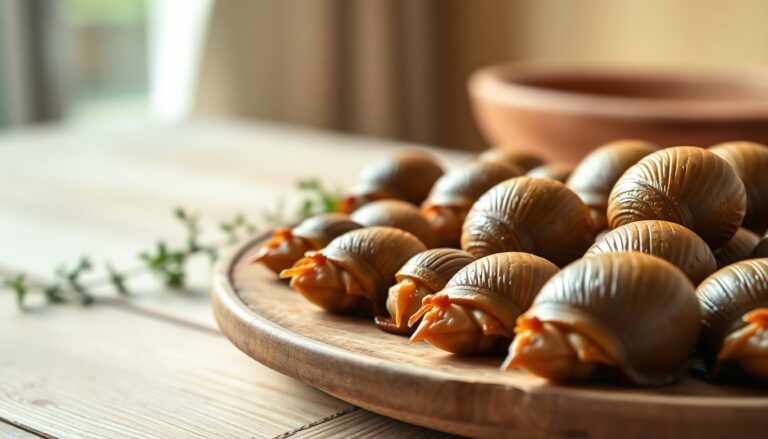
The raw snail is a land mollusc enjoyed in French cooking, where it holds a choice place in gastronomy. Before being prepared, the snail is purged, cleaned and then cooked, but its basic nutritional qualities remain remarkable. With just 77.9 kcal per 100 g and 16.1 g of protein, it is a lean, protein-rich food that is very low in fat (0.92 g). It comes in different varieties, notably the petit-gris and the Burgundy snail. Low in carbohydrate and free of fibre, the snail fits well into a balanced diet geared towards lightness. Its nutrition facts make it as much a dietary food as an original delicacy.
Macronutrient breakdown
Nutrition table per 100 g
| Calories | 78 kcal |
| Kilojoules | 330 kJ |
| Protein | 16,1 g |
| Carbohydrate | 1,3 g |
| Fat | 1 g |
Micronutrients per 100 g
All measured nutrients, ranked by share of the daily reference intake.
- Copper2,8 mg280 %
- Manganese1,2 mg60 %
- EPA0,12 g48 %
- Vitamin E5 mg42 %
- Vitamin B120,92 µg37 %
- Phosphorus157 mg22 %
- Vitamin C15 mg19 %
- Iron2,6 mg19 %
See the other 15 nutrients
- Magnesium48,3 mg13 %
- Zinc1,17 mg12 %
- Calcium90 mg11 %
- Vitamin B31,7 mg11 %
- Vitamin B20,12 mg9 %
- Total omega-30,14 g5 %
- Vitamin B98,5 µg4 %
- Iodine6 µg4 %
- Vitamin A30 µg4 %
- Vitamin B60,03 mg2 %
- Vitamin B10,02 mg2 %
- Potassium35 mg2 %
- Omega-6 LA0,12 g1 %
- Omega-3 ALA0,02 g1 %
- Vitamin K10,1 µg0 %
Anses Ciqual 2025. Source: Anses, 2025, Ciqual food composition table
Tips
The snail lends itself to many preparations, the best known being the classic recipe with garlic, parsley and butter. Be careful, though: it is the parsley butter that pushes up the calorie count. The snail itself is light, but the accompaniments can quickly turn a healthy dish into a fat bomb. To stay on the slimming track, choose cooking in court-bouillon, steaming or seasoning with fresh herbs rather than too much added fat.
Portions and eating: a dozen snails make a reasonable starter. You can enjoy them in a cassolette, in a lightened puff pastry, or added to a pan-fry of vegetables. As for storage, fresh raw snail must be eaten quickly; tinned or frozen versions offer more flexibility.
- Protein: at 16.1 g per 100 g, the snail provides good-quality protein, useful for maintaining muscle mass.
- Very low fat: only 1.4 g, an asset for weight control.
- Minerals: it provides magnesium and iron in particular, useful within a varied diet.
- Glycaemic index: almost nil, thanks to its low carbohydrate content (1.29 g).
For active people: the snail is a valuable source of lean protein, ideal during a cutting or balanced-diet phase. Its low energy density lets you get a good protein intake without excess fat. You can pair it with wholegrain starchy foods for a balanced recovery meal, or top up your intake with other seafood sources such as prawns or scallops, which are also rich in protein and low in fat. To go further on protein intake in sport, see our advice on fitness nutrition.
Varieties and culinary uses: the petit-gris and the Burgundy snail are the most common in France. They are traditionally served in their shells, but also on skewers, in a sauce or in savoury tartlets. Their firm texture and subtle taste go well with garlic, parsley, white wine or light cream.
If you like marine, iodine-rich flavours, explore other treasures from the seafood family, such as mussels, rich in protein and low in calories. To compare the nutrition facts of your favourite foods, also see our calorie table. In short, the snail is an elegant, light, protein-rich dish, as long as you keep the seasoning under control.