Group · Vegetables
Spaghetti squash
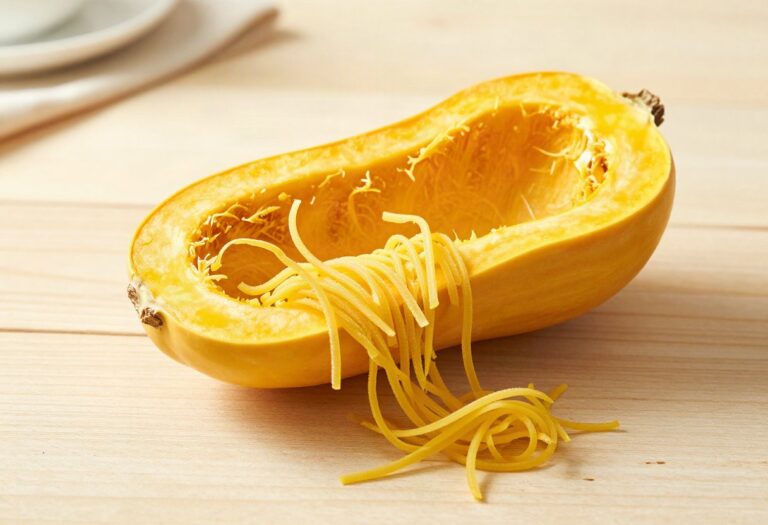
The spaghetti squash gets its name from its flesh, which pulls apart into strands after cooking, like pasta. It is a summer squash with pale yellow skin, and its texture is its main appeal.
In terms of nutrition facts, raw it provides 32.3 kcal per 100 g, with 5.41 g of carbohydrate, 1.5 g of fibre and 0.64 g of protein. It provides 108 mg of potassium and 23 mg of calcium per 100 g, and contains 91.6 g of water.
Macronutrient breakdown
Nutrition table per 100 g
| Calories | 32 kcal |
| Kilojoules | 136 kJ |
| Protein | 0,7 g |
| Carbohydrate | 5,5 g |
| Fat | 0,6 g |
| Fibre | 1,5 g |
Micronutrients per 100 g
All measured nutrients, ranked by share of the daily reference intake.
- Vitamin B60,1 mg7 %
- Manganese0,13 mg7 %
- Vitamin B50,36 mg6 %
- Vitamin B30,95 mg6 %
- Potassium108 mg5 %
- Copper0,04 mg4 %
- Vitamin B10,04 mg3 %
- Magnesium12 mg3 %
- Vitamin B9dietary folate equivalents12 µg
See the other 9 nutrients
- Calcium23 mg3 %
- Vitamin C2,1 mg3 %
- Iron0,31 mg2 %
- Zinc0,19 mg2 %
- Phosphorus12 mg2 %
- Vitamin B20,02 mg1 %
- Vitamin K10,9 µg1 %
- Vitamin E0,13 mg1 %
- Vitamin A5,33 µg1 %
Anses Ciqual 2025. Source: Anses, 2025, Ciqual food composition table
Tips
It does not replace pasta, and it is important to say so. It has 5.41 g of carbohydrate per 100 g against 71 g for dry noodles: the texture is comparable, the energy content is nothing like it. It is a vegetable, not a starchy food.
What makes it an ally, or a trap. An ally if you want volume for few calories; a trap if you count on it to keep you going until the next meal. Add a source of protein and a little fat.
In the oven, halved, cut side down on the tray. Forty minutes at 200 °C, then run a fork through it to pull out the strands. In water, it gets waterlogged and goes soft.
It goes with anything that has character. Tomato sauce, pesto, pecorino: its flesh is very neutral and needs support.
It keeps for two months whole. In a cool, dry place, like all hard-skinned squashes. Once cut, three days in the fridge.