Group · Vegetables
Mixed vegetables (tinned)
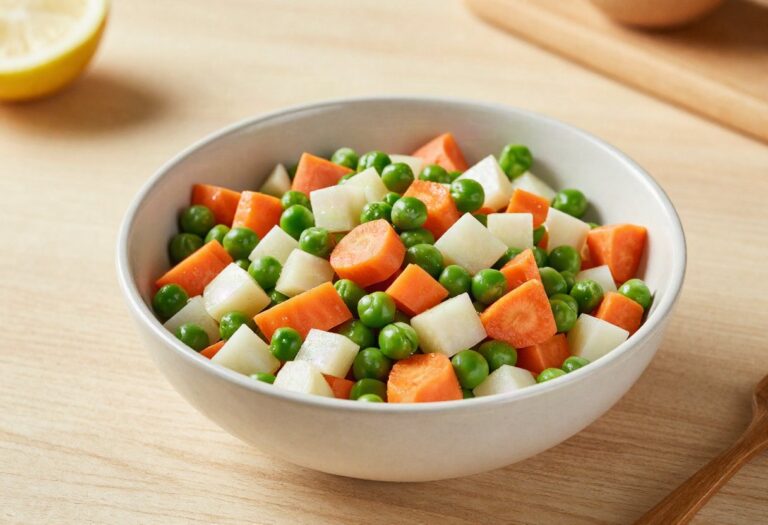
Tinned mixed vegetables are a practical, colourful blend that usually combines carrots, peas, green beans, turnips and sometimes sweetcorn, all cut into small, even dice. Ready to use, they keep for a long time and help out day to day when time is short. Nutritionally, they stay light: just 40.4 kcal per 100 g, with around 5.59 g of carbohydrate, 2.32 g of protein, very little fat and nearly 3.16 g of fibre. This combination makes them an interesting option for bulking out a plate without adding many calories. They fit easily into a balanced diet, as a starter, a side dish or a quick garnish.
Macronutrient breakdown
Nutrition table per 100 g
| Calories | 40 kcal |
| Kilojoules | 170 kJ |
| Protein | 2,4 g |
| Carbohydrate | 5,6 g |
| Fat | 0,3 g |
| Fibre | 3,2 g |
Micronutrients per 100 g
All measured nutrients, ranked by share of the daily reference intake.
- Vitamin A473 µg59 %
- Vitamin K118,2 µg24 %
- Potassium291 mg15 %
- Iron1,05 mg8 %
- Manganese0,15 mg8 %
- Copper0,07 mg7 %
- Vitamin C5 mg6 %
- Phosphorus42 mg6 %
- Vitamin B9dietary folate equivalents24 µg
See the other 10 nutrients
- Vitamin B60,08 mg6 %
- Calcium40,7 mg5 %
- Vitamin B10,05 mg4 %
- Vitamin B30,58 mg4 %
- Vitamin B20,05 mg3 %
- Magnesium10,6 mg3 %
- Zinc0,28 mg3 %
- Vitamin E0,29 mg2 %
- Vitamin B50,14 mg2 %
- Iodine0,2 µg0 %
Anses Ciqual 2025. Source: Anses, 2025, Ciqual food composition table
Tips
Tinned mixed vegetables can be eaten cold or hot, depending on what you fancy. Cold, they make a tasty starter bound with a little yoghurt, fromage frais or a light vinaigrette. Hot, they warm through in a few minutes and go with white meat, fish or an egg. Before eating them, remember to drain them well and rinse them under cold water: this reduces the salt added during canning, an important point if you are watching your weight and water retention.
On nutrition facts, their low energy density and fibre content make them an ally of slimming meals, as they contribute to fullness. Their glycaemic index stays moderate thanks to the variety of vegetables. Canning does, however, reduce some of the heat-sensitive vitamins; to preserve more nutrients, alternate with fresh or frozen vegetables. For example, you can vary with grated carrot, steamed green beans or less salty frozen mixed vegetables.
Smart pairings:
- With a pulse (lentils, chickpeas) for a complete plate rich in plant protein.
- With brown rice or quinoa for a filling, balanced meal.
- As a filling for an omelette, a wrap or a mixed salad.
- Lifted with fresh herbs, lemon juice or spices to cut down on salt.
For active people, mixed vegetables provide digestible carbohydrate and fibre, useful alongside a recovery meal. As their protein content is modest, combine them with a protein source (chicken, fish, egg or tofu) after exercise. To go further on balancing your intake around training, see our guidelines on fitness nutrition.
On storage, an unopened tin keeps for several months away from heat; once opened, transfer the contents to an airtight container and eat within two to three days. To compare their energy content with other products, take a look at the food calorie table and explore more ideas in the vegetable family. Choose versions with no added sugar or salt, and make them a way to fill your plate with colour without guilt.