Group · Starchy foods
Yam
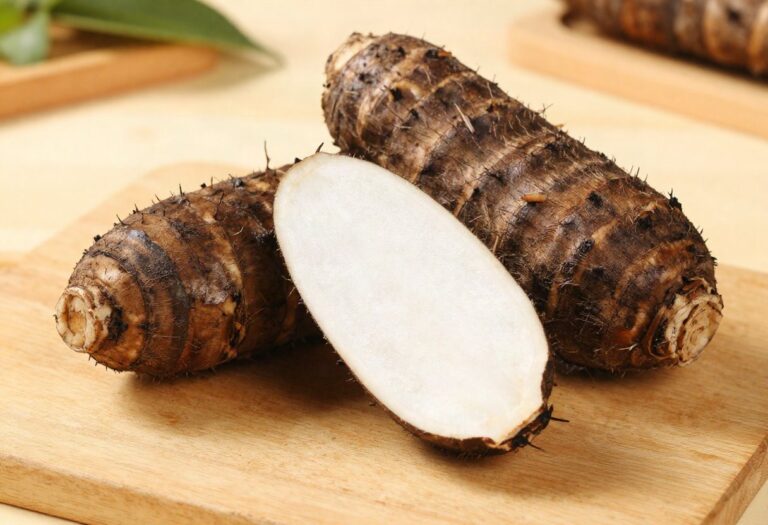
Yam is a tropical tuber grown in Africa, Asia and the Caribbean, where it has a central place in the diet. Beneath its rough skin lies white, yellow or purplish flesh, firm and slightly floury. It is sometimes confused with sweet potato, but it is a starchy food in its own right, rich in complex carbohydrates. At around 109 kcal per 100 g, it provides lasting energy, fibre and very little fat. Yam comes in many varieties and suits both savoury and sweet preparations. In a balanced diet, it is a pleasant replacement for potato and diversifies your sources of carbohydrate.
Macronutrient breakdown
Nutrition table per 100 g
| Calories | 109 kcal |
| Kilojoules | 462 kJ |
| Protein | 1,5 g |
| Carbohydrate | 23,6 g |
| Fat | 0,2 g |
| Fibre | 3,9 g |
Micronutrients per 100 g
All measured nutrients, ranked by share of the daily reference intake.
- Potassium670 mg34 %
- Manganese0,37 mg19 %
- Vitamin B60,23 mg16 %
- Vitamin C12,1 mg15 %
- Copper0,15 mg15 %
- Vitamin B10,1 mg9 %
- Phosphorus49 mg7 %
- Vitamin B50,31 mg5 %
- Vitamin B9dietary folate equivalents16 µg
See the other 9 nutrients
- Magnesium18 mg5 %
- Iron0,52 mg4 %
- Vitamin B30,55 mg3 %
- Vitamin K12,3 µg3 %
- Vitamin E0,34 mg3 %
- Zinc0,2 mg2 %
- Vitamin B20,03 mg2 %
- Calcium14 mg2 %
- Vitamin A6,08 µg1 %
Anses Ciqual 2025. Source: Anses, 2025, Ciqual food composition table
Tips
Versatile, yam can be cooked in a thousand ways. As it is never eaten raw, choose boiling, steaming, baking or mashing. Steaming remains ideal for preserving nutrients and limiting added fat. You can boil then mash it, roast it in cubes with a drizzle of oil and spices, or add it to a stew. A sensible portion is around 100 to 150 g cooked, the equivalent of a starchy side per meal.
- Nutrition facts: around 23.6 g of carbohydrate, 3.9 g of fibre, 1.49 g of protein and only 0.14 g of fat per 100 g.
- Strengths: its fibre promotes fullness and regular digestion, while its complex carbohydrates offer gradual energy.
- Minerals and vitamins: yam notably provides potassium, manganese and vitamin C.
For slimming, yam is higher in calories than a green vegetable but comparable to other starchy foods. Its richness in fibre and its filling nature make it an interesting option, as long as you watch the accompaniments: cream, butter or frying quickly push up the calorie bill. To compare its calories with other foods, see our food calorie table. Yam also has a place in a balanced diet, by varying your sources of carbohydrate.
For active people, yam is an excellent energy reservoir. Eaten 2 to 3 hours before exercise, it provides gradually absorbed carbohydrates, useful for endurance sessions. After training, paired with a source of protein (eggs, fish, poultry or a portion of quinoa), it helps replenish glycogen stores and supports recovery. When bulking up, it helps you reach your calorie needs without resorting to processed foods. To go further on eating for exercise, discover our advice on nutrition for fitness.
Naturally gluten-free, yam suits people managing a gluten intolerance. For storage, keep whole tubers in a dry, cool, airy place away from light, rather than in the fridge. Once cooked, it keeps for 2 to 3 days in the fridge. To diversify your plate, alternate yam with other root starchy foods from the starchy foods family, such as cassava or sweet potato.