Group · Starchy foods
Cassava
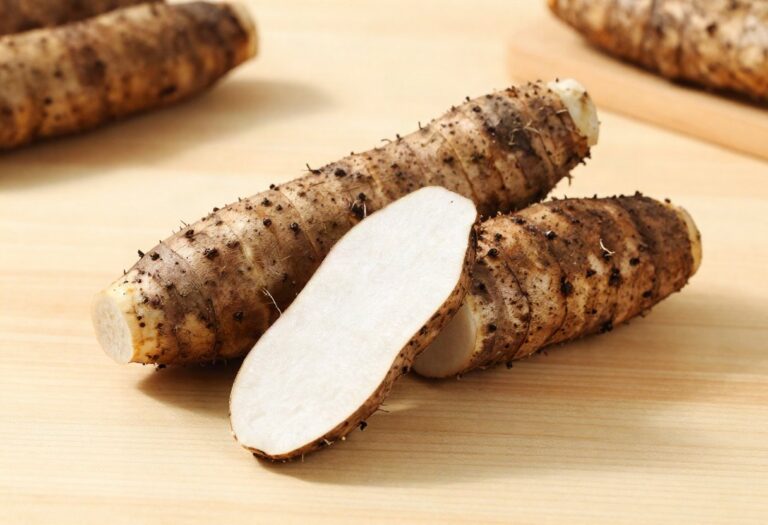
Cassava is a tuberous root native to South America, which has become a staple starchy food in many tropical regions of Africa, Asia and the Caribbean. Rich in starch, this tuber comes in several forms: fresh cassava to cook, cassava flour, semolina (gari), or tapioca extracted from its starch. Its firm white flesh has a melting texture once cooked, with a mild, slightly sweet taste. At around 135 kcal per 100 g, cassava is an interesting source of energy and is naturally gluten-free. It fits into a balanced diet as an alternative to potato or rice, as long as it is well cooked and eaten in reasonable portions.
Macronutrient breakdown
Nutrition table per 100 g
| Calories | 135 kcal |
| Kilojoules | 574 kJ |
| Protein | 0,7 g |
| Carbohydrate | 32,8 g |
| Fat | 0,1 g |
| Fibre | 0,4 g |
Micronutrients per 100 g
All measured nutrients, ranked by share of the daily reference intake.
- Vitamin C13,1 mg16 %
- Phosphorus40,5 mg6 %
- Iron0,6 mg4 %
- Zinc0,35 mg4 %
- Vitamin B30,47 mg3 %
- Vitamin B10,02 mg2 %
- Manganese0,04 mg2 %
- Copper0,02 mg2 %
See the other 2 nutrients
- Calcium12,1 mg2 %
- Vitamin B20,02 mg1 %
Anses Ciqual 2025. Source: Anses, 2025, Ciqual food composition table
Tips
Cassava must only be eaten cooked: preparation is essential to remove the natural compounds present in the raw root. Peel it, remove the central fibre, then boil, steam, fry or roast it. Allow a portion of 100 to 150 g cooked, to be measured out like any starchy food on the plate. It goes wonderfully with slow-cooked dishes, fish and meat, and can also be turned into chips, mash or patties.
In terms of nutrition facts, cassava mainly provides complex carbohydrates (around 32.8 g per 100 g) in the form of starch, little protein (0.69 g) and very little fat (0.04 g). It also provides fibre, vitamin C and potassium. Its glycaemic index stays rather high, especially when boiled for a long time or fried: to limit the glycaemic spike, pair it with green vegetables, pulses or a source of lean protein.
- Cooking: steaming or boiling preserves the texture better than greasy frying. To go further, discover the principles of gentle cooking.
- Storage: fresh cassava keeps for a few days in a cool place. Once peeled, put it in water to stop it turning black, or freeze it.
- Gluten-free: flour and tapioca made from cassava are valuable if you have a gluten intolerance.
For active people, cassava is an excellent carbohydrate reservoir to replenish glycogen stores. Eaten a few hours before an endurance effort, it provides lasting energy; after training, it helps recovery, ideally combined with a source of protein such as fish, eggs or a post-training shaker. Its digestibility, once well cooked, makes it a good base for bulking meals.
If you are watching your weight, keep in mind the calorie density of cassava, which is higher than that of potato. Choose cooking methods without added fat and stay attentive to portions. You can vary things with other tropical starchy foods such as yam or sweet potato, and explore the whole starchy foods family to balance your meals according to your needs.