BCAA benefits: what BCAAs do, side effects, EAA vs BCAA and when to take them
The short answer
BCAAs are three essential amino acids (leucine, isoleucine and valine) found in every protein you eat. On their own, they can’t build muscle: that takes all nine essential amino acids, and a 2017 review by Robert Wolfe concludes that the claim BCAAs alone are anabolic is unwarranted. If you already eat enough protein (1.4 to 2 g per kg of body weight a day for most active people, according to the International Society of Sports Nutrition), their benefits are limited. Their best-documented effect is modest: less muscle soreness after damaging exercise, without faster strength recovery. They are well tolerated, but not a priority: total protein, whey or creatine come first.
This article is for information and does not replace medical advice. If you have kidney or liver disease, a metabolic disorder, are pregnant or take medication, ask your doctor first.
What are BCAAs?
BCAA stands for branched-chain amino acids. They are three of the nine essential amino acids, which your body can’t make and must get from food.
- Leucine is the “signal”: it switches on a cell pathway (mTOR) that starts muscle protein building;
- isoleucine and valine are building blocks and can be burned as fuel by muscle during exercise.
You get them from any protein-rich food: meat, fish, eggs, dairy, legumes. See our list of the highest-protein foods.
BCAA 2:1:1 vs 4:1:1: what does the ratio mean?
The ratio is leucine to isoleucine to valine. 2:1:1 has twice as much leucine as each of the others: it is the ratio most used in studies and the closest to food protein. 4:1:1 and 8:1:1 blends add more leucine. We found no trial showing a higher ratio works better: the total amount of leucine matters more than the label.
What do BCAAs do? What the research shows
Building muscle: BCAAs alone fall short
To build new muscle protein, your body needs all nine essential amino acids. In his 2017 review, Robert Wolfe explains that if you only take BCAAs, the other six can only come from breaking down your own muscle. The theoretical maximum gain is capped at about 30%, and the real figure is lower. He found no study directly measuring the effect of oral BCAAs alone, and the two infusion studies showed a decrease in both muscle protein building and breakdown. His verdict: claiming BCAAs alone produce an anabolic response is unwarranted.
A study from the same year adds nuance. In 10 resistance-trained men, 5.6 g of BCAAs right after training raised muscle protein synthesis by 22% versus placebo over 4 hours (Jackman et al., 2017). So there is an effect, but it was measured over a few hours, in a small group, without comparison to a complete protein.
When your protein intake is already adequate
This is the key point. The ISSN (2017) recommends 1.4 to 2 g of protein per kg per day for most active people, and 20 to 40 g of quality protein per serving, with 700 to 3,000 mg of leucine plus the full set of essential amino acids. It advises focusing on whole-food protein, since it is all the essential amino acids together that drive muscle building. A scoop of whey or a protein-rich meal already provides BCAAs, plus the six others. To spread your intake well, see our guide on how to take protein powder.
Muscle soreness and damage: a modest effect
This is where BCAAs have the most data. Several meta-analyses of randomized trials point the same way:
| Study | What was analyzed | Result |
|---|---|---|
| Doma et al., 2021 | 25 studies, 479 participants, muscle-damaging exercise | Fewer muscle damage markers at 48 h and less soreness at 24 and 48 h; no faster strength recovery |
| Weber et al., 2021 | 10 randomized trials, single session | Less soreness in 7 of 10 studies, mainly in trained people with mild to moderate damage; start before exercise |
| Fedewa et al., 2019 | 8 studies, 61 participants on BCAAs | Clear drop in soreness versus placebo |
| Julea and Saleh, 2025 | 22 trials, 511 participants, pure BCAAs | Moderate support for less soreness; inconsistent evidence for strength, endurance and body composition |
The limits are real: small groups, very different doses (from 1.5 g to more than 80 g a day), and participants who did not all eat enough protein. Less soreness doesn’t mean more muscle or better performance: Doma’s review found no gain in strength recovery.
Strength, endurance, weight loss
For strength and endurance, results are inconsistent (Julea and Saleh, 2025), and only one of the 22 studies found a change in body composition. We found no solid trial on weight loss: BCAA powder won’t make you lose weight; calorie balance and enough protein do the work.
EAA vs BCAA
EAAs are all nine essential amino acids, BCAAs included. In theory they are what covers every need of muscle building, as Wolfe and the ISSN point out. If you want an amino acid supplement, EAAs, or simply a complete protein like whey, make more sense than BCAAs alone.
BCAA side effects and safety
BCAAs are well tolerated at usual doses. Even in trials in sick patients, such as the Cochrane review on ALS (Parton et al., 2003), BCAAs caused about as many side effects as the control treatment, but brought no benefit for the disease. A few points to watch:
| Situation | What to know |
|---|---|
| Maple syrup urine disease | Inherited disorder where the body can’t break down BCAAs: do not take |
| Kidney or liver disease | Protein and amino acid intake should be set with your doctor |
| Excess weight, insulin resistance | High blood BCAA levels are linked to insulin resistance in humans; in rats, BCAAs added to a high-fat diet made it worse (Newgard et al., 2009). An association, not proof that supplements are harmful |
| Pregnancy, breastfeeding, children | No safety data on supplements: avoid, food is enough |
| Drug-tested athletes | BCAAs are not banned, but any sports supplement can be contaminated: pick brands that test their batches |
The main downside is cost: paying for three amino acids your diet or protein powder already gives you.
When to take BCAAs and how much
- Protein first: check you reach 1.4 to 2 g per kg a day, in servings of 20 to 40 g. If you do, BCAAs add little.
- Timing: Weber’s meta-analysis advises not taking them only after exercise, but starting before. In practice: some before, some after your workout.
- Dose: trials range from a few grams to very high amounts; Jackman used 5.6 g after training. The ISSN targets 700 to 3,000 mg of leucine per serving, within a complete protein.
- When they may help: fasted training, hard-to-reach protein targets (low appetite, limited plant-based diet), or limiting soreness after an unusual workout.
- For women: protein needs per kg are the same, and studies don’t suggest a different rule for BCAAs.
To plan meals around training, see what to eat before and after exercise and nutrition for muscle gain.
BCAA vs creatine
They are different products. Creatine is one of the best-studied supplements for strength and muscle mass; BCAAs mainly affect soreness. If you only pick one to make progress, choose creatine: see our guide on how to take creatine and our best creatine comparison. For recovery, L-glutamine is often paired with BCAAs, also with limited evidence.
Nutrition•pro: 2:1:1 BCAA capsules made in France
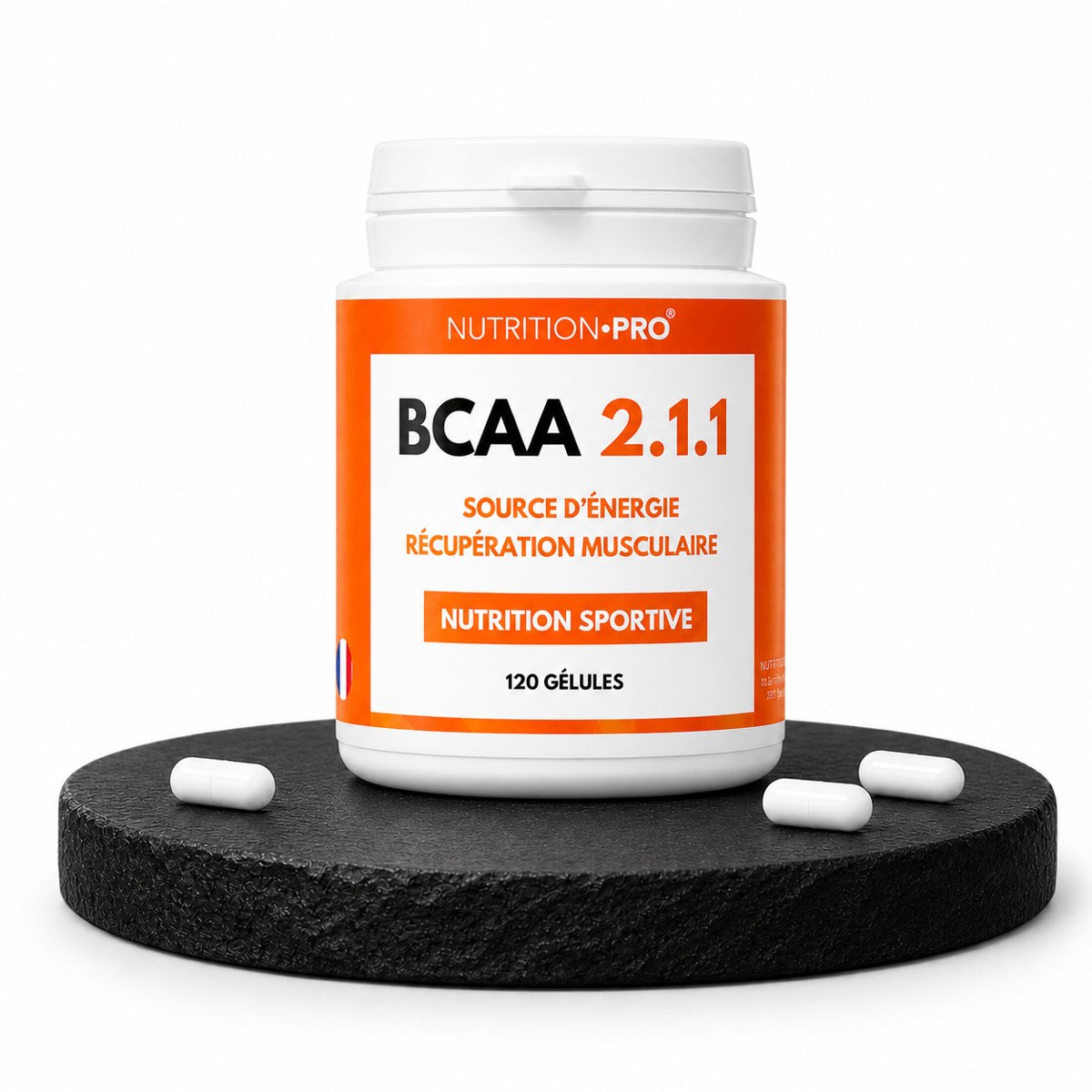
If you train hard and want to try BCAAs, especially for soreness, Nutrition•pro BCAA 2.1.1 stands out for a simple, transparent formula. The brand says it designs and makes its formulas in France, and the product page states “made in France”. It lists:
- 3,000 mg of BCAAs per 6 capsules: 1,500 mg leucine, 750 mg isoleucine and 750 mg valine, the 2:1:1 ratio used in studies;
- a short ingredient list: the three amino acids in a vegetable capsule (HPMC), with no flavoring or sweetener;
- 3 capsules before and 3 after exercise, with a large glass of water: in line with Weber’s advice to start before training;
- 120 capsules, 20 days at 6 a day; also available as a powder;
- €24.99 per jar (price checked on 22/11/2026), about €1.25 a day.
How does the dose compare? 3 g a day is less than the 5.6 g in Jackman’s study and many soreness trials, but the 1,500 mg of leucine fits the ISSN range over the day. Capsules are handy if you don’t like powdered drinks. The studies above did not test this product, and if your protein intake is already adequate, expect a modest effect.
Promo code: SEOCONSULTINGSL for 10% off your order, €22.49 per jar, about €1.12 a day (as of 22/11/2026).
See Nutrition•pro BCAA 2.1.1 →
Partner link: we earn a commission if you order through this link, at no extra cost to you.
If you’d rather get a complete protein, see our best whey protein comparison.
Our pick: BCAA 2:1:1 Dynveo (Dynveo) See the product → Partner link
Frequently asked questions
What does BCAA do?
BCAAs are building blocks of muscle protein, and leucine also signals muscle to start building. Without the other six essential amino acids, that signal isn’t enough to build muscle.
When should you take BCAAs?
Around training, starting before your session rather than only after, according to Weber’s 2021 meta-analysis.
BCAA vs creatine: which is better?
Creatine has strong evidence for strength and muscle mass. BCAAs mainly bring a modest drop in soreness. For progress, creatine comes first.
What are the side effects of BCAAs?
Few side effects. The real downside is limited benefit if you eat enough protein. Avoid them with maple syrup urine disease, and ask your doctor if you have kidney or liver disease or are pregnant.
Do BCAAs help with weight loss?
No solid trial shows it.
Do I need BCAAs if I take whey?
Usually not: whey already contains BCAAs along with all the other essential amino acids.
Sources
- Wolfe R.R. Branched-chain amino acids and muscle protein synthesis in humans: myth or reality? J Int Soc Sports Nutr, 2017; 14: 30. PubMed 28852372
- Jackman S.R. et al. Branched-Chain Amino Acid Ingestion Stimulates Muscle Myofibrillar Protein Synthesis following Resistance Exercise in Humans. Front Physiol, 2017; 8: 390. PubMed 28638350
- Jäger R. et al. International Society of Sports Nutrition Position Stand: protein and exercise. J Int Soc Sports Nutr, 2017; 14: 20. PubMed 28642676
- Doma K. et al. The effect of branched-chain amino acid on muscle damage markers and performance following strenuous exercise: a systematic review and meta-analysis. Appl Physiol Nutr Metab, 2021; 46(11): 1303-1313. PubMed 34612716
- Weber M.G. et al. The use of BCAA to decrease delayed-onset muscle soreness after a single bout of exercise: a systematic review and meta-analysis. Amino Acids, 2021; 53(11): 1663-1678. PubMed 34669012
- Fedewa M.V. et al. Effect of branched-Chain Amino Acid Supplementation on Muscle Soreness following Exercise: A Meta-Analysis. Int J Vitam Nutr Res, 2019; 89(5-6): 348-356. PubMed 30938579
- Julea M., Saleh S.N. The Effect of Oral Pure Branched-Chain Amino Acid Supplementation on Exercise Performance and Body Composition: A Systematic Review. Cureus, 2025; 17(11): e96017. PubMed 41346907
- Parton M., Mitsumoto H., Leigh P.N. Amino acids for amyotrophic lateral sclerosis / motor neuron disease. Cochrane Database Syst Rev, 2003; (4): CD003457. PubMed 14583978
- Newgard C.B. et al. A branched-chain amino acid-related metabolic signature that differentiates obese and lean humans and contributes to insulin resistance. Cell Metab, 2009; 9(4): 311-26. PubMed 19356713