Pomelo (Chinese grapefruit): benefits, calories and precautions
The short answer
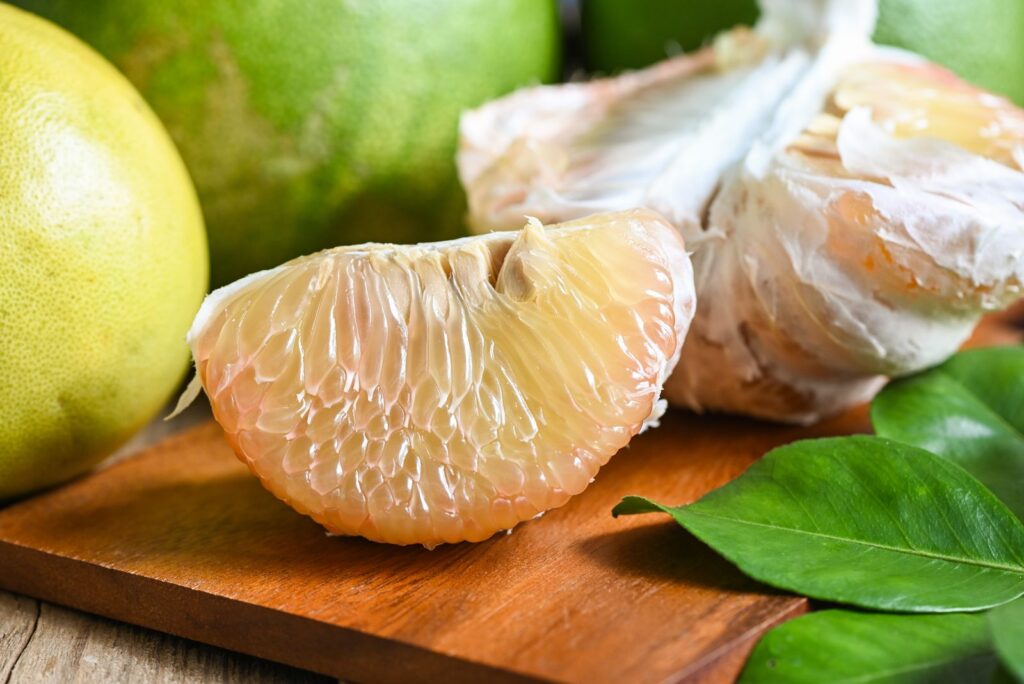
Pomelo, or Chinese grapefruit, is a large, low-calorie citrus fruit, with 38 kcal per 100 g, and very rich in vitamin C: 61 mg per 100 g. Watch the names: what is sold in France as « pamplemousse » (grapefruit) is in fact what the Ciqual table calls « pomelo », a different citrus fruit, a little less rich in vitamin C. The two have one important thing in common: they can interact with certain medicines, like grapefruit juice. If the leaflet for your treatment advises against grapefruit, avoid pomelo too.
This article gives information; it does not replace the advice of your doctor or pharmacist.
Grapefruit, « pomelo », pomelo (Chinese grapefruit): do not confuse them
Citrus names are a real headache in French. The Anses Ciqual table distinguishes them like this:
| Name in the Ciqual table | What it is | Where to find it |
|---|---|---|
| Pomelo (dit pamplemousse), yellow or pink | the ordinary grapefruit, commonly sold in France under the name « pamplemousse » | pomelo (grapefruit) page |
| Pamplemousse chinois | a larger citrus fruit with a thick skin, sold mostly in Asian grocery shops; called pomelo in English | pomelo (Chinese grapefruit) page |
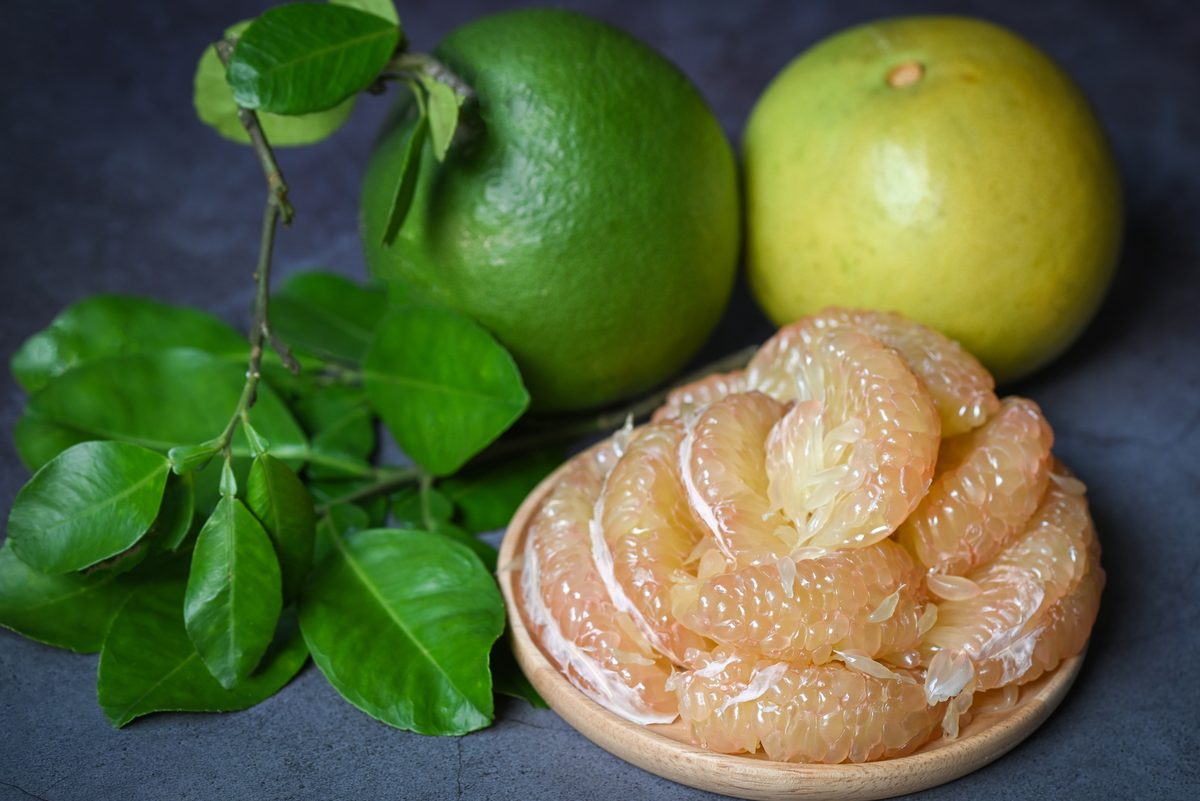
Hence the confusion: a « pomelo » on the fruit aisle of a French supermarket means the fruit everyone else calls grapefruit, whereas a « pomelo » in an English-language or Asian recipe means the Chinese grapefruit. In the rest of this article, we call the Chinese grapefruit pomelo and the ordinary one grapefruit.
Nutritional values compared
| Per 100 g of raw flesh | Pomelo (Chinese grapefruit) | Grapefruit | Pink grapefruit |
|---|---|---|---|
| Energy | 38 kcal | 34 kcal | not measured |
| Water | 89 g | 90 g | 88 g |
| Carbohydrate | 7.1 g | 5.9 g | 6.2 g |
| Fibre | 1 g | 1.1 g | 1.6 g |
| Vitamin C | 61 mg | 36 mg | 31 mg |
| Potassium | 216 mg | 171 mg | 135 mg |
| Beta-carotene | 0 | 350 µg | 686 µg |
Pomelo therefore contains nearly twice as much vitamin C as grapefruit. As the reference intake for an adult is 80 mg a day, a 150 g portion of pomelo provides about 90 mg, more than the reference. Pink grapefruit stands out for its beta-carotene, a precursor of vitamin A, which gives it its colour.
To compare with other fruit, see our ranking of foods rich in vitamin C.
The real strengths of pomelo
- Very rich in vitamin C: 61 mg per 100 g, more than orange (47.5 mg according to Ciqual).
- Low in calories: 38 kcal per 100 g, as it is 89% water.
- A source of potassium: 216 mg per 100 g.
You sometimes read that pomelo « burns fat » or « detoxifies »: no serious study shows this. It is a good fruit, not a remedy.
Pomelo and medicines: the key point
Grapefruit juice is known to increase the blood concentration of many medicines. According to a review published in 2013 in the Canadian Medical Association Journal, more than 85 medicines are known or suspected to interact with grapefruit, 43 of them with possible serious adverse effects, and a single whole grapefruit or 200 ml of juice is enough to cause an interaction. The authors point out that Seville oranges, limes and pomelos produce the same type of interaction.
The mechanism: compounds in the fruit, furanocoumarins, irreversibly block an enzyme in the gut, CYP3A4, which normally breaks down part of the medicine. The effect lasts until the gut makes new enzymes: leaving a few hours between the fruit and the medicine is therefore not enough.
| Human study | Medicine | Result |
|---|---|---|
| Kidney transplant case, Japan, 2003 | tacrolimus, immunosuppressant | sharp rise in blood level after eating pomelo |
| 12 volunteers, 2006 | ciclosporin, immunosuppressant | exposure to the medicine increased by about 19% with 240 ml of juice |
| 12 volunteers, 2007 | felodipine, for high blood pressure | real effect but weaker than with grapefruit |
| Thai volunteers, 2015 | ciclosporin | exposure increased by about 29% with 250 g of pulp, twice |
The medicines affected by grapefruit include in particular certain statins for cholesterol, such as simvastatin, certain blood pressure medicines of the felodipine family, and immunosuppressants such as ciclosporin and tacrolimus. The list is long and changes: the only reliable rule is to read the leaflet of each of your medicines and ask your pharmacist. The 2013 review also stresses that older people, who often take several treatments, are particularly exposed.
How long does the effect last, and what are the risks?
The 2013 Canadian review gives precise figures, measured with grapefruit and felodipine, a medicine for high blood pressure. They explain why spacing out doses is not enough:
| Gap between a 200 ml glass of juice and the medicine | Strength of the interaction |
|---|---|
| Juice drunk within the 4 hours before | maximum effect |
| 10 hours before | still half of the maximum effect |
| 24 hours before | still a quarter of the maximum effect |
In other words, a glass of juice at breakfast can still act on the evening medicine, and even a little on the next morning’s. The same review states which medicines are at risk: they are taken by mouth, a large part is normally destroyed before reaching the blood, and they are broken down by the CYP3A4 enzyme. Between 2008 and 2012, the number of medicines that can cause serious effects with grapefruit rose from 17 to 43.
The serious effects described are varied: heart rhythm disturbances, muscle damage, toxicity to the bone marrow or kidneys, respiratory depression, gastrointestinal bleeding. Finally, the authors point out that people over 45 buy the most grapefruit and receive the most prescriptions, and that a marked interaction has been observed in patients over 70. If an elderly relative eats citrus fruit every morning and takes several treatments, a check with their pharmacist is useful.
The official French list: the ANSM thesaurus
In France, the reference for drug interactions is the thesaurus of the national medicines safety agency (ANSM). Its latest version, from September 2023, has an entry for grapefruit, « juice and fruit »: the whole fruit is therefore concerned, not just the juice. The ANSM states that the consequences depend on each person’s sensitivity, the amount consumed, taking it at the same time, which worsens the effect, and the therapeutic margin of the medicine. It recommends advising against grapefruit with the listed medicines, especially simvastatin, whose concentrations can be considerably increased.
| Medicine | What it is for | ANSM level |
|---|---|---|
| Simvastatin | cholesterol | 🔴 combination not advised |
| Atorvastatin | cholesterol | 🟠 to be taken into account |
| Immunosuppressants: ciclosporin, tacrolimus, sirolimus | transplant, autoimmune diseases | 🔴 combination not advised |
| Ticagrelor | antiplatelet, after a heart attack | 🔴 combination not advised |
| Dronedarone, ivabradine | heart rhythm disorders, heart failure | 🔴 combination not advised |
| Lercanidipine, verapamil | blood pressure | 🟠 to be taken into account |
| Carbamazepine | epilepsy | 🔴 combination not advised |
| Sertraline | depression | 🔴 combination not advised |
| Lurasidone | psychiatric disorders | 🔴 combination not advised |
| Buspirone | anxiety | 🟠 to be taken into account |
| Avanafil, vardenafil | erectile dysfunction | 🔴 combination not advised |
| Olaparib, regorafenib, venetoclax | cancer treatments | 🔴 combination not advised |
| Tolvaptan | kidney diseases, sodium | 🔴 combination not advised |
| Ivacaftor | cystic fibrosis | 🔴 combination not advised |
| Naloxegol | constipation on opioids | 🔴 combination not advised |
| Halofantrine | malaria | 🔴 combination not advised |
This list does not name pomelo specifically, but the 2013 Canadian review and the studies cited above show that it produces the same type of interaction. If one of these medicines is on your prescription, avoid grapefruit and pomelo, and talk to your pharmacist.
The traffic light for pomelo
| Situation | Verdict | Why |
|---|---|---|
| No medicines | 🟢 no restriction | low-calorie fruit, very rich in vitamin C |
| Treatment whose leaflet does not mention grapefruit | 🟢 probably fine | if in doubt, ask your pharmacist |
| Treatment whose leaflet advises against grapefruit | 🔴 avoid | pomelo produces the same type of interaction |
| Transplant, immunosuppressant treatment | 🔴 avoid | documented case with tacrolimus, effect measured with ciclosporin |
| Diabetes | 🟢 in a normal portion | 7 g of carbohydrate per 100 g |
What about the pill or pregnancy?
Two questions come up often. The contraceptive pill does not appear in the « grapefruit » entry of the ANSM thesaurus: there is no combination advised against on that basis, but if in doubt, your pill’s leaflet and your pharmacist remain the references. During pregnancy, pomelo and grapefruit are not among the foods to avoid: they are fruit, to be washed before peeling like all fruit, and rich in vitamin C. The only point of vigilance concerns the treatments taken during pregnancy, to be checked with your doctor or midwife.
Citrus fruit compared: vitamin C and interactions
Pomelo is the vitamin C champion among common citrus fruit. But not all citrus fruit raise the same question with medicines:
| Per 100 g of raw flesh | Calories | Vitamin C | Cited for interactions? |
|---|---|---|---|
| Pomelo (Chinese grapefruit) | 38 kcal | 61 mg | yes, like grapefruit |
| Clementine, mandarin | 46 kcal | 49 mg | not cited |
| Orange | 42 kcal | 47.5 mg | not cited |
| Lemon | 24 kcal | 45 mg | not cited |
| Bitter orange, known as Seville orange | not measured | 44.5 mg | yes |
| Grapefruit | 34 kcal | 36 mg | yes |
| Lime | 39 kcal | 29 mg | yes |
« Not cited » does not mean « tested and without effect »: it simply means that these citrus fruits do not appear in the lists of the Canadian review or of the ANSM thesaurus. If you take a medicine that is sensitive to grapefruit, ask your pharmacist which fruit to choose; orange, clementine and lemon provide almost as much vitamin C, 45 to 49 mg per 100 g. Bitter orange marmalade, meanwhile, is made with precisely one of the citrus fruits cited.
Whole fruit or juice: what changes
Grapefruit is often drunk as juice. The Ciqual table lets you compare the flesh of the fruit with the grapefruit juices sold in France:
| Per 100 g | Pomelo (Chinese grapefruit), flesh | Grapefruit, flesh | Grapefruit juice, pure juice |
|---|---|---|---|
| Calories | 38 kcal | 34 kcal | 43 kcal |
| Carbohydrate | 7.1 g | 5.9 g | 8.9 g |
| Fibre | 1 g | 1.1 g | 0.15 g |
| Vitamin C | 61 mg | 36 mg | 22.5 mg |
| Potassium | 216 mg | 171 mg | 128 mg |
The juice loses almost all the fibre and a good part of the vitamin C of the fruit, while providing more sugars. The effect also shows in blood sugar: international tables give a glycaemic index of 25 for raw grapefruit and 48 for grapefruit juice without added sugar, also measured in people with type 2 diabetes. No value exists for pomelo or its juice.
For those counting carbohydrates, in diabetes, about 210 g of pomelo flesh provides 15 g of carbohydrate, compared with about 170 g of pure grapefruit juice, without the fibre. The fruit in segments therefore remains the better choice. And on the medicines side, an important reminder: both the fruit and the juice interact. For a meal idea, grapefruit goes very well in a savoury salad, as in our avocado, prawn and grapefruit salad, where you can use grapefruit or pomelo.
Does pomelo help you lose weight?
No fruit makes you lose weight on its own. But at 38 kcal per 100 g, pomelo is among the lowest-calorie fruits: a large 200 g portion provides about 77 kcal. It is a good replacement for a sugary dessert.
On blood sugar, international tables give a glycaemic index of 25 for raw grapefruit, measured in people with type 2 diabetes; no value is given for pomelo. See also orange and diabetes for a similar citrus fruit.
How to choose and eat it
- Choosing it: pick one that feels heavy for its size, a sign of juicy flesh.
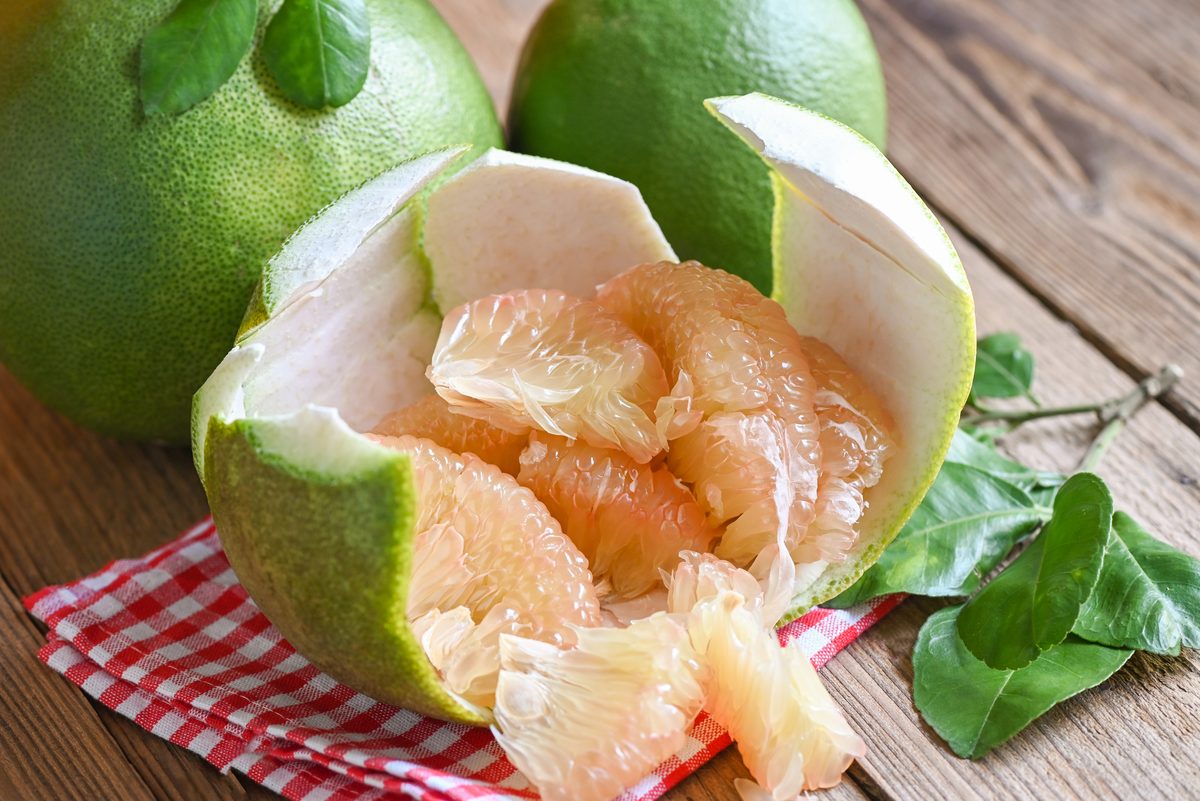
- Peeling it: cut into the thick skin, remove it, then take off the white, bitter membrane around each segment.
- Eating it plain, in a fruit salad, or in a savoury salad, Thai style, with prawns, fresh herbs and peanuts.
Frequently asked questions
What is the difference between grapefruit and pomelo?
In France, the fruit sold as « pamplemousse » is the ordinary grapefruit (Ciqual’s « pomelo »). Pomelo, the Chinese grapefruit, is a different citrus fruit, larger, with a thicker skin, and nearly twice as rich in vitamin C.
How many calories in a pomelo?
38 kcal per 100 g of flesh, according to the Ciqual table.
Does pomelo interact with medicines?
Yes, like grapefruit. Studies have shown it with ciclosporin, tacrolimus and felodipine. If your leaflet advises against grapefruit, avoid it too.
Can you eat pomelo with statins?
It depends on the statin. Some, like simvastatin, are very sensitive to grapefruit. Check the leaflet and ask your pharmacist.
Should you leave a gap between grapefruit and the medicine?
No, it is not enough: the effect on the gut enzyme lasts until it is renewed.
Does pomelo help you lose weight?
No, but it is one of the lowest-calorie fruits, handy for replacing a sugary dessert.
Does the whole fruit interact too, or only the juice?
The fruit too: the ANSM thesaurus covers « grapefruit, juice and fruit », and a study measured the effect of 250 g of pomelo pulp on ciclosporin.
Which medicines are incompatible with grapefruit?
The ANSM thesaurus lists about twenty, including simvastatin, ticagrelor, immunosuppressants, carbamazepine, sertraline and several cancer drugs. The leaflet of each medicine says so.
Can you eat pomelo when pregnant?
Yes: it is not among the foods to avoid during pregnancy. Just check compatibility with any treatments you take.
How many hours between grapefruit and a medicine?
No gap is safe: according to the 2013 Canadian review, the interaction keeps half its strength 10 hours after a glass of juice, and still a quarter after 24 hours. If your leaflet advises against grapefruit, avoid it completely.
Is grapefruit juice as good as the fruit?
No: according to Ciqual, pure grapefruit juice has almost no fibre left, less vitamin C and more sugars than the fruit, and its glycaemic index is 48 versus 25 for raw fruit.
Why are older people more exposed to interactions?
Because they take more medicines, and a marked interaction has been observed in patients over 70, according to the 2013 Canadian review.
Our sources
- Ciqual 2025 table (Anses): pamplemousse chinois; pomelo (dit pamplemousse), yellow and pink.
- Bailey DG, Dresser G, Arnold JM. Grapefruit-medication interactions: forbidden fruit or avoidable consequences? CMAJ, 2013 (PMC3589309).
- Egashira K et al. Pomelo-induced increase in the blood level of tacrolimus in a renal transplant patient. Transplantation, 2003 (PMID 12698101).
- Grenier J et al. Pomelo juice, but not cranberry juice, affects the pharmacokinetics of cyclosporine in humans. Clin Pharmacol Ther, 2006 (PMID 16513449).
- Guo LQ et al. Different roles of pummelo furanocoumarin and cytochrome P450 3A5*3 polymorphism in the fate and action of felodipine. Curr Drug Metab, 2007 (PMID 17691921).
- Anlamlert W et al. Pomelo enhances cyclosporine bioavailability in healthy male Thai volunteers. J Clin Pharmacol, 2015 (PMID 25408261).
- Atkinson FS, Foster-Powell K, Brand-Miller JC. International tables of glycemic index and glycemic load values: 2008. Diabetes Care, 2008.
- Regulation (EU) No 1169/2011: reference intake for vitamin C, 80 mg.
- ANSM, Thésaurus des interactions médicamenteuses, September 2023: entry « Pamplemousse (jus et fruit) ».
- Ciqual 2025 table (Anses): grapefruit (pomelo) juice, pure juice.
- Atkinson FS, Foster-Powell K, Brand-Miller JC. International tables of glycemic index and glycemic load values: 2008. Diabetes Care, 2008: grapefruit juice without added sugar.


