Silica supplement: benefits, best forms (MMST, orthosilicic acid, horsetail) and side effects
The short answer
Silicon is a mineral found in water, plant foods and beer, and in your bones, skin and hair. Silica supplements come in several forms: monomethylsilanetriol (MMST, “organic silicon”), stabilized orthosilicic acid, horsetail and bamboo. They are not equal: some are well absorbed, others barely at all. The evidence for benefits is modest: a few small placebo-controlled trials show effects on skin, nails and hair strength, plus a signal on a bone-formation marker, with no proven gain in bone density. At usual doses (around 10 mg a day), trials found no side effects, but long-term data are lacking.
This article is for information and does not replace medical advice. If you have osteoporosis, significant hair loss, kidney disease or are pregnant, talk to your doctor before taking silica.
What is silica, and how much do you get from food?
In water and blood, silicon travels in a dissolved form called orthosilicic acid (OSA). In plants it builds up as silica, tiny mineral particles that dissolve poorly. In the US Framingham Offspring cohort, average intake was about 30 mg a day, one of the highest of any trace element (Jugdaohsingh et al., 2004). There is no official recommended intake, because no deficiency disease is known in humans.
Types of silica supplements: MMST, orthosilicic acid, horsetail, bamboo
What matters most is absorption. A London team measured how much silicon healthy fasting volunteers excreted in urine after different sources (Sripanyakorn et al., 2009):
| Silicon source | What it is | Share absorbed (urine) |
|---|---|---|
| Monomethylsilanetriol (MMST) | Synthetic molecule, liquid | 64% |
| Alcohol-free beer | Dissolved silicon from barley | 64% |
| Green beans | Food | 44% |
| Orthosilicic acid solution | Reference dissolved form | 43% |
| Choline-stabilized orthosilicic acid | Supplement (capsules, drops) | 17% |
| Bananas | Food | 4% |
| Colloidal silica | Silica particles | 1% |
- MMST (“organic silicon”): well absorbed. The EU authorized it in 2016 as a novel food ingredient in liquid supplements for adults, up to 10.4 mg of silicon a day, after a favorable opinion from the European Food Safety Authority (EFSA).
- Stabilized orthosilicic acid: OSA tends to clump into silica, so makers stabilize it with choline, vanillin, maltodextrin or collagen peptides. It is the form used in the main skin, hair and bone trials.
- Horsetail and bamboo silica: mostly poorly soluble silica. We found no human trial measuring their effect on bones or hair. For horsetail, the European Medicines Agency only recognizes a traditional use to increase urine flow in minor urinary complaints, and for superficial wounds.
- Silicon dioxide (E551): mainly an anti-caking additive, poorly absorbed as a silicon source.
Silica benefits: what the studies show
Bones: a signal, not proof
In the Framingham cohort (2,847 people), men and premenopausal women with the highest silicon intake (over 40 mg a day) had hip bone density up to 10% higher than those with the lowest (under 14 mg). There was no link in postmenopausal women, and an observation does not prove cause and effect.
The only sizable placebo-controlled trial (Spector et al., 2008) followed 136 women with osteopenia for 12 months. All took calcium and vitamin D; some added 3, 6 or 12 mg of silicon as choline-stabilized OSA. A marker of bone collagen formation rose at 6 and 12 mg, but spine bone density did not change, and the hip effect appeared only in a subgroup analysis. No silicon-related side effects. For your bones, the basics still come first: see how to prevent osteoporosis with diet and foods high in calcium.
Skin, nails and hair: two small positive trials
Skin and nails. Fifty women with sun-damaged skin took 10 mg of silicon a day (choline-stabilized OSA) or a placebo for 20 weeks (Barel et al., 2005). Skin roughness fell by 8 to 19% depending on the measure, while it rose on placebo; the women also rated their nails and hair as less brittle.
Hair. Forty-eight women with fine hair took 10 mg a day or a placebo for 9 months (Wickett et al., 2007). Hair lost less strength on silicon and became thicker than at baseline. This trial measured hair strength, not hair loss or regrowth: it says nothing about balding or shedding.
| Use | What studies show | Level of evidence |
|---|---|---|
| Bone density | Link in one cohort; 12-month trial with no spine density gain | Insufficient |
| Skin (roughness, elasticity) | 1 placebo-controlled trial, 50 women, 20 weeks | Low |
| Brittle nails | Self-rated improvement in the same trial | Low |
| Fine hair (strength, thickness) | 1 placebo-controlled trial, 48 women, 9 months | Low |
| Hair loss, arthritis, inflammation | No solid human trial found | Insufficient |
All these trials are small, partly run by researchers linked to the maker of the form studied, and never repeated at scale. The skin and hair results come from choline-stabilized OSA and don’t automatically apply to other forms. Losing hair? Look for the cause first: see our best supplements for hair loss and our guide to biotin. For skin, collagen has more research: see collagen benefits, types and food sources. For joints, where we found no solid silica trial, see our best joint supplements.
Silica-rich water
Water provides dissolved, well-absorbed silicon. In a small UK study, 15 people with Alzheimer’s disease and their carers drank up to 1 liter a day of silicon-rich mineral water for 12 weeks (Davenward et al., 2013). Urinary aluminum excretion rose, and cognition improved meaningfully in 3 of 15 patients. There was no placebo group, and the authors call it a first step. To choose a water, see our best bottled water comparison.
Silica supplement side effects and safety
At trial doses (3 to 12 mg a day), no silicon-related side effects were reported, either in the 12-month bone trial or in a 4-week MMST trial at 10.5 mg a day (Jugdaohsingh et al., 2013). EFSA judged MMST safe under the proposed conditions (opinion of March 9, 2016), but one pharmacologist argued long-term safety data were insufficient (Vanden Berghe, 2013). Published studies are short.
| Situation | What to know |
|---|---|
| Kidney disease | Absorbed silicon leaves through urine: check with your doctor first |
| Horsetail | Traditional diuretic; avoid if you have been told to limit fluids (severe heart or kidney disease); not under 12 |
| Fish allergy | Some forms are stabilized with marine collagen: read the label |
| Pregnancy, breastfeeding | No trial data: ask your doctor or midwife |
| Children | MMST is authorized for adults only |
How much silica per day?
- Trial dose: around 10 mg of elemental silicon a day for skin and hair, 3 to 12 mg for bone. Compare elemental silicon, not the total ingredient weight.
- Duration: effects were measured after 20 weeks (skin) and 9 months (hair). Give it at least 3 months.
- Form: prefer a form with documented absorption (stabilized OSA, MMST) over powdered horsetail or bamboo.
- Don’t stack several silica products.
Dynveo: orthosilicic acid stabilized with collagen
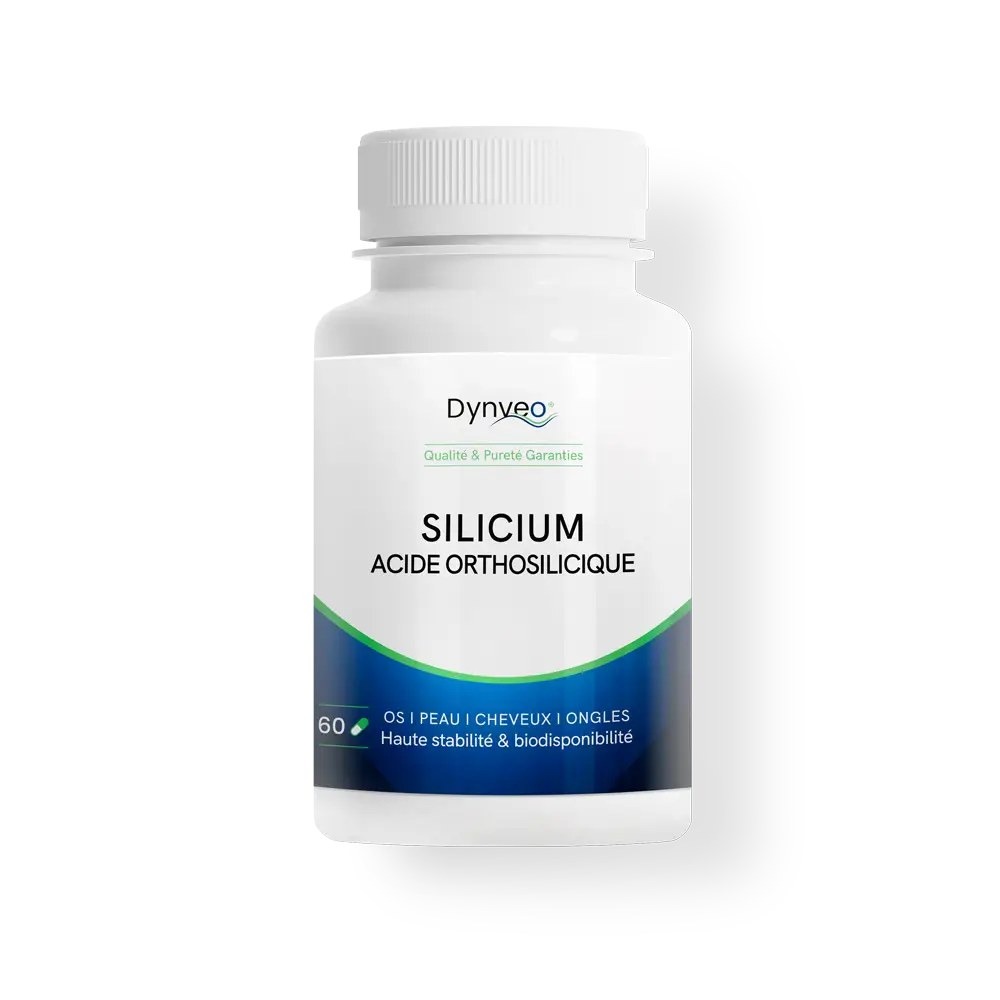
If you want to try silica, Dynveo’s Silicium acide orthosilicique stands out for a clear label on form and dose:
- a patented ingredient, Prosagen Si: orthosilicic acid stabilized with marine collagen peptides, a dissolved form;
- 300 mg per capsule, providing 30 mg of orthosilicic acid and 9 mg of silicon;
- 1 capsule a day with a meal and a large glass of water, for 2 to 6 months; 60 capsules, a 2-month supply;
- pullulan vegetable capsule, no additives; ingredient made in Monaco, packed by the brand in Teyran (France), with a published certificate of analysis per batch;
- €29.90 per bottle (price checked on 22/11/2026), about €0.50 a day.
How does the dose compare? 9 mg of silicon is very close to the 10 mg used in the skin and hair trials and within the bone trial range. The form differs, though: the published trials above used choline-stabilized OSA, not collagen. The brand cites studies on its own ingredient, which do not replace a large independent trial. The 246 mg of collagen is there to stabilize the silicon; the brand itself notes it is not a nutritional dose. Avoid it with a fish allergy; not vegan. The brand advises seeking professional advice during pregnancy.
Partner link: we earn a commission if you order through this link, at no extra cost to you.
Frequently asked questions
What are the benefits of silica?
It is part of the structure of bone and connective tissue. As a supplement, small trials show effects on skin roughness, brittle nails and fine-hair strength. Evidence for bone density is lacking.
Does silica help hair growth?
One trial showed thicker, stronger fine hair after 9 months; none has shown it stops hair loss or regrows hair.
What is the best form of silica supplement?
Forms with documented absorption: MMST and stabilized orthosilicic acid. Colloidal silica and plant silica are poorly absorbed.
What are the side effects of silica supplements?
None reported in trials at about 10 mg a day, but studies are short. Check with your doctor if you have kidney disease or are pregnant.
Is horsetail a good source of silica?
Its silica is poorly soluble, and the EMA only recognizes a traditional diuretic use. We found no human trial on bones or hair.
Sources
- Jugdaohsingh R. et al. Dietary silicon intake is positively associated with bone mineral density in men and premenopausal women of the Framingham Offspring cohort. J Bone Miner Res, 2004; 19(2): 297-307. PubMed 14969400
- Sripanyakorn S. et al. The comparative absorption of silicon from different foods and food supplements. Br J Nutr, 2009; 102(6): 825-34. PubMed 19356271
- Spector T.D. et al. Choline-stabilized orthosilicic acid supplementation as an adjunct to calcium/vitamin D3 stimulates markers of bone formation in osteopenic females. BMC Musculoskelet Disord, 2008; 9: 85. PubMed 18547426
- Barel A. et al. Effect of oral intake of choline-stabilized orthosilicic acid on skin, nails and hair in women with photodamaged skin. Arch Dermatol Res, 2005; 297(4): 147-53. PubMed 16205932
- Wickett R.R. et al. Effect of oral intake of choline-stabilized orthosilicic acid on hair tensile strength and morphology in women with fine hair. Arch Dermatol Res, 2007; 299(10): 499-505. PubMed 17960402
- Jugdaohsingh R. et al. The silicon supplement ‘Monomethylsilanetriol’ is safe and increases the body pool of silicon in healthy pre-menopausal women. Nutr Metab (Lond), 2013; 10(1): 37. PubMed 23622499; critical reply: Vanden Berghe D.A., 2013. PubMed 24499245
- Davenward S. et al. Silicon-rich mineral water as a non-invasive test of the ‘aluminum hypothesis’ in Alzheimer’s disease. J Alzheimers Dis, 2013; 33(2): 423-30. PubMed 22976072
- Commission Implementing Decision (EU) 2016/1344 authorizing organic silicon (monomethylsilanetriol) as a novel food ingredient. eur-lex.europa.eu
- European Medicines Agency (EMA/HMPC). Equiseti herba (horsetail herb), EU herbal monograph. ema.europa.eu