Maltodextrin: a real danger or a false accusation? What the studies say
The short answer
Maltodextrin is not toxic, but in the body it behaves almost like pure glucose. Made from maize, wheat, potato or tapioca starch, it is digested very quickly and raises blood sugar fast: in a 2020 trial, 50 g of maltodextrin gave a blood sugar level 30 minutes later close to that of 50 g of glucose. It has a use during long exercise, where this fast sugar is helpful. In everyday life, it adds fast carbohydrate where you do not expect it, in products that look « low in sugar » on the label. Studies in mice also suggest an unfavourable effect on the gut barrier, with no proof in humans.
This article is for information only and does not replace medical advice. If you have diabetes, talk to your doctor or dietitian.
What is maltodextrin?
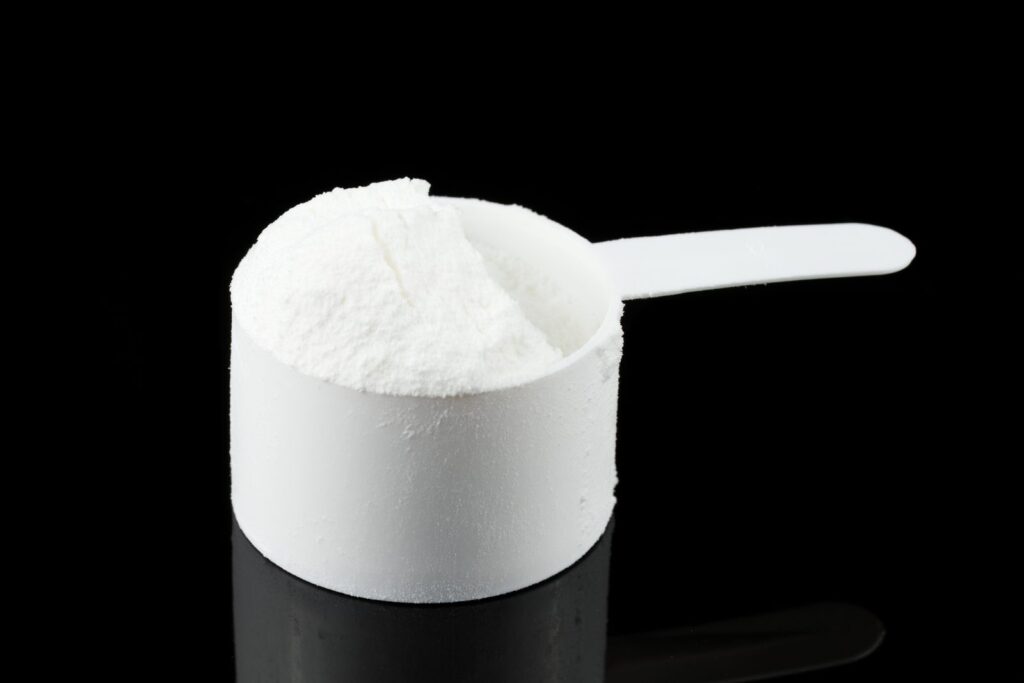
Maltodextrin is a white powder obtained by breaking starch down into shorter chains of glucose, by hydrolysis. According to the review by Hofman et al. (Critical Reviews in Food Science and Nutrition, 2016), digestible maltodextrins are chains of glucose whose proportion of reducing sugars, called dextrose equivalent or DE, ranges from 3 to 20%. Above 20, it is called glucose syrup. They taste only mildly sweet, dissolve well, thicken and act as a carrier for flavourings: that is why the industry uses them everywhere.
Two important points:
- It is not an additive in the regulatory sense: maltodextrin has no E number. It appears in the ingredients list under its own name.
- It is not a « sugar » on the label: the « of which sugars » line counts only simple sugars. A large part of the maltodextrin is therefore counted in the carbohydrate, not in the sugars. A product can thus show little sugar while containing a lot of maltodextrin.
Not to be confused with maltitol, a polyol sweetener, see our maltitol guide, nor with resistant maltodextrin, a fibre that is hardly digested at all.
Glycaemic index: the real issue
Maltodextrin is made of glucose, and its short chains are cut up very quickly by digestive enzymes. The review by Hofman et al. concludes that the glucose from maltodextrins is rapidly absorbed in the small intestine, and that replacing unprocessed starch with maltodextrin can increase the glycaemic load and blood sugar after a meal.
| 50 g of | Blood sugar 30 minutes later |
|---|---|
| Glucose | 135.9 mg/dL |
| Tapioca maltodextrin | 127.9 mg/dL |
| Mix of maltodextrin and 15% resistant maltodextrin | 124.7 mg/dL |
| Tapioca resistant maltodextrin, a fibre | 104.6 mg/dL |
Digestible maltodextrin therefore raises blood sugar almost as much as pure glucose, the glycaemic index reference at 100. You sometimes read GIs of 105 to 136: these figures circulate without a verifiable source in the international GI tables, which contain no measurement of maltodextrin on its own. Remember the order of magnitude: very high, close to glucose, well above table sugar, measured at around 65. For the notion of GI, see our guide to the glycaemic index.
Diabetes and maltodextrin
For a person with diabetes, maltodextrin should be counted as glucose: every gram is a gram of fast carbohydrate. It raises two practical problems:
- it is invisible in the « sugars » line of the label: look at the total carbohydrate and the ingredients list;
- it hides in products you think of as neutral: protein powders, dehydrated soups and sauces, ready meals, « no added sugar » biscuits.
To correct a hypoglycaemic episode, the French Diabetes Federation (Fédération Française des Diabétiques) recommends 15 g of fast sugars, for example three sugar lumps: maltodextrin adds nothing more. See our guide to type 2 diabetes: diet and prevention.
Microbiome and gut: what the studies show
This is the most worrying argument, but for now it rests on studies in animals and in the laboratory:
- in mice, water enriched with maltodextrin degraded the layer of mucus that protects the gut and favoured the survival of salmonella (Nickerson et al., PLoS One, 2014);
- in mice, a diet enriched with maltodextrin worsened induced intestinal inflammation, by reducing mucus production (Laudisi et al., Cellular and Molecular Gastroenterology and Hepatology, 2019).
These results raise questions, in particular for chronic inflammatory bowel diseases. But no study has shown this effect in humans, and the doses used in mice do not necessarily correspond to everyday consumption. Cautious conclusion: no need to panic, but no reason to eat a lot of it either. See also our guide to the gut microbiome.

Human microbiome: the first data
Since the studies in mice, researchers have started to test maltodextrin on human microbiomes, in the laboratory. In 2026, a team fermented fibres with the stools of 6 healthy adults and 6 people with Crohn’s disease in remission, adding one of 12 common additives or ingredients, including maltodextrin.
| Effect observed with maltodextrin | In whom |
|---|---|
| Significant change in the composition of the microbiome | both groups |
| Drop in the total quantity of bacteria | both groups |
| Increased acetate production | both groups |
| Decreased butyrate production | healthy people |
| Drop in bacteria of the Faecalibacterium genus | Crohn’s disease |
These results fit with the caution already mentioned, but they come from fermentation in a test tube, with the stools of 12 people: it is not a living gut. In humans, a 2025 review on inflammatory bowel diseases brought together 18 studies on ultra-processed foods and additives. It concludes that links are possible, but the trials that removed additives from the diet did not produce convincing results. If you have Crohn’s disease or ulcerative colitis, it is with your gastroenterologist or dietitian that you should discuss any exclusion.
Where is maltodextrin found?
| Product | Role of maltodextrin |
|---|---|
| Sports drinks and gels | source of fast carbohydrate during exercise |
| Mass gainers, bulking products | often the main ingredient, for the calories |
| Some whey and protein powders | flavour carrier, texture |
| Dehydrated soups, sauces and stock | thickener, carrier |
| Crisps, flavoured savoury biscuits | seasoning carrier |
| Desserts, ice creams, « light » products | texture, fat replacement |
| Powdered table sweeteners | bulking carrier |
| Baby foods and growing-up milks | source of carbohydrate |
How to spot it: the ingredients list mentions « maltodextrin » or « dextrin ». Its close relatives, which contain more sugars, are glucose syrup and dried glucose syrup. Ingredients are listed in descending order of quantity: the higher maltodextrin is in the list, the more there is. See our guide to food labels.
How many products contain it?
To gauge its place on the shelves, we queried the collaborative database Open Food Facts: more than 10,600 products sold in France, with a complete ingredients list, mention maltodextrin. A few of the best-represented families:
| Product family | Products containing maltodextrin |
|---|---|
| Biscuits and cakes | 531 |
| Desserts | 397 |
| Sauces | 376 |
| Baby foods | 339 |
Maltodextrin is therefore not reserved for sports products: it is everywhere, often in small amounts, as a texturing agent or flavour carrier. It is mainly when it comes at the top of the list, in a gainer, a drink or a « light » dessert, that it really weighs on blood sugar.
Wheat maltodextrin and gluten intolerance
Maltodextrin can be made from wheat. Yet European allergen labelling rules provide an exception: wheat-based maltodextrins, like wheat-based glucose syrups, do not have to be flagged as containing gluten. The reason: their manufacture removes the wheat proteins, including gluten, to a level considered safe.
In practice, a wheat maltodextrin therefore poses no problem for people with coeliac disease, according to these rules. If you need to avoid gluten, the « gluten-free » statement or the crossed grain logo remains the safest guide for the product as a whole. See our guide to understanding gluten intolerance.
Maltodextrin in whey: should you avoid it?
In a good-quality whey, maltodextrin has no nutritional role: it dilutes the protein and acts as a flavour carrier. A whey that contains a lot shows less protein per 100 g and more carbohydrate. Two checks:
- the protein per 100 g: compare it from one whey to another; the higher it is, the less room there is for maltodextrin;
- the ingredients list: a short whey, whey protein, flavouring, possibly an emulsifier and a sweetener, does not contain any.
For a gainer, it is different: the maltodextrin is deliberate, because the aim is to provide a lot of calories. To compare the wheys on the market, see our comparison of the best wheys, and for bulking, our guide to nutrition and muscle gain.
During exercise: its real use
During long exercise, the body needs fast carbohydrate. The joint position of the American College of Sports Medicine and the North American dietitians (2016) recommends about 30 to 60 g of carbohydrate per hour for efforts of one to two and a half hours, and up to 90 g per hour beyond that, with mixed carbohydrates. Maltodextrin, mildly sweet in taste and easy to dilute, is one of the most widely used carbohydrates in these drinks. In this context, its speed of absorption is an advantage, not a flaw. See our guide to hydration and sports performance.
Glucose alone or a glucose-fructose mix?
In sports drinks, maltodextrin is often combined with fructose. According to the authors of the review below, these mixes increase the share of the drink’s carbohydrate that is actually burned as fuel during exercise, and improve digestive comfort. A 2015 review brought together 14 studies on efforts of 2.5 to 3 hours, mainly cycling and in men:
| Drink tested | Effect on average power, compared with glucose or maltodextrin alone |
|---|---|
| Fructose and glucose or maltodextrin, ratio from 0.5:1 to 1:1, from 1.3 to 2.4 g of carbohydrate per minute, or about 78 to 144 g per hour | small to moderate gain, from 1 to 9% |
| Ratio 0.5:1, at 1.7 g per minute or more, or about 100 g per hour | clearer gain, from 4 to 9% |
| Ratio 0.5:1, from 1.4 to 1.6 g per minute | gain of 1 to 3% |
At high doses, the mixes were also associated with fewer digestive problems. But the benefit depends on the effort. In a 2025 trial in 15 semi-professional footballers, over a simulated 120-minute match, 90 g per hour of a fructose-glucose mix did not preserve performance any better than 60 g per hour of glucose alone, and caused more abdominal cramps. For an outing of an hour, or for recreational sport, these calculations are not needed: the benchmarks of the 2016 joint position, cited above, are enough.
Rinsing your mouth without swallowing: a surprising use
For some efforts, maltodextrin works even without being swallowed. Simply rinsing your mouth with a sugary solution stimulates receptors in the mouth linked to the brain areas that handle movement and motivation. A 2025 meta-analysis brought together 33 studies on physical performance, in adults who had eaten before the effort:
- the effect on performance is small but significant;
- it was more marked during endurance efforts, with maltodextrin solutions, for rinses of 10 seconds or less, and after a carbohydrate-rich meal;
- the certainty of the evidence remains low.
It is an option for athletes who tolerate sugary drinks badly during exercise, but it does not replace carbohydrate intake during an effort lasting several hours. And it is of no use for correcting a hypoglycaemic episode: in that case, you need to swallow 15 g of fast sugars, as the French Diabetes Federation reminds us.
The alternatives
- Day to day: minimally processed starchy foods, oats, wholemeal bread, pulses, rather than ready-made products.
- In a whey: a native or isolate whey with a short ingredients list.
- For bulking: blended oats, banana, fromage frais, instead of a gainer.
- During exercise: maltodextrin remains a good choice; banana, fruit paste or dates are food-based alternatives.

Frequently asked questions
Is maltodextrin dangerous?
It is not toxic. Its main drawback is that it raises blood sugar almost like glucose. Effects on the gut have been shown only in mice.
What is the glycaemic index of maltodextrin?
Very high, close to that of glucose. The figures of 105 to 136 often quoted do not appear in the international GI tables.
Is maltodextrin a sugar?
It is a chain of glucose. On the label, it counts mainly in the carbohydrate, not in the « of which sugars » line.
Is maltodextrin not recommended for people with diabetes?
It should be counted as a fast sugar: it raises blood sugar very quickly. It is best avoided day to day.
Do you need a whey without maltodextrin?
Yes if you want a whey that is high in protein and low in carbohydrate: look at the ingredients list and the protein per 100 g.
Does maltodextrin make you gain weight?
No more than other carbohydrates at equal calories, about 4 kcal per gram. But it hides in products where you do not expect it.
Does maltodextrin contain gluten?
Even when made from wheat, maltodextrin is exempt from the « gluten » allergen statement under European regulations, because its manufacture removes the wheat proteins.
How many products contain maltodextrin?
More than 10,600 products sold in France contain it according to Open Food Facts, notably biscuits, desserts, sauces and baby foods.
Does maltodextrin damage the human microbiome?
We do not know. In the laboratory, with human stools, it changed the composition of the microbiome and reduced the quantity of bacteria. But no study has shown a harmful effect in humans in real-life conditions.
Should you combine maltodextrin and fructose during exercise?
For efforts of more than 2.5 hours at high doses, around 100 g of carbohydrate per hour, the mixes improved power by 4 to 9% in the studies. For shorter efforts, it is not necessary.
Is maltodextrin also a pesticide?
Yes, in a different use: in 2025 EFSA assessed maltodextrin as an insecticide and acaricide active substance on crops. This changes nothing about its status as a food ingredient.
Our sources
- Hofman DL, van Buul VJ, Brouns FJ. Nutrition, Health, and Regulatory Aspects of Digestible Maltodextrins. Critical Reviews in Food Science and Nutrition, 2016.
- Astina J, Sapwarobol S. Attenuation of glycaemic and insulin responses following tapioca resistant maltodextrin consumption in healthy subjects. Journal of Nutritional Science, 2020.
- Nickerson KP et al. The dietary polysaccharide maltodextrin promotes Salmonella survival and mucosal colonization in mice. PLoS One, 2014.
- Laudisi F et al. The Food Additive Maltodextrin Promotes Endoplasmic Reticulum Stress-Driven Mucus Depletion and Exacerbates Intestinal Inflammation. Cellular and Molecular Gastroenterology and Hepatology, 2019.
- Atkinson FS et al. International Tables of Glycemic Index and Glycemic Load Values 2008, Diabetes Care: GI of sucrose.
- Thomas DT, Erdman KA, Burke LM. Nutrition and Athletic Performance, ACSM joint position, 2016.
- Fédération Française des Diabétiques: treating hypoglycaemia with sugar.
- Open Food Facts, products sold in France containing maltodextrin, queried on 25 September 2026.
- Regulation (EU) No 1169/2011, Annex II: exemption of wheat-based maltodextrins and glucose syrups from the allergen statement.
- Alessa H et al. In vitro effects of twelve food additives on gut microbiome and its fibre fermentation capacity in adults with Crohn’s disease in remission and healthy controls. Nutrients, 2026 (PMID 41754185).
- Soublette Figuera A et al. Effects of ultra-processed foods and food additives on disease activity in adults with inflammatory bowel disease: a scoping review. J Clin Med, 2025 (PMID 41227194).
- Rowlands DS et al. Fructose-glucose composite carbohydrates and endurance performance: critical review and future perspectives. Sports Med, 2015 (PMID 26373645).
- Fischer A et al. Negligible effects of fructose-glucose composite carbohydrates on performance across a prolonged soccer match simulation. Int J Sport Nutr Exerc Metab, 2025 (PMID 40537112).
- Deng H et al. Fed, not fasted: is carbohydrate mouth rinsing still ergogenic? A three-level meta-analysis. J Int Soc Sports Nutr, 2025 (PMID 41199504).
- EFSA. Peer review of the pesticide risk assessment of the active substance maltodextrin. EFSA Journal, 2025 (PMID 40071031).