How to Lose Belly Fat: What Really Works
“Losing belly fat” is one of the most common goals, and the happy hunting ground of the biggest scams. No belt, herbal tea or set of crunches targets belly fat: one trial showed that six weeks of abdominal exercises reduce neither waist circumference nor abdominal fat. What works is well known: a moderate calorie deficit to reduce overall body fat, endurance exercise, which acts particularly on the deep fat in your belly, less alcohol and fewer sugary drinks, and enough sleep. This guide goes through each lever, with the figures to back it up.
👉 Free tool: Calorie deficit: calculate it in 30 seconds, no sign-up needed.
Measuring your belly: waist circumference
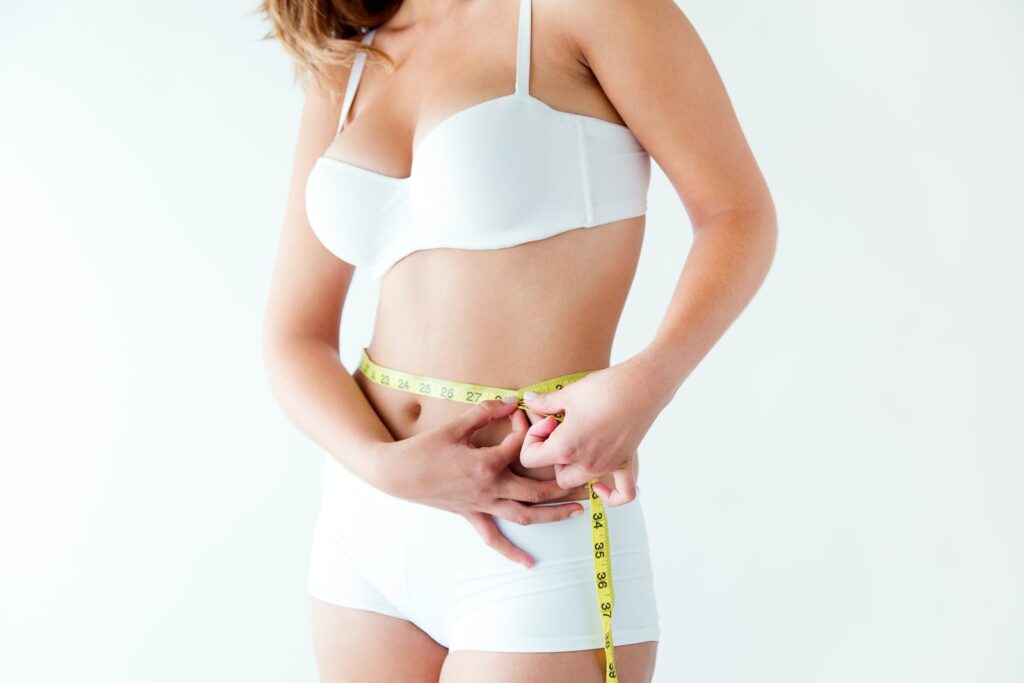
Before trying to reduce it, measure it. The HAS (the French National Authority for Health) describes the method: halfway between the lower edge of the last rib and the top of the iliac crest (the top of the hip bone), with a tape measure held horizontally, at the end of a normal breath out, arms by your sides.
Waist circumference is, according to the HAS, a simple indicator of excess abdominal fat, and this excess is associated, independently of BMI, with metabolic and vascular complications. The thresholds to know:
| Threshold | Women | Men | Meaning |
|---|---|---|---|
| Abdominal obesity (European populations) | ≥ 80 cm | ≥ 94 cm | Risk factor for diabetes and cardiovascular disease, independently of BMI |
| Higher thresholds used in the United States | ≥ 88 cm | ≥ 102 cm | High risk level |
| Target proposed by the HAS (2023) | ≤ 88 cm | ≤ 102 cm | Target to reach alongside a healthy weight, for overweight or uncomplicated obesity |
Note: the HAS does not recommend, in first-line care, the waist-to-hip ratio or bioelectrical impedance to assess fat. Our waist and hip measurement tool gives an indication, but waist circumference alone remains the reference measure. Measure it once a month, under the same conditions: it is a better gauge of your progress than weight alone.
Two kinds of belly fat, two different issues
Your belly contains two types of fat:
- Subcutaneous fat, just under the skin, the kind you can pinch.
- Visceral fat, deeper, around the abdominal organs.
Visceral fat is the most studied for health. A meta-analysis (Vissers et al., 2013) notes that excess visceral fat seems to trigger a cascade of metabolic disturbances and coexists with fat deposits in the muscle, liver or heart. This is why the HAS has made reducing a high waist circumference a treatment goal, even in someone who is simply overweight. To find out more about the liver, see our guide to liver health.
Why crunches do not melt belly fat
The idea of “spot reduction” is intuitive: working a muscle would burn the fat covering it. Two trials tested it directly.
- Vispute et al. (2011): 24 sedentary adults did 7 abdominal exercises, 2 sets of 10 repetitions, 5 days a week for 6 weeks, with their diet kept constant. Result: no effect on weight, body fat percentage, abdominal fat, waist measurement or skinfolds. Only abdominal muscle endurance had improved.
- Ramírez-Campillo et al. (2013): 11 adults trained a single leg for 12 weeks, with sets of 960 to 1,200 repetitions. Total fat mass fell by 5.1%, but fat decreased in the arms and trunk, not in the trained leg.
Your body draws on its reserves across the whole body. Crunches and core work remain useful for posture, trunk strength and your back, but they are not what will flatten your belly.
What really reduces abdominal fat
1. A moderate calorie deficit
Reducing body fat means eating a little less than you burn. The European guidelines used by the HAS: a 15 to 30% reduction in usual intake, often around 600 kcal per day, for a loss of about 0.5 kg per week, without going below 1,200 kcal per day outside medical supervision. It is all explained in our guide to the calorie deficit and can be calculated with the calorie deficit tool.
2. Endurance exercise, which targets deep fat
This is the most useful piece of information in this guide. A large meta-analysis of 117 studies and 4,815 participants (Verheggen et al., 2016) compared the effect of exercise and diet on visceral fat measured by imaging. Diet led to more weight loss, but exercise tended to reduce visceral fat more. Above all, without weight loss, exercise reduced visceral fat by 6.1%, against 1.1% for diet. In other words, your belly can improve before the scales move.
Another meta-analysis (Vissers et al., 2013) specifies that moderate- to high-intensity aerobic training has the greatest potential, with effects visible from 12 weeks, even without dieting. Brisk walking, cycling, swimming, running: choose what you can stick to.
Santé publique France’s guidelines for adults: at least 30 minutes of dynamic physical activity a day, and twice a week muscle strengthening, flexibility and balance work. For someone who is overweight, the HAS cites roughly 225 to 300 minutes of moderate activity per week. And in between, get up at least every 2 hours. Our guide to daily physical activity gives ideas, and the calories burned tool estimates your expenditure.
3. Both together
Exercise acts strongly on visceral fat, diet on total weight. Combining them is the most complete strategy, and physical activity has a bonus: according to Anses (the French food safety agency), it is also the best factor for not regaining the weight you have lost.
4. Keeping your muscle while you lose weight
A flatter belly means less fat, not less muscle. Yet Anses establishes that all weight-loss diets lead to a loss of lean mass, about 15% of the weight lost, and that only physical activity done at the same time limits this loss. A meta-analysis of 24 trials (Wycherley et al., 2012) also shows that, at equal calories, a diet higher in protein preserves lean mass slightly better and leads to slightly more fat loss. In practice: a source of protein at every meal and muscle strengthening twice a week. Our protein needs tool helps you see where you stand.
As the years go by, extra vigilance
The prevalence of obesity rises with age, as the French figures show. In the 2015 Esteban study, cited by the HAS, obesity was twice as common among 55 to 74 year olds as among 18 to 39 year olds: 21.5% versus 10.1% in men, 20.6% versus 11.3% in women. In total, 49% of adults were overweight or obese.
This trend makes the levers above all the more important after 50: physical activity for visceral fat, strength work for muscle. Anses also notes that after 65, cycling between losing and regaining weight causes muscle loss and fat gain. A slow, steady approach is better than a succession of diets.
The “flat belly” plate: fewer myths, more guidelines
Cutting down on alcohol
Alcohol provides 7.1 kcal per gram, the HAS points out. It cannot be stored: it is oxidised first, at the expense of fat oxidation, which indirectly favours fat storage. In a cross-sectional study cited by the HAS, among 765 men aged 43 to 85, alcohol consumption was associated with an increased risk of abdominal adiposity. Santé publique France’s guidelines: no more than 10 standard drinks a week, no more than 2 a day, and some alcohol-free days.
Replacing sugary drinks
Water is the only drink recommended by Santé publique France. Fizzy drinks, even diet ones, and fruit juices should be limited, and in any case to one glass a day at most.
| Drink | Quantity | Approximate energy |
|---|---|---|
| Water | Any volume | 0 kcal |
| Regular cola | 33 cl can | about 132 kcal |
| Beer (4 to 5% alcohol) | 25 cl | about 98 kcal |
| Strong beer (over 8% alcohol) | 25 cl | about 156 kcal |
| Red wine | 10 cl | about 76 kcal |
To estimate your consumption, the alcohol calories tool works it out drink by drink.
Limiting ultra-processed foods
In the trial by Hall et al. (2019), an ultra-processed diet made people eat 508 kcal more per day than a minimally processed diet, eaten freely, with a gain of 0.9 kg in two weeks. Home cooking remains the simplest way to take back control.
Moving towards a Mediterranean-style diet
The HAS (2023) proposes a Mediterranean-style diet, rich in fruit, vegetables, pulses, wholegrain cereals, olive oil and oily fish. It specifies that its effect on weight is greater when combined with an energy restriction and more physical activity, and followed for more than six months. Our guide to the Cretan diet goes into detail.
Protein and fibre at every meal
They help you stick to the deficit without hunger. The HAS advises that every meal should contain foods that generate satiety: fruit and vegetables, pulses, nuts. To find out more, see our guide to natural appetite suppressants.
Sleep and stress: the underrated levers
In the trial by Nedeltcheva et al. (2010), ten overweight adults followed the same diet with 8.5 hours or 5.5 hours of possible sleep. With short sleep, the share of weight lost as fat fell by 55% and hunger was stronger. A small, short trial, but it fits with the HAS (2023) guidelines: get up at a regular time, get light exposure in the morning, limit screens in the evening, keep your bedroom quiet, cool and dark.
Stress mainly matters through its effects on behaviour: the HAS lists eating in response to emotions and work-related stress among the things to assess. You will find some ideas in our guide to diet and stress management.
Scams and false promises
- Sweat belts, heated shaping girdles: they promise spot reduction. Yet trials show that fat does not leave the area you work on (Ramírez-Campillo, 2013).
- “Flat belly” herbal teas and “fat-burner” supplements: the HAS asks healthcare professionals to warn against supplements taken without a prescription and products sold on the internet whose benefit is questionable. Anses did not evaluate these products in its 2010 report, and considers that an evaluation is needed.
- “Flat belly in 7 days”: the body responds slowly to changes in intake. The model by Hall et al. (2011) describes a half-life of about a year for the weight response.
- Crash diets: they expose you to yo-yo dieting, with weight regained mainly as fat, according to Anses.
A typical week for a flatter belly
- Monday, Wednesday, Friday: 30 to 45 minutes of endurance (brisk walking, cycling, swimming).
- Tuesday and Thursday: 20 to 30 minutes of full-body strength work, core included, plus 30 minutes of walking.
- Weekend: a longer active outing (hiking, cycling), and a calmer day.
- Every day: vegetables at every meal, water as your drink, no more than one glass of a sugary drink, a source of protein at each meal, getting up every 2 hours if you work seated, going to bed at a regular time.
This programme follows Santé publique France’s guidelines. Adapt it to your fitness: if you are returning to activity after a long break, start gently and build up gradually.
Recipes to support your plan
Go for filling, low-calorie dishes: lentil and vegetable soup, chicken and quinoa salad, courgette soup, salmon en papillote with baby vegetables or vegetable and chickpea tagine. All our slimming recipes are here.
Common misconceptions about belly fat
“200 crunches a day and it’s sorted”
No: the Vispute (2011) trial showed no effect of abdominal exercises on belly fat over six weeks.
“If the scales do not move, I am not making progress”
Wrong. Without weight loss, exercise reduces visceral fat by about 6% according to the Verheggen (2016) meta-analysis. Waist circumference is a better indicator than weight for this goal.
“Some foods melt belly fat”
No food targets abdominal fat. What matters is your overall diet and the overall deficit.
“Belly fat is the last to go”
For visceral fat, the data from Verheggen and Vissers show on the contrary that it responds to physical activity within a few weeks.
Precautions
- A belly that swells suddenly, is painful, or rapid unexplained weight gain warrants seeing a doctor: this is not a fat problem.
- At the menopause, the distribution of fat changes: see our guide to diet during the menopause.
- If you are returning to exercise with heart or joint problems or significant overweight, prior medical advice is useful. The HAS reminds us that any activity must take the person’s fitness into account.
- During pregnancy, no energy restriction, according to Anses.
Frequently asked questions
Can you lose belly fat without losing weight?
Yes, partly. According to the Verheggen (2016) meta-analysis, exercise without weight loss reduces visceral fat by about 6%. Your waist circumference can therefore fall before your weight does.
How long does it take to see a result on your belly?
The Vissers (2013) meta-analysis observes a drop in visceral fat from 12 weeks of aerobic training, even without dieting. Measure your waist once a month.
Which exercise is best for losing belly fat?
Moderate- to high-intensity endurance (brisk walking, cycling, running, swimming) has the greatest effect on visceral fat according to Vissers (2013). Add muscle strengthening twice a week, as Santé publique France advises.
What waist circumference is considered too high?
The HAS uses 80 cm for women and 94 cm for men as thresholds for abdominal obesity, and proposes a target of 88 cm maximum for women and 102 cm for men.
Does beer really give you a belly?
Alcohol provides 7.1 kcal per gram and alcohol consumption has been associated with more abdominal adiposity in men, according to a study cited by the HAS. A 25 cl glass of beer provides about 98 kcal according to Ciqual.
This article is for information only and does not replace the advice of your doctor or a dietitian.
Our sources
- Haute Autorité de santé. Overweight and obesity in adults: first-line medical management (in French). Supporting report. September 2011.
- Haute Autorité de santé. Care pathway guide: overweight and obesity in adults, and its summary (in French). January 2023, updated in February 2024.
- Anses. Risk assessment of weight-loss dietary practices (in French). Collective expert report. November 2010.
- Santé publique France. Recommendations on diet, physical activity and sedentary behaviour for adults (in French). 2019.
- Anses. Ciqual food composition table (in French). 2025.
- Vispute SS, Smith JD, LeCheminant JD, Hurley KS. The effect of abdominal exercise on abdominal fat. J Strength Cond Res. 2011. PMID 21804427.
- Ramírez-Campillo R, Andrade DC, Campos-Jara C et al. Regional fat changes induced by localized muscle endurance resistance training. J Strength Cond Res. 2013. PMID 23222084.
- Verheggen RJ, Maessen MF, Green DJ et al. A systematic review and meta-analysis on the effects of exercise training versus hypocaloric diet: distinct effects on body weight and visceral adipose tissue. Obes Rev. 2016. PMID 27213481.
- Vissers D, Hens W, Taeymans J et al. The effect of exercise on visceral adipose tissue in overweight adults: a systematic review and meta-analysis. PLoS One. 2013. PMID 23409182.
- Hall KD, Ayuketah A, Brychta R et al. Ultra-processed diets cause excess calorie intake and weight gain. Cell Metab. 2019. PMID 31105044.
- Hall KD, Sacks G, Chandramohan D et al. Quantification of the effect of energy imbalance on bodyweight. Lancet. 2011. PMID 21872751.
- Nedeltcheva AV, Kilkus JM, Imperial J et al. Insufficient sleep undermines dietary efforts to reduce adiposity. Ann Intern Med. 2010. PMID 20921542.
- Wycherley TP, Moran LJ, Clifton PM, Noakes M, Brinkworth GD. Effects of energy-restricted high-protein, low-fat compared with standard-protein, low-fat diets: a meta-analysis of randomized controlled trials. Am J Clin Nutr. 2012. PMID 23097268.