Diet and the menopause: weight and bone health

The menopause occurs at 51 on average, according to the French national health insurance (Assurance maladie). It does not necessarily make you put on weight in itself, but it changes the way the body stores fat and keeps its muscle, and it speeds up bone loss for 5 to 10 years. Diet does not replace treatment when it is needed, but it acts on three fronts: protecting your bones (calcium, vitamin D, protein), limiting abdominal fat and looking after your heart, whose risk rises after the menopause. Here are the official guidelines and what the studies say, including on soya.
👉 Free tool: Calorie needs – get your result in 30 seconds, no sign-up.
What changes in your body
According to the Assurance maladie, the menopause occurs naturally between 45 and 55 and is considered established when periods have been absent for a year. It is preceded by a transition phase, the perimenopause, which begins 2 to 4 years earlier; symptoms most often appear around the age of 47.
The distribution of fat and muscle
The large American SWAN study followed women throughout this transition, with precise measurements of body composition (Greendale et al., JCI Insight, 2019). The result: at the start of the transition, the rate of fat mass gain doubles and lean mass (mainly muscle) starts to decrease, until about 2 years after the last period. Total weight does not accelerate: it keeps rising at the same pace as before, then levels off. In other words, the scales lie a little: at the same weight, you can have more fat and less muscle. That is why waist circumference is a better guide than weight alone.
Bones
Inserm explains that oestrogens slow the breakdown of bone and promote the formation of new bone. When their level collapses at the menopause, bone loss speeds up for 5 to 10 years. As a result, osteoporosis is two to three times more common in women than in men. Around the age of 65, an estimated 39% of women are affected, and 70% from the age of 80. In 2019, Inserm counted around 484,000 fragility fractures in France, mainly of the hip, vertebrae and wrist.
The heart
Cardiovascular disease is the leading cause of death in women, and the risk rises clearly after the menopause. A scientific statement from the American Heart Association (El Khoudary et al., Circulation, 2020) describes unfavourable changes in body composition, blood lipids and vascular health during the transition. It concludes that your fifties are a key window for prevention. Our guide cholesterol: the foods to favour complements this section.
Your nutritional needs after 50
Good news: most references remain those of the adult woman. There is only one clear drop, iron, since there are no more menstrual losses.
| Guideline | Value | Source |
|---|---|---|
| Calcium (woman aged 25 and over) | 950 mg/day | Anses 2021 |
| Vitamin D | 15 µg/day | Anses 2021 |
| Iron, postmenopausal woman | 11 mg/day (compared with 16 mg/day before, with heavy periods) | Anses 2021 |
| Magnesium | 300 mg/day | Anses 2021 |
| Protein | 0.83 g per kilo of body weight per day | EFSA 2017 |
| Fibre | 25 g/day | EFSA 2017 |
| Water (drinks and food) | 2 L/day | EFSA 2017 |
| Energy, moderate activity, 40-49 years | about 2,050 kcal/day | EFSA 2017 |
| Energy, moderate activity, 50-59 years | about 2,030 kcal/day | EFSA 2017 |
| Energy, moderate activity, 60-69 years | about 1,860 kcal/day | EFSA 2017 |
Energy needs therefore fall little between 40 and 60, and mainly after 60. What makes the difference is the level of activity: for a woman aged 50 to 59, EFSA gives about 1,790 kcal a day if she is sedentary, compared with 2,290 kcal if she is active. To estimate your own case, our calorie needs tool gives an order of magnitude.
Protecting your bones: calcium, vitamin D, protein and movement
Calcium
Anses sets the reference at 950 mg a day. The PNNS recommends 2 dairy products a day for adults; the Assurance maladie, in its advice for the menopause, goes up to 3 dairy products a day and/or a calcium-rich water. The sources are varied:
| Food (Ciqual) | Calcium per 100 g | Protein per 100 g |
|---|---|---|
| Parmesan | 980 mg | 31.1 g |
| Emmental | 978 mg | 27.9 g |
| Comté | 907 mg | 27.8 g |
| Sardines in oil, tinned, drained | 333 mg | 23.3 g |
| Almonds with skin | 260 mg | 18.8 g |
| Dried fig | 167 mg | 2.9 g |
| Plain yoghurt | 137 mg | 3.83 g |
| Semi-skimmed milk | 121 mg | 3.46 g |
| Cannellini beans, boiled | 120 mg | 6.75 g |
| Calcium-fortified soya drink | 98 mg | 3.42 g |
| Calcium-rich mineral water (Hépar) | 54.9 mg (that is 549 mg per litre) | 0 g |
Two observations: hard cooked-pressed cheeses concentrate calcium, but also saturated fat (21.7 g per 100 g of Comté, compared with 1.08 g for plain yoghurt according to Ciqual), so small portions are enough; and an unfortified plant-based drink provides almost nothing (16.8 mg per 100 g for an unfortified plain soya drink, according to Ciqual), so check the label. Full ranking in our guide foods high in calcium.
Vitamin D
It allows you to absorb calcium. The Assurance maladie points out that it is mainly made by the skin under the effect of UVB. On the plate, oily fish are the best sources: according to Ciqual, 100 g of sardines in oil provide 7.56 µg, half of the 15 µg reference. Inserm specifies that in adults who are deficient, calcium and vitamin D supplementation helps strengthen bones, without being a sufficient treatment for established osteoporosis. The dose and supplementation are decided with your doctor; our vitamin D guide details the sources.
Protein
The EFSA reference remains 0.83 g per kilo of body weight per day, or about 54 g for a 65 kg woman. Protein serves mainly to preserve muscle mass, the very thing that decreases during the transition according to SWAN. EFSA notes, however, that the data do not allow a conclusion that an intake above this reference affects bone density. Spreading protein over the three meals is simple: egg or fromage blanc in the morning, fish, poultry or pulses at lunch and dinner. Our protein needs tool calculates your own baseline.
Movement, essential
Inserm is clear: physical exercise has a beneficial effect on bone density at any age, and maintains muscles and balance, which reduces the risk of falls. Sedentary behaviour, conversely, promotes bone loss. The Assurance maladie recommends weight-bearing exercises with impact and muscle strengthening, and for example walking 3 or 4 times a week for 30 to 45 minutes. The PNNS adds strength, flexibility and balance activities at least twice a week. To go further: our guide bone health and osteoporosis.
To avoid: smoking and excess alcohol, which promote bone loss according to Inserm. The Assurance maladie adds that smoking brings the menopause forward by 1 to 2 years and intensifies its symptoms.
Managing your weight and your belly
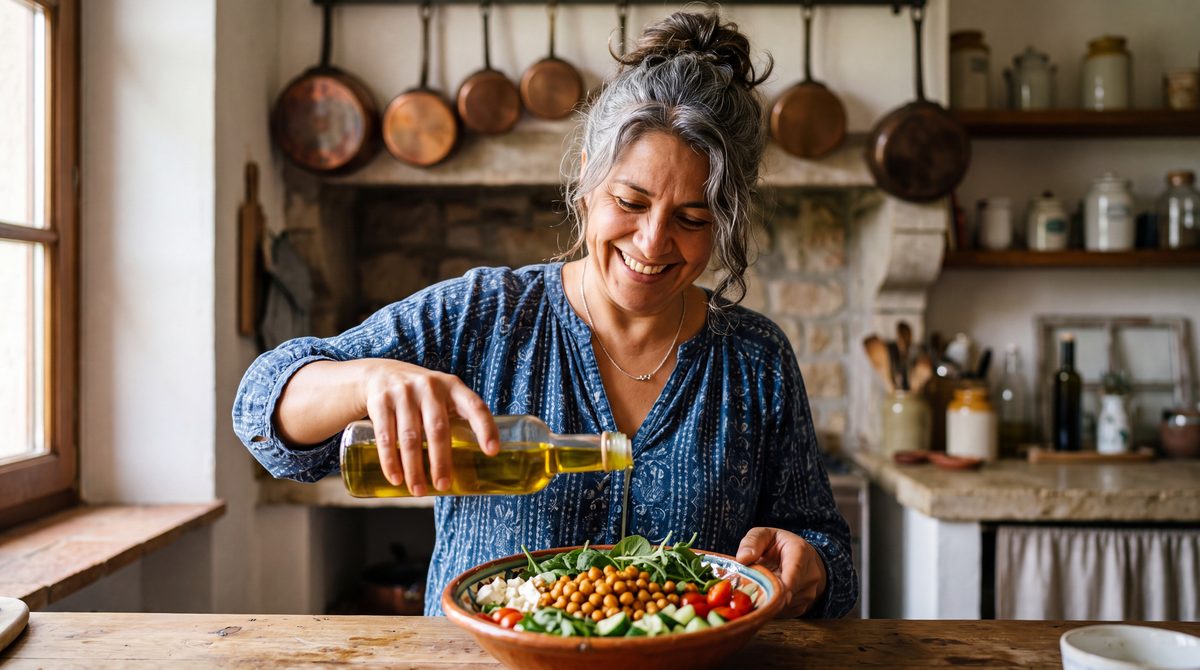
The Assurance maladie advises avoiding restrictive diets and following a balanced diet rich in calcium. Keep in mind that the transition already costs you muscle (SWAN study): the aim is to preserve muscle mass as much as to limit fat. The levers that make sense:
- Protein at every meal: eggs, fish, poultry, pulses, dairy products.
- Fibre for fullness and digestion: EFSA considers 25 g a day adequate and associates higher intakes with better weight maintenance. Vegetables, lentils, wholegrain starchy foods. See our guide dietary fibre.
- Less added sugar, fewer sugary drinks and ultra-processed foods, as the PNNS recommends (no more than one glass of sugary drink a day).
- Good fats: the PNNS favours rapeseed, walnut and olive oils; avocado and a small handful of nuts a day also have their place.
- Less alcohol: the Assurance maladie points out that excess alcohol worsens menopausal symptoms, and sets the guideline at a maximum of 10 standard drinks a week, with no more than 2 a day.
To target the belly, our guide losing belly fat: what works sorts fact from fiction, and the waist-to-hip ratio tool helps you track your progress. The eating pattern most consistent with all these guidelines remains the Mediterranean diet.
Looking after your heart every day
Since the transition comes with unfavourable changes in blood lipids and body composition (AHA, 2020), the « heart » plate and the « menopause » plate are one and the same. The 2019 PNNS guidelines for adults provide the framework:
- Fish twice a week, including one oily fish (sardine, mackerel, herring, salmon), rich in omega-3. According to Ciqual, 100 g of oven-baked mackerel provides 1.34 g of DHA.
- Pulses at least twice a week and at least one wholegrain starchy food a day, for fibre.
- At least 5 portions of fruit and vegetables a day, for example 3 portions of vegetables and 2 of fruit.
- Poultry rather than red meat, limiting other meats to 500 g a week and processed meats to 150 g. The Assurance maladie gives the same advice for the menopause: favour white meat, avoid processed meats and excess red meat.
- Less salt, by tasting before salting, and iodised salt when you use it.
Iron, for its part, becomes less critical: without periods, the Anses reference drops back to 11 mg a day. An iron supplement « out of habit » therefore no longer has any reason to exist without medical advice. Our guide omega-3 details the best sources, and the DASH diet guide is for those whose blood pressure is rising.
Hot flushes: what your plate can (or cannot) do
The Assurance maladie advises avoiding alcohol, coffee and dishes that are too hot or spicy, dressing in light layers and tackling stress, which worsens hot flushes. Sleep is often disturbed: our guide foods and sleep gives a few ideas for dinner.
And soya?
The phytoestrogens in soya (isoflavones) are often presented as a natural solution. The data are disappointing:
- The Cochrane review (Lethaby et al., 2013), which analysed 43 randomised trials and 4,364 participants, concludes that there is no conclusive evidence that phytoestrogen supplements reduce the frequency or severity of hot flushes. It notes a strong placebo effect, with a drop of 1% to 59% in the placebo groups, and a lead worth exploring for genistein-concentrated extracts.
- Afssa (now Anses) concluded in 2005 that the enthusiasm for isoflavone supplements does not rest on rigorous demonstration of an effect on hot flushes, and that trials with dietary soya protein generally did no better than placebo.
- On safety, the same expert appraisal observes no adverse effect up to 1 mg of isoflavones per kilo of body weight per day, and recommends not exceeding this dose. Supplements are not advised for women with a personal or family history of breast cancer, and caution is asked for people treated for hypothyroidism.
In practice: tofu and edamame remain good sources of plant protein in a varied diet (Ciqual gives 13.4 g of protein and 100 mg of calcium per 100 g of plain tofu), but do not expect them to have an effect on hot flushes, and discuss any supplement with your doctor. Menopausal hormone therapy, which according to Inserm slows bone loss and reduces the risk of fracture, is a medical decision.
A typical day
- Breakfast: plain yoghurt or fromage blanc, oat flakes, red berries, a few almonds.
- Lunch: lentil salad with feta, raw vegetables with rapeseed oil, wholemeal bread.
- Snack: a piece of fruit and a piece of Comté, or two dried figs.
- Dinner: salmon, quinoa and spinach, vegetables, fruit; to drink, water, possibly calcium-rich.
More ideas: tofu and vegetable stir-fry with sesame, sardine and white bean salad (calcium from tinned sardines and beans), mustard mackerel or broccoli and potato gratin. Also discover our nutrition guides by age.
Common myths
- « The menopause inevitably makes you put on several kilos. » In SWAN, weight does not accelerate at the time of the transition. It is the composition that changes: more fat, less muscle.
- « Soya replaces hormone therapy. » No: the Cochrane review finds no conclusive evidence on hot flushes, and Afssa notes that the effects of phytoestrogens differ from those of oestrogens.
- « More calcium is always better. » The reference is 950 mg a day; beyond that, Anses sets a safe upper limit of 2,500 mg a day. Supplements are taken on medical advice.
- « Dairy products decalcify. » That is not the position of the French authorities: the PNNS and the Assurance maladie recommend, on the contrary, 2 to 3 dairy products a day.
- « You have to eat far less after 50. » According to EFSA, needs fall little before 60. Physical activity weighs more than age.
Precautions
Talk to your doctor if you have had a fracture after a minor fall, if you have a family history of osteoporosis or breast cancer, or before any supplement (calcium, vitamin D, isoflavones, herbs). Inserm points out that the decision to treat osteoporosis depends on the fracture risk, estimated from measured bone density and other factors (age, weight, history of fracture). Unintentional weight loss, for its part, should always be reported.

Frequently asked questions
How many dairy products a day at the menopause?
The PNNS recommends 2 dairy products a day for adults; the Assurance maladie advises 3 dairy products a day and/or a calcium-rich water at the menopause. The Anses reference is 950 mg of calcium a day.
Why do you gain belly fat at the menopause?
According to the SWAN study, the rate of fat mass gain doubles at the start of the transition, while muscle mass decreases, until about 2 years after the last period. Waist circumference increases even if weight barely moves.
Does soya help with hot flushes?
The 2013 Cochrane review finds no conclusive evidence. Anses recommends not exceeding 1 mg of isoflavones per kilo per day and advises against supplements in the case of a history of breast cancer.
Should you take vitamin D after the menopause?
Not systematically. The reference is 15 µg a day. According to Inserm, in adults who are deficient, calcium and vitamin D help strengthen bones. Your doctor judges whether a test or a supplement is worthwhile.
Which exercise protects your bones?
Weight-bearing exercises with impact (brisk walking, climbing stairs) and muscle strengthening, recommended by the Assurance maladie, for example 3 or 4 walks of 30 to 45 minutes a week.
This article is for information only and does not replace the advice of your doctor, your gynaecologist or a dietitian.
Our sources
- Assurance maladie (ameli.fr). Ménopause : définition, symptômes et diagnostic ; Bien vivre la ménopause.
- Inserm. Ostéoporose, dossier d’information. Octobre 2023.
- Anses. Actualisation des références nutritionnelles françaises en vitamines et minéraux. Mars 2021.
- EFSA. Dietary Reference Values for nutrients, Summary report. EFSA supporting publication 2017:e15121.
- Santé publique France. Recommandations relatives à l’alimentation, à l’activité physique et à la sédentarité pour les adultes. 2019.
- Afssa. Sécurité et bénéfices des phyto-estrogènes apportés par l’alimentation. Recommandations. 2005.
- Greendale GA, Sternfeld B, Huang M, et al. Changes in body composition and weight during the menopause transition. JCI Insight. 2019;4(5):e124865. PMID 30843880.
- Lethaby A, Marjoribanks J, Kronenberg F, et al. Phytoestrogens for menopausal vasomotor symptoms. Cochrane Database Syst Rev. 2013;(12):CD001395. PMID 24323914.
- El Khoudary SR, Aggarwal B, Beckie TM, et al. Menopause Transition and Cardiovascular Disease Risk: Implications for Timing of Early Prevention. A Scientific Statement From the American Heart Association. Circulation. 2020;142(25):e506-e532. PMID 33251828.
- Anses. Table de composition nutritionnelle des aliments Ciqual 2025.