Group · Dairy
Comté
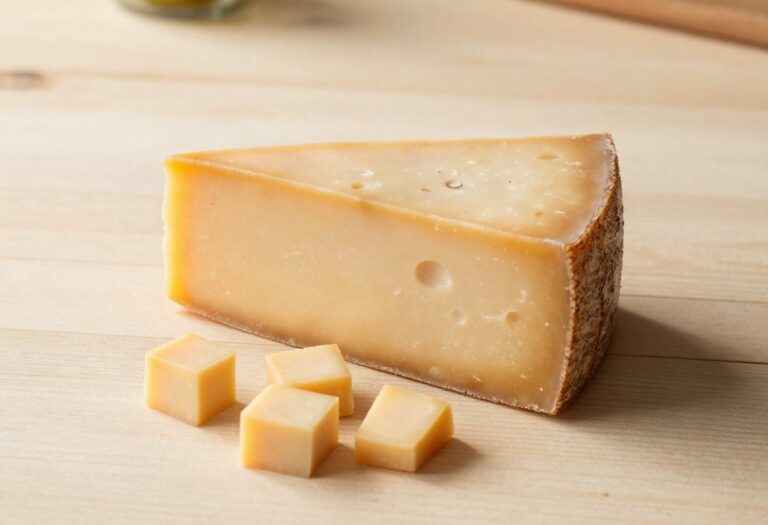
Comté is an emblematic French cheese, made from raw cow’s milk in the Jura mountains. Matured for several months in cellars, it develops complex aromas that vary with its maturing time: a young Comté (4 to 8 months) remains mild and fruity, while an old Comté (18 to 36 months) has stronger notes, sometimes with crystals. A cooked pressed-curd cheese par excellence, it belongs to the large family of hard cheeses. Rich in protein (27.2 g per 100 g) and calcium, it is a tasty, dense food. At 413 kcal per 100 g, it fits into a balanced diet as long as you watch the portions.
Macronutrient breakdown
Nutrition table per 100 g
| Calories | 413 kcal |
| Kilojoules | 1710 kJ |
| Protein | 27,2 g |
| Fat | 33,8 g |
Micronutrients per 100 g
All measured nutrients, ranked by share of the daily reference intake.
- Calcium907 mg113 %
- Vitamin B122,59 µg104 %
- Phosphorus681 mg97 %
- Copper0,61 mg61 %
- Zinc3,84 mg38 %
- Vitamin B20,38 mg27 %
- Iodine24,4 µg16 %
- Selenium7,02 µg13 %
See the other 9 nutrients
- Magnesium43,7 mg12 %
- Omega-3 ALA0,21 g11 %
- EPA0,03 g10 %
- Total omega-30,24 g9 %
- Potassium116 mg6 %
- Omega-6 LA0,45 g5 %
- Iron0,49 mg4 %
- Vitamin B95 µg3 %
- Manganese0,03 mg2 %
Anses Ciqual 2025. Source: Anses, 2025, Ciqual food composition table
Tips
Comté can be enjoyed in a thousand ways: on a cheeseboard, grated over gratins, melted in a Franche-Comté fondue, or simply cubed with drinks. A reasonable portion is around 30 g, the equivalent of about 120 kcal, which makes it a pleasure that is entirely compatible with slimming if you stay measured.
- Nutrition facts: with 0 g of carbohydrates, its glycaemic index is zero. Its 33.8 g of fat explain its calorie density, so measure it out carefully.
- Quality protein: its 27.2 g of protein per 100 g make it an excellent source for fullness and maintaining muscle.
- Minerals: Comté is particularly rich in calcium and phosphorus, which are good for strong bones.
As for pairings, it goes beautifully with country bread, walnuts, fresh fruit such as apple or grapes, and a Jura wine. To limit calories, have it at the end of a meal rather than on top of a sweet dessert. Keep it in the vegetable drawer of the fridge, wrapped in breathable paper, and take it out 30 minutes before eating to release its aromas.
If you are looking for similar hard cooked cheeses, gruyère and Emmental share comparable nutritional profiles. For a lighter everyday option, turn to 0% fromage blanc. You will find all cheeses and dairy products in the section on dairy products.
For active people: Comté is a practical, portable snack, rich in protein and natural salt, useful after a session to support muscle recovery and make up for mineral losses through sweat. Pair a small portion with complex carbohydrates (wholemeal bread, dried fruit) to replenish energy reserves. When gaining mass, its calorie density is an advantage; when cutting, keep the portion modest. To go further, see our protein snack ideas, which can include a little matured cheese.
In short, Comté offers real nutritional benefits thanks to its protein and calcium, as long as you respect the quantities to preserve the calorie balance of your meals.
If you have diabetes: this cheese contains only traces of carbohydrates. Portion, salt and saturated fat are covered in our guide to cheese and diabetes.