Group · Vegetables
Round lettuce
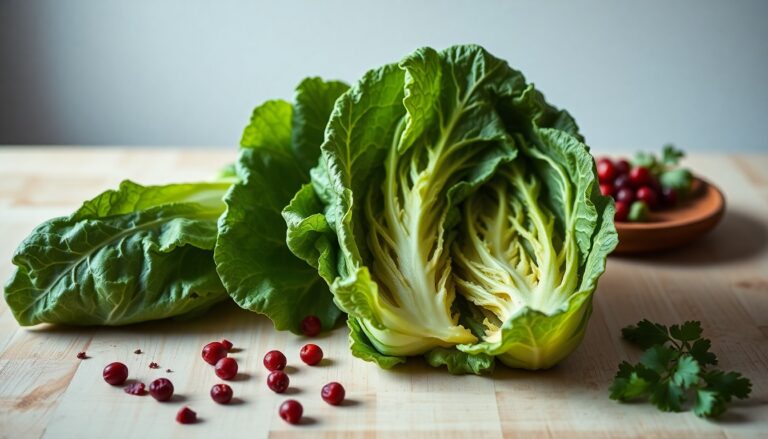
Round lettuce is one of the most commonly eaten salad leaves on our plates. With tender leaves forming a pretty rounded head, it comes in several varieties such as batavia, butterhead lettuce or iceberg lettuce, which is crunchy and thirst-quenching. Very low in calories (barely 14.7 kcal per 100 g), it is more than 90% water and provides gentle fibre, vitamin K, folate and a little provitamin A. Its freshness and versatility make it an ideal base for salads, but also a light filling for sandwiches, wraps and various dishes. It is the discreet ally of a balanced, light diet.
Macronutrient breakdown
Nutrition table per 100 g
| Calories | 15 kcal |
| Kilojoules | 62 kJ |
| Protein | 1,4 g |
| Carbohydrate | 1,3 g |
| Fat | 0,2 g |
| Fibre | 1,1 g |
Micronutrients per 100 g
All measured nutrients, ranked by share of the daily reference intake.
- Vitamin K1123 µg164 %
- Vitamin A303 µg38 %
- Manganese0,4 mg20 %
- Potassium206 mg10 %
- Calcium64,6 mg8 %
- Iron1,1 mg8 %
- Vitamin C5,53 mg7 %
- Vitamin B60,09 mg7 %
- Vitamin B9dietary folate equivalents49 µg
See the other 13 nutrients
- Vitamin B10,06 mg6 %
- Vitamin B20,07 mg5 %
- Phosphorus30 mg4 %
- Selenium2,33 µg4 %
- Magnesium14,9 mg4 %
- Copper0,04 mg4 %
- Omega-3 ALA0,06 g3 %
- Vitamin B50,14 mg2 %
- Vitamin B30,35 mg2 %
- Zinc0,2 mg2 %
- Vitamin E0,18 mg2 %
- Iodine1,22 µg1 %
- Omega-6 LA0,03 g0 %
Anses Ciqual 2025. Source: Anses, 2025, Ciqual food composition table
Tips
Round lettuce is best eaten raw, freshly washed and spun dry, to keep its crunchy texture and its nutrition facts. A generous portion of 50 to 100 g is enough to bulk out a meal without adding many calories. To make the most of its benefits, dress it just before serving: a vinaigrette made with olive oil helps the absorption of fat-soluble vitamins such as provitamin A and vitamin K.
On calories and slimming, lettuce is a champion: its richness in water and fibre gives a filling effect for very little energy. Its glycaemic index is almost nil, which makes it an ideal candidate in a balanced diet. Beware, though, of fatty sauces, croutons and cheese, which can quickly turn a light salad into a high-calorie dish.
- Tasty pairings: mix it with cucumber, tomatoes or radishes for a colourful salad rich in water.
- In the kitchen: it can also be briefly braised, like a braised lettuce, or slipped into a velvety soup.
- Storage: keep it in the vegetable drawer, wrapped in a damp cloth, and eat it within 2 to 3 days so that it does not wilt.
Nutritionally, round lettuce provides folate (vitamin B9), potassium, a little manganese and vitamin C. Its gentle fibre contributes to digestive comfort. With less than 1.35 g of protein, 1.22 g of carbohydrate and negligible fat per 100 g, it remains a food of low energy density, perfect for making generous, low-calorie plates.
For active people, lettuce is not a source of energy or protein, but it hydrates and ideally completes a recovery meal. Combine it with a source of protein (egg, chicken, fish) and starchy foods to replenish glycogen after exercise. If you are looking to top up your protein intake, discover our protein snack ideas.
To vary your salad leaves, also try cos lettuce or lamb’s lettuce, and browse the whole vegetable family to enrich your plates through the seasons. Round lettuce, grown almost all year round, remains a simple, fresh reflex for eating light.